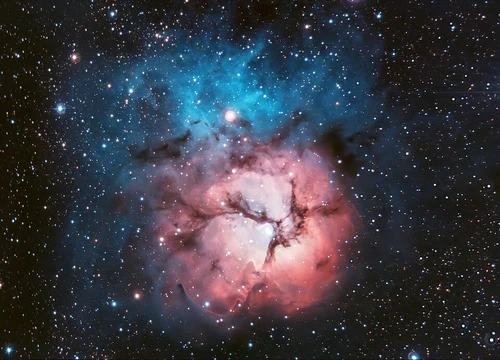
NGC 2899
Bipolar planetary nebula in Vela, shaped by a binary star system.

NGC 2899 is a planetary nebula found in the southern constellation Vela. English astronomer John Herschel discovered it on February 27, 1835. A moderate-sized amateur telescope can show the nebula, but a larger instrument is needed to make out its details. It lies about 3,350 light-years (with an uncertainty of 670 light-years) from the Sun and roughly 25,894 light-years (plus or minus 3 light-years) from the Galactic Center.
The nebula has an overall kidney shape, stretched along an axis running from west-northwest to east-southeast. Its structure is bipolar, with a significant equatorial component, and astronomers think this shape comes from a binary star system. The nebula expands at an average rate of 43 to 56 km/s, while some high-velocity features move at 110 to 130 km/s. The central star’s core mass is estimated at about 1.2 times the Sun’s mass.
NGC 2899 sits inside a large cavity in the surrounding material. This cavity has a quadrupolar shape, measuring 14 by 11 parsecs, and its elongation runs along a position angle of 37° (plus or minus 5°), which aligns with the planetary nebula’s minor axis. The cavity was likely carved out by a fast stellar wind from the central star during its asymptotic giant branch phase, before the nebula formed. The nebula’s shape and filamentary structures also point to the influence of a binary star system.
Quick Facts
- Epoch
- J2000
- Ra
- 09 · 27 · 03.2
- Dec
- −56 · 06 · 21.1
- Dist Ly
- 1026 ±
- Appmag V
- 11.8
- Constellation
- Vela
- Names
- NGC 2899, Gum 27, PN G277.1-03.8
Facts from the source article.
Lore & Background
NGC 2899 was discovered by English astronomer John Herschel on February 27, 1835. It can be viewed with a moderate-sized amateur telescope, but a larger telescope is required to resolve details. The nebula has an overall kidney shape elongated along an axis from WNW to ESE, with a bipolar topology and a significant equatorial structure. This shape is believed to result from a binary star system. The mean expansion rate is 43 to 56 km/s, with high-velocity structures expanding at 110 to 130 km/s. The core mass of the central star is estimated as ~1.2 M☉. The nebula lies within a large cavity in the surrounding medium, which has a quadrupolar shape with a physical dimension of 14 pc × 11 pc. The elongation lies along a position angle of 37°±5°, aligned with the minor axis of the planetary nebula. This opening was most likely crafted by a fast stellar wind from the central star during its asymptotic giant branch stage, prior to the formation of the planetary nebula. The shape and filamentary structures suggest the interaction of a binary star system.
Reader's Guide
NGC 2899 is significant as an example of a bipolar planetary nebula whose morphology is attributed to a binary star system. Its kidney shape, equatorial structure, and filamentary features all point to binary interaction. The nebula's location within a large, quadrupolar cavity—aligned with the nebula's minor axis—indicates that a fast stellar wind from the central star during its asymptotic giant branch stage carved out the surrounding medium before the nebula formed. The measured expansion rates (43–56 km/s mean, 110–130 km/s for high-velocity structures) and the estimated core mass of the central star (~1.2 M☉) provide key data for understanding the evolution of such systems. The nebula's distance from the Sun (3,350 ± 670 light-years) and from the Galactic Center (25,894 ± 3 light-years) place it in a specific region of the Milky Way. Its discoverer, John Herschel, recorded it in 1835, and it remains a target for amateur and professional astronomers alike.
Did You Know?
- The nebula has a kidney shape elongated from WNW to ESE, with a bipolar topology and significant equatorial structure.
- The nebula lies within a large, quadrupolar cavity measuring 14 pc × 11 pc, likely carved by a fast stellar wind during the asymptotic giant branch stage.
Frequently Asked Questions
Who discovered NGC 2899 and when?
English astronomer John Herschel first catalogued this nebula on February 27, 1835, while conducting his sweeping surveys of the southern sky. It has carried the NGC 2899 designation in the New General Catalogue ever since.
Where can I find NGC 2899 in the sky?
It sits in the southern constellation Vela, roughly 3,350 light-years from the Sun (with an uncertainty of about 670 light-years). A moderate amateur telescope will show the glow, but bringing out the finer structure calls for a larger aperture.
What does NGC 2899 actually look like?
The nebula presents a kidney-shaped outline stretched along a west-northwest to east-southeast axis. Its structure is bipolar with a prominent equatorial component, a form astronomers attribute to the influence of a binary star system at its core.
How fast is NGC 2899 expanding?
The average expansion velocity of the nebula's gas falls between 43 and 56 km/s. Certain high-velocity structures within it are racing outward at roughly 110 to 130 km/s, well above the general flow.
How far is NGC 2899 from the Galactic Center?
It lies approximately 25,894 light-years from the Milky Way's center, with an uncertainty of only about three light-years. That places it comfortably in the outer disk of our galaxy.
More in Planetary Nebulae, Part 2 1-24
Spotted an error? Know more?
Reader corrections go straight into our review queue. Suggest an edit · How this site is sourced