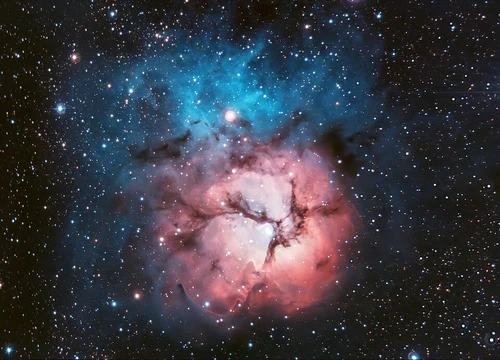
NGC 6302
A bipolar nebula with one of the hottest known central stars.

NGC 6302, also known as the Bug Nebula, Butterfly Nebula, or Caldwell 69, is a bipolar type planetary nebula in the constellation Scorpius. Its structure is among the most complex ever seen in any planetary nebula, featuring ionization walls, knots, and sharp edges to its lobes. The central star is one of the hottest known, with a surface temperature in excess of 250,000 degrees Celsius, implying the progenitor star was very large.
- Constellation
- Scorpius
- Type
- bipolar planetary nebula
- Central star temperature
- over 250,000 °C (200,000 K also indicated)
- Central star mass
- 0.64 solar masses
- Progenitor star mass
- around 5 solar masses
- Progenitor star type
- likely B5-9V main sequence
- Northwest lobe flow velocity at 1.71 arc
- 263 km/s
- Northwest lobe maximum outward velocity
- over 600 km/s
Lore & Background
NGC 6302 has been known since at least 1888, as it is included in the New General Catalogue. The earliest-known study was by Edward Emerson Barnard, who drew and described it in 1907. The nebula featured in some of the first images released after the final servicing mission of the Hubble Space Telescope in September 2009.
The nebula's complex structure can be approximated as bipolar with two primary lobes, though there is evidence for a second pair of lobes from a previous phase of mass loss. A dark lane runs through the waist, obscuring the central star at all wavelengths. The prominent northwest lobe extends up to 3.0 arcminutes from the central star and is estimated to have formed from an eruptive event around 1,900 years ago. Its walls expand such that each part has a speed proportional to its distance from the central star; at 1.71 arcminutes the flow velocity is 263 km/s, and at the extreme periphery it exceeds 600 km/s. The western edge of the lobe shows characteristics suggestive of a collision with pre-existing globules of gas.
The central star, a white dwarf, was identified in 2009 using the upgraded Wide Field Camera 3 on board the Hubble Space Telescope. It had escaped detection due to its high temperature (radiating mainly in the ultraviolet), the dusty torus absorbing much ultraviolet light, and the bright background. The star has a current mass of around 0.64 solar masses and a temperature of 200,000 Kelvin. The original mass was around five solar masses, likely a B5-9V main sequence star, but most of its mass was ejected in the event that created the planetary nebula. The star has ceased nuclear burning and is fading at a predicted rate of 1% per year.
Reader's Guide
NGC 6302 is significant for its extreme complexity and the exceptional properties of its central star. The star is among the hottest known, with a surface temperature over 250,000 degrees Celsius, and its detection in 2009 by the upgraded Hubble Space Telescope's Wide Field Camera 3 marked a milestone in observational astronomy. The dense equatorial disc of gas and dust is postulated to have shaped the bipolar, hourglass-like structure, creating features such as ionization walls, knots, and sharp edges. The nebula's dust chemistry is unusual, showing evidence for multiple crystalline silicates, crystalline water ice, quartz, and possibly carbonates—though the carbonate detection has been disputed due to difficulties in forming carbonates in a non-aqueous environment. Additionally, NGC 6302 belongs to a group of objects where hydrocarbon molecules formed in an oxygen-rich environment, a rare combination. Its legacy includes being among the first images released after the final Hubble servicing mission, and it continues to be a subject of study for understanding complex nebular dynamics and stellar evolution.
Did You Know?
- The central star of NGC 6302 has a surface temperature in excess of 250,000 degrees Celsius, making it one of the hottest stars known.
- The nebula's central star was first identified in 2009 using the upgraded Wide Field Camera 3 on the Hubble Space Telescope.
- The dark lane through the nebula's waist shows evidence for crystalline water ice and quartz, and possibly carbonates, though the carbonate detection is disputed.
The Central Star – A White Dwarf at the Edge of Known Physics
The heart of NGC 6302 is one of the most extreme stellar objects known to astronomers. This white dwarf radiates at a surface temperature exceeding 250,000 degrees Celsius, a figure that places it among the hottest stars ever catalogued. Reaching such an extraordinary temperature implies that the progenitor star must have been remarkably massive. Indeed, the original star carried roughly five solar masses and would have appeared as a B-type main-sequence star, likely in the B5 to B9 range, before shedding most of its envelope in the cataclysmic event that birthed the nebula. What remains today is a compact remnant weighing only about 0.64 solar masses, no longer fusing nuclear fuel and steadily cooling. Its luminosity and temperature indicate a fade of roughly one percent per year, marking its slow march toward becoming a cold, dark white dwarf. For decades this star was invisible to observers, hidden by its ultraviolet-dominated radiation, the absorbing dusty torus, and the glare of the surrounding nebulosity, until the upgraded Wide Field Camera 3 on the Hubble Space Telescope finally revealed it in 2009.
Sculpting the Bipolar Architecture
The nebula's shape is often described as bipolar, resembling an hourglass, with two dominant lobes stretching away from a dense equatorial disc of gas and dust. Astronomers believe this disc channeled the star's outflows into the characteristic two-lobed geometry. Yet the structure is far from simple. Evidence points to a second, fainter pair of lobes that may represent an earlier episode of mass loss, suggesting the nebula was built in at least two distinct phases. The most prominent feature is a large northwest lobe reaching roughly three arcminutes from the central star. Its walls expand at speeds proportional to their distance from the core: at an angular separation of 1.71 arcminutes the flow velocity is measured at 263 kilometres per second, while at the outermost edge the outward speed surpasses 600 kilometres per second. This lobe is estimated to have been launched by an eruptive event approximately 1,900 years ago. Along its western boundary, the gas shows telltale signs of having collided with pre-existing globules, distorting the outflow and leaving a scarred, irregular edge. Ionization fronts, dense knots, and razor-sharp lobe boundaries further testify to the violent dynamics at work.
A Dusty Chemistry Defying Expectations
The dark equatorial lane threading through the waist of NGC 6302 has proven to be a chemical oddity. Spectroscopic analysis reveals multiple crystalline silicate species, crystalline water ice, and quartz—minerals that together paint a picture of a surprisingly rich and varied solid-phase environment. Perhaps most controversially, certain spectral features have been interpreted as the first detection of carbonates outside our solar system. That claim has been challenged, because forming carbonate minerals in a non-aqueous, space environment is chemically difficult, and the dispute remains open. Adding to the puzzle, the dust in this nebula contains both oxygen-bearing silicate molecules and carbon-bearing polycyclic aromatic hydrocarbons. In typical stellar evolution, a star is either oxygen-rich or carbon-rich, with the transition occurring late as nuclear and chemical changes reshape its atmosphere. NGC 6302 belongs to a small group of objects where hydrocarbon molecules appear to have formed within an oxygen-rich setting, a combination that challenges standard models of how dust and molecules assemble around dying stars.
From Sketchbook to Space Telescope
NGC 6302 has been part of the astronomical record since at least 1888, when it was included in the New General Catalogue. The earliest known detailed study belongs to Edward Emerson Barnard, who in 1907 drew and described the object, capturing its distinctive shape long before modern imaging existed. For over a century the nebula remained a catalogued curiosity, studied with modest instruments. That changed dramatically in September 2009, when the Hubble Space Telescope completed its final servicing mission. Among the first images released to showcase the newly upgraded Wide Field Camera 3 was a striking view of NGC 6302, revealing structural complexity—ionization walls, knots, and sharp lobe edges—that ground-based telescopes had never resolved. The same WFC3 instrument, with its improved resolution and sensitivity, also made possible the 2009 identification of the hidden central white dwarf, which had eluded detection in earlier Hubble observations. The nebula thus stands as both a historical anchor, linking to the nineteenth-century cataloguing era, and a modern benchmark for what space-based optics can reveal about the final stages of stellar life.
Frequently Asked Questions
What is NGC 6302?
NGC 6302 is a bipolar planetary nebula in the constellation Scorpius, popularly called the Bug Nebula or Butterfly Nebula because of its winged silhouette. It is also catalogued as Caldwell 69 and is renowned for possessing one of the most intricate structures ever recorded in a planetary nebula.
What makes NGC 6302's structure stand out?
Its lobes are defined by sharp edges, ionization walls, and dense knots that together create a level of detail rarely seen in other planetary nebulae. The bipolar geometry is what gives the object its insect- or butterfly-like appearance visible through telescopes.
How hot is the central star of NGC 6302?
The central white dwarf has a surface temperature exceeding 250,000 degrees Celsius, placing it among the hottest known central stars in any planetary nebula. Such extreme heat points to a very massive progenitor that burned through its fuel quickly before ejecting its outer layers.
What kind of star created NGC 6302?
The progenitor was most likely a B5-9V main-sequence star with a mass roughly five times the Sun's. After shedding its envelope, it left behind a compact 0.64 solar-mass remnant at the nebula's core.
Where in the sky can I find NGC 6302?
NGC 6302 lies within the constellation Scorpius, so it is best targeted during the summer observing season from mid-northern latitudes. Its position in one of the sky's most crowded star fields can make it a bit tricky to isolate visually, but it rewards binoculars or a small telescope with a striking butterfly shape.
More in Planetary Nebulae, Part 2 1-24
Spotted an error? Know more?
Reader corrections go straight into our review queue. Suggest an edit · How this site is sourced