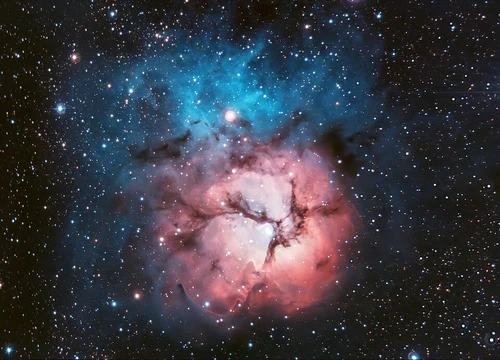
Stingray Nebula
The youngest-known planetary nebula, first observed in the 1980s.

The Stingray Nebula, also cataloged as Hen 3-1357, is the youngest planetary nebula known, first appearing in the 1980s. It lies 18,000 light-years away in the southern constellation Ara (the Altar). While it spans about 130 times the size of our Solar System, it is roughly one-tenth the size of most other planetary nebulae.
Its central star, SAO 244567, evolves rapidly. Before the early 1970s, observers on Earth saw it as a preplanetary nebula, with gas that had not yet become hot and ionized. Images of the nebula reveal that older, outer gas shells act as a collimator for newer gas flowing out from the star—a key observation, since this process was poorly understood.
The star was first cataloged as He 3-1357 by Karl Gordon Henize in 1976, who classified it as an A- or B-type Hα emission-line star. In 1971, it was observed as a post-asymptotic giant branch B1 or B2 supergiant. Planetary nebula emission lines were detected in 1989 by the International Ultraviolet Explorer. Because the nebula was newly formed and very small, ground-based telescopes could not resolve it; Matt Bobrowsky used the Hubble Space Telescope to discover it, naming it the Stingray Nebula.
In 1993, M. Parthasarathy and colleagues reviewed historical brightness measurements and found the central star fading in optical light. It received the variable star designation V839 Arae in 1997. By 1995, the central star was observed as a DA white dwarf, having dimmed by a factor of three between 1987 and 1995. This white dwarf has an estimated mass of 0.6 solar masses and a luminosity of 3,000 solar luminosities, with a companion star 0.3 arcsecond away. The nebula’s mass is estimated at 0.015 solar masses. In 1998, Bobrowsky and colleagues reported that Hubble observations revealed a 17th-magnitude companion to the 15th-magnitude central star.
The central star is unusual: it brightened and faded over 20 years, its temperature rising by 40,000 °C, possibly due to a helium flash. In January 2021, NASA announced that the nebula had been fading since the 1990s, after reaching peak brightness. Previously photoionized, its positive ions have been recombining with electrons. Team member Martín A. Guerrero of the Instituto de Astrofísica de Andalucía in Spain said, "This is very, very dramatic, and very weird. What we're witnessing is a nebula's evolution in real time.
- Distance
- 18,000 light-years (5,600 parsecs)
- Size
- 130 times the size of the Solar System
- Relative size
- One tenth the size of most other known planetary nebulae
- Central star
- SAO 244567
- Central star mass
- 0.6 M☉
- Central star luminosity
- 3,000 L☉
- Nebula mass
- 0.015 M☉
- Companion star separation
- 0.3 arcsecond
Lore & Background
Prior to the discovery of the nebula, its central star was known as He 3-1357, which Karl Gordon Henize classified as an A- or B-type Hα emission-line star in 1976. It was observed in 1971 to be post-asymptotic giant branch B1 or B2 supergiant. Planetary nebula emission lines were identified in this star in 1989 by the International Ultraviolet Explorer. As the nebula would be newly formed and very small, ground-based observations were not able to resolve it; so Matt Bobrowsky observed it with the Hubble Space Telescope, discovering the nebula, which he named the 'Stingray Nebula'.
In 1993, M. Parthasarathy et al. looked at the history of measurements of the brightness of the central star, and concluded that it was fading in the optical region of the spectrum. It was given its variable star designation, V839 Arae, in 1997. In 1995 the central planetary nebula nucleus was observed as a DA white dwarf, having seemingly faded by a factor of three between 1987 and 1995. The white dwarf has an estimated mass of 0.6 M☉ and luminosity of 3,000 L☉ and has an observed companion star separated by 0.3 arcsecond. The mass of the nebula is estimated as 0.015 M☉. In 1998 Bobrowsky et al. described how the Hubble Space Telescope observations revealed a 17th-magnitude companion to the Stingray's 15th-magnitude central star.
The central star is unusual in that it has brightened and faded over a period of 20 years. Its temperature went up by 40,000 °C. An explanation for this is that it has undergone a helium flash. In January 2021, NASA discovered that the nebula had been fading since the 1990s, when it reached its peak brightness. Previously photoionized, the positive ions of the nebula have been recombining with the electrons.
Reader's Guide
The Stingray Nebula is significant as the youngest-known planetary nebula, having appeared only in the 1980s, allowing astronomers to observe a nebula's evolution in real time. The image of the nebula shows how the older outer shells of gas are acting as a collimator for the more recent gas outflow from the central star—an important observation, as this process has not been well understood. Its central star, SAO 244567, is fast-evolving and unusual in that it has brightened and faded over a period of 20 years, with its temperature going up by 40,000 °C, possibly due to a helium flash. The nebula's fading since the 1990s, with positive ions recombining with electrons, was noted by NASA in January 2021. As Martín A. Guerrero stated, 'This is very, very dramatic, and very weird. What we're witnessing is a nebula's evolution in real time. In a span of years, we see variations in the nebula. We have not seen that before with the clarity we get with this view.' The legacy of the Stingray Nebula lies in its role as a unique laboratory for studying planetary nebula formation and evolution, particularly the collimation of outflows by older gas shells.
Did You Know?
- The Stingray Nebula is the youngest-known planetary nebula, having appeared in the 1980s.
- Its central star, SAO 244567, increased in temperature by 40,000 °C over 20 years.
- The nebula is only about one tenth the size of most other known planetary nebulae.
- In January 2021, NASA reported that the nebula had been fading since the 1990s.
More in Planetary Nebulae, Part 2 1-24
Spotted an error? Know more?
Reader corrections go straight into our review queue. Suggest an edit · How this site is sourced