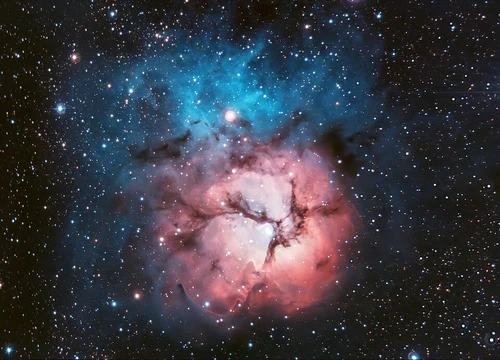
Southern Crab Nebula
A southern-sky nebula resembling the Crab Nebula.

The Southern Crab Nebula, also cataloged as WRAY 16-147 and Hen 2-104, lies in the constellation Centaurus. Its name comes from its visual similarity to the Crab Nebula, which is located in the northern sky. The nebula sits several thousand light-years away, and at its heart is a symbiotic pair: a Mira variable star and a white dwarf.
The designation Hen 2-104 originates from Karl Gordon Henize’s 1967 catalog of southern planetary nebulae, which listed 459 objects. The nebula was first noted in that catalog, and a major advance in understanding it came in 1989, when it was observed with a CCD imager on the 2.2-meter telescope at La Silla Observatory using various filters. While ground-based telescopes had already captured it, the Hubble Space Telescope’s 1999 images—taken with the Wide Field and Planetary Camera 2 at a wavelength of 658 nanometers—revealed far more detail, showing that the central stars are a red giant and a white dwarf. That camera is known for its distinctive “stair-step” image shape and for capturing famous astrophotos like the Pillars of Creation.
In 2008, a study of the Southern Crab and its symbiotic star system was published, combining imaging and spectroscopic data from Hubble, the Very Large Telescope, and other observatories. The European Southern Observatory defines a symbiotic star system as a binary in which a small, hot star (a white dwarf or main-sequence star) orbits a red giant, often surrounded by a gas or dust envelope—gas-rich systems are called S-types, and dust-rich ones D-types.
Hubble imaged the nebula again in 2019, this time with the newer Wide Field Camera 3, using filters at wavelengths of about 502, 656, 658, and 673 nanometers. These images were released to mark the 29th anniversary of the space telescope’s 1990 launch aboard the Space Shuttle.
Quick Facts
- Credit
- ESA, NASA, and STScI
- Epoch
- J2000
- Ra
- 14 · 11 · 52.06
- Dec
- -51 · 26 · 24.1
- Dist Ly
- 7000 ly
- Appmag V
- 14.20
- Constellation
- Centaurus
- Notes
- Has a symbiotic star system at its center
- Names
- V852 Cen, Hen 2-104, IRAS 14085-5112, PN G315.4+09.4, Wray 16-147, 2MASS J14115206-5126241
Facts from the source article.
Lore & Background
The Southern Crab was noted in a 1967 catalog by Karl Gordon Henize. It was observed using a CCD imager with the 2.2 meter telescope at the La Sila observatory in 1989, marking a major expansion of knowledge about the nebula, and it was observed using various filters. The nebula had already been observed using Earth-based telescopes, but images taken with the Hubble Space Telescope in 1999 provided much more detail, revealing that at the center of the nebula are a pair of stars, a red giant and a white dwarf.
In 1999, it was imaged by the Hubble Space Telescope's Wide Field and Planetary Camera 2, noted for its unique 'stair-step' crop and for such astrophotos as the Pillars of Creation. The WFPC2 images were taken at an optical light wavelength of 658 nm. The nebula was imaged again by the Hubble Space Telescope in 2019, and a set of images to celebrate the anniversary of the space telescope's launch in 1990 (29 years) by the Space Shuttle. This time a newer camera the WFC3 was used to image the nebula, at wavelengths filters of about 502, 656, 658, and 673 nanometers.
In 2008, an investigation of the Southern Crab with its symbiotic star was published. The study used imaging and spectroscopic data from space and Earth-surface telescopes including Hubble and VLT observatories. The ESO defines a symbiotic star system as 'binaries in which a small hot star (white dwarf or main sequence star) orbits around a red giant star. These systems are often surrounded by an envelope of gas or dust; those with gas are known as S-types and those with dust as D-types.'
Reader's Guide
The Southern Crab Nebula is significant as a symbiotic star system, a class of binary stars that are often surrounded by gas or dust envelopes. Its central star is a Mira variable–white dwarf pair, and the nebula's structure was clarified by Hubble Space Telescope observations in 1999 and 2019. The 1999 images from WFPC2 revealed the pair of stars at its center, while the 2019 WFC3 images provided multi-wavelength views. The 2008 investigation combined data from Hubble and VLT observatories to study the symbiotic star. The nebula's name was officially added to the IAU Catalog of Star Names in 2026, cementing its place in astronomical nomenclature. Its legacy includes being a subject of anniversary images for the Hubble Space Telescope, and its 1989 observation at La Sila marked a major expansion of knowledge about the object.
Did You Know?
- The Southern Crab Nebula is named for its resemblance to the Crab Nebula in the northern sky.
- Its central star is a symbiotic Mira variable–white dwarf pair.
- The nebula was imaged by the Hubble Space Telescope in 1999 and again in 2019.
More in Planetary Nebulae, Part 2 1-24
Spotted an error? Know more?
Reader corrections go straight into our review queue. Suggest an edit · How this site is sourced