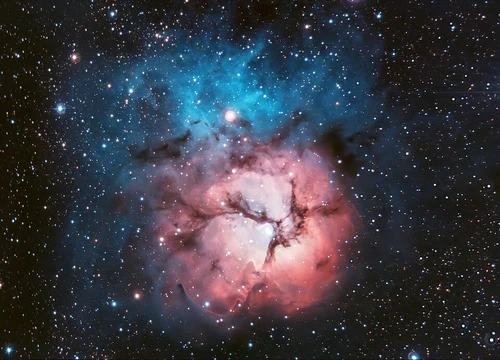
Sh 2-216
Closest planetary nebula to Earth, ancient and faint.

Sh 2-216 (Sharpless 216) is a very old planetary nebula in the constellation Perseus. It holds the distinction of being the nearest such nebula to Earth, lying roughly 129 parsecs (420 light-years) away.
The nebula is among the oldest known, estimated at about 600,000 years old. Its great age makes it extremely faint and spread out, with an angular size of roughly 100 arcminutes—over three times the apparent width of the full Moon. Sh 2-216 is now colliding with the interstellar medium. As it travels, its eastern side has been compressed and brightened by the gas it plows through, producing a visible bow-shock structure in deep images.
Its central star is a hot white dwarf cataloged as LS V+46 21 (or WD 0441+467). This is a DAO-type white dwarf, showing both hydrogen and helium in its spectrum. Because the nebula’s gas has been slowed by its interaction with the surrounding medium while the star continues on its original path, the star no longer sits at the nebula’s geometric center.
The object first appeared in Stewart Sharpless’s 1959 catalog of H II regions. Its enormous size and low surface brightness led to it being mistaken for an H II region. In 1981, emission-line ratios of nitrogen and sulfur suggested it was actually a planetary nebula, and the central white dwarf was confirmed in 1985.
Quick Facts
- Location
- Perseus
- Ra
- 04 · 45 · 35
- Dec
- +46 · 49 · 39
- Dist Ly
- 420 ly
- Mag V
- 12.87
- Notes
- Closest known planetary nebula from Earth
- Names
- Sharpless 216, LBN 744, SIM 1, PK 158+00 1
Facts from the source article.
Lore & Background
Sh 2-216 is one of the oldest known planetary nebulae, with an estimated age of roughly 600,000 years. Due to its advanced age, the nebula is extremely faint and highly dispersed, covering an angular diameter of about 100 arcminutes—more than three times the width of the full Moon. The nebula is currently interacting with the interstellar medium (ISM). As it moves through space, its eastern edge has become compressed and brightened due to the resistance of surrounding gas, creating a visible bow-shock structure in deep-exposure images.
The central star of Sh 2-216 is a hot white dwarf designated LS V+46 21 (also known as WD 0441+467). It is a DAO-type white dwarf, exhibiting a spectrum with lines of both hydrogen and helium. Due to the nebula's interaction with the ISM, the central star is no longer located at the geometric center of the nebulosity, as the gas has been decelerated while the star continues its original trajectory.
The object was first cataloged by Stewart Sharpless in 1959 in his second catalog of H II regions. It was initially misidentified as an H II region due to its massive size and low surface brightness. Its nature as a planetary nebula was proposed in 1981 based on emission line ratios of nitrogen and sulfur, and the central white dwarf was confirmed in 1985.
Reader's Guide
Sh 2-216 holds significance as the closest known planetary nebula to Earth, at a distance of about 129 pc (420 ly). Its extreme age—roughly 600,000 years—makes it one of the oldest such objects, resulting in a faint, highly dispersed appearance spanning over 100 arcminutes. The nebula's interaction with the interstellar medium is a key feature, compressing and brightening its eastern edge into a bow-shock structure. The central star, a DAO-type white dwarf, has been displaced from the geometric center due to differential motion between the decelerated gas and the star. Originally misidentified as an H II region in Sharpless's 1959 catalog, its true nature was recognized in 1981 through emission line ratios, with the central white dwarf confirmed in 1985. This object illustrates the late-stage evolution of planetary nebulae and their eventual dissolution into the interstellar medium.
Did You Know?
- Sh 2-216 is the closest planetary nebula to Earth, at about 129 pc (420 ly).
- Its angular diameter of about 100 arcminutes is more than three times the width of the full Moon.
- The central star, LS V+46 21, is a DAO-type white dwarf with both hydrogen and helium spectral lines.
- The nebula was first cataloged in 1959 as an H II region and reclassified as a planetary nebula in 1981.
More in Planetary Nebulae, Part 2 1-24
Spotted an error? Know more?
Reader corrections go straight into our review queue. Suggest an edit · How this site is sourced