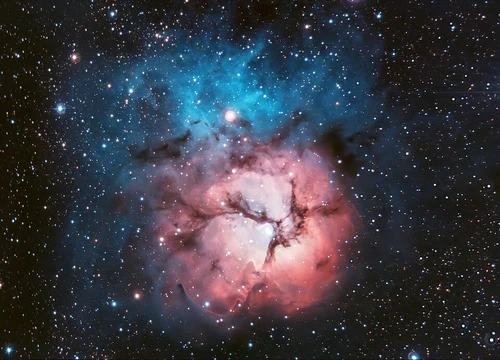
Ring Nebula
A planetary nebula in Lyra, discovered by Charles Messier in 1779.

The Ring Nebula is a planetary nebula in the northern constellation of Lyra, located about midway between the prominent stars Beta and Gamma Lyrae. It is catalogued as Messier 57, M57, and NGC 6720, and was discovered by Charles Messier in 1779. Notable for its distinctive ring-like appearance, it is a popular target for amateur astronomers.
Quick Facts
- Credit
- NASA/STScI/AURA
- Epoch
- J2000
- Ra
- 18 · 53 · 35.097
- Dec
- +33 · 01 · 44.88
- Dist Pc
- 790 · 30
- Radius Pc
- 0.1 · x · 0.14
- Appmag V
- 8.8
- Constellation
- Lyra
- Absmag V
- −0.2 · 0.7 · 1.8B · b · none
- Names
- M 57, NGC 6720, GC 4447.
Facts from the source article.
Lore & Background
The Ring Nebula was discovered by French astronomer Charles Messier while searching for comets in late January 1779. Messier's report of his independent discovery of Comet Bode reached fellow French astronomer Antoine Darquier de Pellepoix two weeks later, who then independently rediscovered the nebula while following the comet. Darquier later reported that it was '...as large as Jupiter and resembles a planet which is fading,' which may have contributed to the use of the persistent 'planetary nebula' terminology. It was entered into Messier's catalogue as the 57th object. Messier and German-born astronomer William Herschel speculated that the nebula was formed by multiple faint stars that were unresolvable with his telescope.
In 1800, German Count Friedrich von Hahn announced that he had discovered the faint central star at the heart of the nebula a few years earlier. He also noted that the interior of the ring had undergone changes, and said he could no longer find the central star. In 1864, English amateur astronomer William Huggins examined the spectra of multiple nebulae, discovering that some of these objects, including M57, displayed the spectra of bright emission lines characteristic of fluorescing glowing gases. Huggins concluded that most planetary nebulae were not composed of unresolved stars, as had been previously suspected, but were nebulosities. The nebula was first photographed by Hungarian astronomer Eugene von Gothard in 1886.
The central star was discovered by Hungarian astronomer Jenő Gothard on September 1, 1886, from images taken at his observatory in Herény, near Szombathely. Within the last two thousand years, the central star of the Ring Nebula has left the asymptotic giant branch. It no longer produces its energy through nuclear fusion and, in evolutionary terms, it is now becoming a compact white dwarf star. The central star now consists primarily of carbon and oxygen with a thin outer envelope composed of lighter elements. Its mass is about 0.61–0.62 M☉, with a surface temperature of 125,000±5,000 K. Currently it is about 300 times more luminous than the Sun, but its apparent magnitude is only +15.75. In 2025 JWST observed a dust disk around the central star.
Reader's Guide
The Ring Nebula is significant as a classic example of a planetary nebula, formed when a star expels a luminous envelope of ionized gas during its final evolutionary stages before becoming a white dwarf. Its discovery by Charles Messier in 1779 and subsequent independent rediscovery by Antoine Darquier de Pellepoix highlight its early recognition. The nebula's spectral analysis by William Huggins in 1864 was pivotal in demonstrating that such objects are glowing gases rather than unresolved stars, advancing the understanding of nebulae. Its central star, a carbon-oxygen white dwarf, was first observed by Friedrich von Hahn around 1800 and later confirmed by Jenő Gothard in 1886. The nebula's expansion rate of roughly 1 arcsecond per century, measured from photographs over 50 years, and its spectroscopic expansion velocity of 20–30 km/s provide insights into its dynamics. The interior blue-green tinge from doubly ionized oxygen and outer reddish hue from hydrogen and ionized nitrogen illustrate its chemical composition. The nebula's prolate spheroid shape, viewed at about 30° from Earth, and its estimated expansion age of 1,610 ± 240 years contribute to its legacy as a well-studied object in astrophysics.
Did You Know?
- The Ring Nebula was discovered by Charles Messier in 1779 while searching for comets.
- Its central star is a carbon-oxygen white dwarf with a surface temperature of 125,000±5,000 K.
- The nebula's expansion rate is roughly 1 arcsecond per century, based on photographs taken over 50 years.
More in Planetary Nebulae, Part 2 1-24
Spotted an error? Know more?
Reader corrections go straight into our review queue. Suggest an edit · How this site is sourced