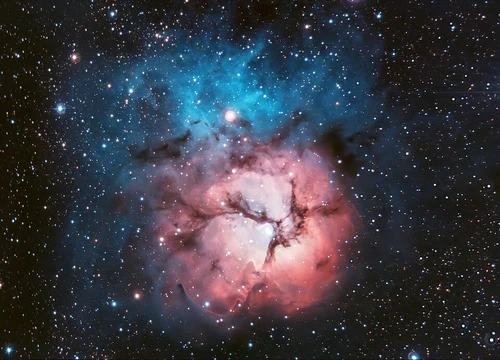
Red Spider Nebula
A two-lobed planetary nebula with a hot white dwarf.

The Red Spider Nebula (NGC 6537) is a planetary nebula in the constellation Sagittarius, discovered by Edward Charles Pickering on 15 July 1882. It is notable for its prominent two-lobed shape with an S-shaped symmetry, likely due to a binary companion or magnetic fields, and for its extremely hot central white dwarf, which may be among the hottest known.
- Catalog designations
- NGC 6537
- Discoverer
- Edward Charles Pickering
- Discovery date
- 15 July 1882
- Constellation
- Sagittarius
- Central star temperature
- 150,000–250,000 K (possibly up to 340,000 K or 500,000 K)
- Distance
- variously estimated as 1,900 light-years or 3,000–8,000 light-years
- Lobe outflow velocity
- 300 km/s
- Lobe dynamical age
- around 3,700 years
Lore & Background
The Red Spider Nebula was discovered by Edward Charles Pickering on 15 July 1882. It lies in the northwest of Sagittarius. Its distance is uncertain, with estimates ranging from 1,900 light-years to a more likely 3,000–8,000 light-years. The nebula has a prominent two-lobed shape, possibly due to a binary companion or magnetic fields, and an S-shaped symmetry of the lobes. The gas walls of the lobes are rippled in a complex way, not smooth.
The central white dwarf produces a powerful, hot (≈10,000 K) wind blowing at 300 km/s, generating waves 100 billion kilometers high. These waves arise from supersonic shocks that compress and heat local gas, causing atoms to radiate visible light. The winds give the nebula its 'spider' shape and contribute to its expansion. The central star is surrounded by a dust shell, making its exact properties hard to determine; its surface temperature is probably 150,000–250,000 K, though up to 500,000 K is not ruled out. Observations with Hubble and JWST NIRCam showed hot (≈1000 K) circumstellar dust around the central star. Researchers propose that interactions between the progenitor star and a close companion are responsible for many features. The central binary may be surrounded by a circumbinary disk. Non-detection in X-rays suggests the companion is less massive than the Sun.
A research team studied the nebula with Hubble, ALMA, Chandra, and JWST. The core is consistent with a highly asymmetric ring or irregular spiral with a radius of 5 arcseconds (0.04 parsec). The core is surrounded by an equatorial molecular torus with a deprojected radius of about 0.13 parsec and an inclination of 38°, having an outflow velocity of 13 km/s and an age of around 10,000 years. Molecular hydrogen imaging showed the polar lobes are closed bubble-like structures with an extent of about 100 arcseconds (deprojected about 0.9 parsec), outflow velocity around 300 km/s, and dynamical age around 3,700 years. The lobes have an S-shape in iron [Fe II] imaging, also seen in NGC 6302, likely tracing fast shocks from a collision between an active, collimated stellar wind and slower-moving material forming the polar lobe rims.
Reader's Guide
The Red Spider Nebula is significant as a well-studied example of a bipolar planetary nebula with complex morphology. Its S-shaped lobes and rippled walls, driven by supersonic shocks from a fast wind (300 km/s) emanating from an extremely hot central white dwarf (possibly up to 500,000 K), make it a key object for understanding the role of binary companions and magnetic fields in shaping planetary nebulae. The presence of a dust shell and hot circumstellar dust (≈1000 K) around the central star, along with a proposed circumbinary disk, highlights the importance of binary interactions in its evolution. Multi-wavelength observations with Hubble, ALMA, Chandra, and JWST have revealed a core with an asymmetric ring or irregular spiral, an equatorial molecular torus (age ~10,000 years), and polar lobes (age ~3,700 years) with an S-shaped iron emission feature also seen in NGC 6302. The non-detection in X-rays constrains the companion mass to less than that of the Sun. The nebula's legacy lies in its demonstration of how fast winds, shocks, and binary dynamics create intricate structures, providing a benchmark for models of late stellar evolution.
Did You Know?
- The central white dwarf may have a surface temperature as high as 500,000 K, making it among the hottest known.
- The nebula's lobes have an outflow velocity of about 300 km/s and a dynamical age of around 3,700 years.
- The equatorial molecular torus has an age of around 10,000 years and an outflow velocity of 13 km/s.
More in Planetary Nebulae, Part 2 1-24
Spotted an error? Know more?
Reader corrections go straight into our review queue. Suggest an edit · How this site is sourced