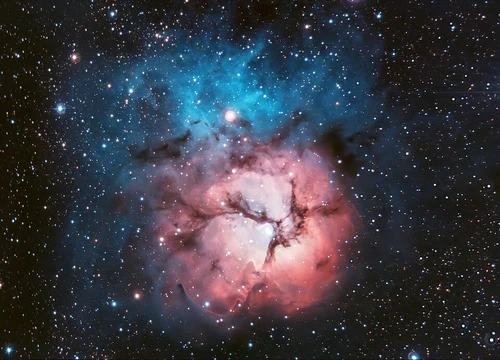
Owl Nebula
A planetary nebula with an owl-like face in Ursa Major.

The Owl Nebula (cataloged as Messier 97, M97, or NGC 3587) is a planetary nebula located some 2,030 light-years away in the constellation Ursa Major. Its distinctive owl-like appearance comes from an inner shell that is not round but instead shaped like a barrel, tilted at a 45-degree angle relative to our line of sight. The nebula is roughly 8,000 years old and is built from three concentric shells, with the outermost shell about 20–30% larger than the one inside it.
This nebula formed when material from the stellar wind of its central star was expelled as the star evolved along the asymptotic giant branch. It contains about 0.13 solar masses of matter, including hydrogen, helium, nitrogen, oxygen, and sulfur, all at a density of less than 100 particles per cubic centimeter. Its outer radius is around 0.91 light-years (0.28 parsecs), and it expands into the surrounding interstellar medium at speeds between 27 and 39 kilometers per second.
The central star, of 14th magnitude, has passed a key turning point in its evolution and is condensing into a white dwarf. It has 55–60% of the Sun’s mass, shines with 41 to 148 times the Sun’s luminosity, and has an effective temperature of 123,000 Kelvin. The Spitzer Space Telescope resolved the star as a point source, finding no infrared excess that would indicate a circumstellar disk.
French astronomer Pierre Méchain discovered the Owl Nebula on February 16, 1781. Méchain was a colleague of Charles Messier, who observed the nebula a few weeks later and added it to his catalog as Messier 97 on March 24, 1781. Messier noted: “Nebula in the great Bear, near Beta: It is difficult to see, reports M. Méchain, especially when one illuminates the micrometer wires: its light is faint, without a star. M. Méchain saw it the first time on Feb 16, 1781, & the position is that given by him. Near this nebula he has seen another one, [the position of] which has not yet been determined [Messier 108], and also a third which is near Gamma of the Great Bear [Messier 109]. (diam. 2′).” In 1844, Admiral William H. Smyth classified it as a planetary nebula. When William Parsons, the 3rd Earl of Rosse, observed it in Ireland in 1848, his hand-drawn illustration resembled an owl’s head.
- Distance
- 2,030 light years
- Age
- about 8,000 years
- Mass
- 0.13 solar masses
- Outer radius
- 0.91 ly (0.28 pc)
- Expansion velocity
- 27–39 km/s
- Central star mass
- 55–60% of solar mass
- Central star temperature
- 123,000 K
Lore & Background
The Owl Nebula was discovered by French astronomer Pierre Méchain on February 16, 1781. Charles Messier observed it a few weeks later and included it in his catalog as Messier 97 on March 24, 1781. Messier noted it was difficult to see, with faint light and no star. In 1844, Admiral William H. Smyth classified it as a planetary nebula. When William Parsons, 3rd Earl of Rosse, observed it in 1848, his hand-drawn illustration resembled an owl's head, and it has been known as the Owl Nebula ever since.
The nebula was formed from outflow of material from the stellar wind of its central star as it evolved along the asymptotic giant branch. It is arranged in three concentric shells, with the outermost shell about 20–30% larger than the inner shell. The owl-like appearance is due to an inner shell that is barrel-like and aligned at 45° to the line of sight. The nebula holds about 0.13 solar masses of matter, including hydrogen, helium, nitrogen, oxygen, and sulfur, with density less than 100 particles per cubic centimeter. Its outer radius is about 0.91 ly and it expands at 27–39 km/s into the interstellar medium.
The central star, of 14th magnitude, has passed its turning point and is condensing to form a white dwarf. It has 55–60% of solar mass, 41 to 148 times solar luminosity, and an effective temperature of 123,000 K. The Spitzer Space Telescope resolved it as a point source without infrared excess characteristic of a circumstellar disk. Later developments in the late 1900s include discovery of a giant red halo of wind around its inner shells and mapping of the nebula's structure.
Reader's Guide
The Owl Nebula holds significance as a well-studied planetary nebula with a distinctive morphology. Its three concentric shells and barrel-like inner structure provide insight into the mass-loss processes during the asymptotic giant branch phase of stellar evolution. The central star, now condensing into a white dwarf, offers a glimpse into the final stages of Sun-like stars. The nebula's composition—hydrogen, helium, nitrogen, oxygen, and sulfur—and low density (under 100 particles per cubic centimeter) inform models of chemical enrichment in the interstellar medium. Its expansion velocity range of 27–39 km/s helps constrain the dynamics of planetary nebulae. Historically, its discovery by Méchain and inclusion in Messier's catalog, along with Lord Rosse's 1848 drawing that gave it the popular name, make it a classic object in amateur and professional astronomy. The late 1900s discovery of a giant red halo and structural mapping further deepened understanding of its evolution. For observers, it is a challenging target: faintly visible in small telescopes or 20×80 binoculars under good conditions, but requiring a 10-inch or larger aperture to see the owl-like eye features. It lies just over 2.5 degrees southeast of Beta Ursae Majoris in the Big Dipper's bowl.
Did You Know?
- The Owl Nebula was discovered by Pierre Méchain on February 16, 1781.
- Its owl-like appearance comes from an inner shell that is barrel-shaped and tilted 45° to our line of sight.
- The central star has an effective temperature of 123,000 K and is condensing into a white dwarf.
- The nebula expands into the interstellar medium at velocities between 27 and 39 km/s.
More in Planetary Nebulae, Part 2 1-24
Spotted an error? Know more?
Reader corrections go straight into our review queue. Suggest an edit · How this site is sourced