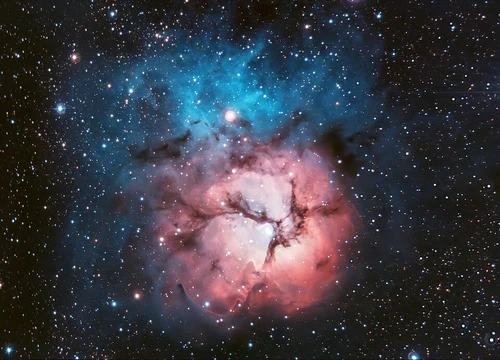
Ou 5
A planetary nebula with a short-period eclipsing binary central star.

Ou 5 (IPHASXJ211420.0+434136) is a planetary nebula in the constellation Cygnus. Its central star is an eclipsing binary with a short orbital period, which is uncommon for such nebulae. The nebula was first detected by the IPHAS survey on August 1, 2010, and later independently found by French amateur astronomer Nicolas Outters in September 2012. It lies two degrees east of the North America Nebula.
Variability was noticed in the three IPHAS observations of Ou 5. Follow-up photometry in October and November 2013, using the 80 cm IAC80 telescope at Teide Observatory, revealed that the central star is an eclipsing binary with an 8.7-hour orbit. This short period indicates that the stars went through a common envelope phase during the red giant stage that preceded the nebula’s formation. Such a phase is often linked to the bipolar shapes seen in many planetary nebulae, and Ou 5 does show bipolar features. The barrel-shaped nebula’s structure suggests multiple mass ejection events occurred during that common envelope stage.
The eclipses of the compact primary star allow spectra of the fainter secondary to be obtained. The secondary is a late K or early M-type star. The hot primary and cool secondary have estimated masses of 0.50 M☉ and 0.23 M☉, respectively.
Quick Facts
- Epoch
- J2000
- Ra
- 21 · 14 · 20.03
- Dec
- +43 · 41 · 36.00
- Dist Pc
- 3,100 ± 300
- Constellation
- Cygnus
- Names
- IPHASXJ211420.0+434136, PN G086.9-03
Facts from the source article.
Lore & Background
Ou 5 was discovered by the IPHAS project in data taken on August 1, 2010, and independently by French amateur astronomer Nicolas Outters in September 2012. It is located two degrees east of the North America Nebula. The nebula showed signs of variability during the three occasions when IPHAS observed it, prompting follow-up photometric observations by the IPHAS team in October and November 2013 using the 80 cm IAC80 telescope at the Teide Observatory. The derived light curve revealed that the central star is an eclipsing binary with a short orbital period of 8.7 hours. This short period implies that during the red giant phase preceding the formation of the planetary nebula, the stars must have formed a common envelope binary. Passing through a common envelope stage is often invoked to explain the bipolar shape seen in many planetary nebulae, and Ou 5 does have bipolar features. The structure of the barrel-shaped nebula suggests that there may have been multiple mass ejection events during the common envelope phase.
Reader's Guide
The significance of Ou 5 lies in its central eclipsing binary system, which provides a rare opportunity to study the aftermath of a common envelope phase in planetary nebula formation. The short orbital period of 8.7 hours confirms that the stars passed through a common envelope stage, a process thought to produce bipolar morphologies. The eclipses of the compact primary star allow spectra of the fainter secondary star to be obtained, revealing it to be a late K or early M-type star. The estimated masses of the hot primary and cool secondary are 0.50 M☉ and 0.23 M☉, respectively. The barrel-shaped nebula and its bipolar features, along with evidence of multiple mass ejection events, make Ou 5 a key object for understanding the role of binary interactions in shaping planetary nebulae. Its legacy is as a well-documented example of a common envelope binary central star, offering direct observational constraints on models of binary evolution and nebular shaping.
Did You Know?
- Ou 5 was discovered by the IPHAS project on August 1, 2010, and independently by amateur astronomer Nicolas Outters in September 2012.
- Its central star is an eclipsing binary with an orbital period of only 8.7 hours.
- The secondary star is a late K or early M-type star with a mass of 0.23 M☉.
- The nebula is barrel-shaped and shows bipolar features, suggesting multiple mass ejection events during the common envelope phase.
More in Planetary Nebulae, Part 2 1-24
Spotted an error? Know more?
Reader corrections go straight into our review queue. Suggest an edit · How this site is sourced