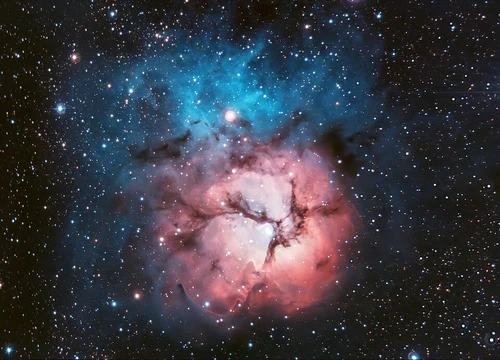
NGC 7662
A bright, blue planetary nebula in Andromeda with triple-shell structure.

NGC 7662 is a planetary nebula in the northern constellation Andromeda, known as the Blue Snowball Nebula, Snowball Nebula, and Caldwell 22. Discovered by William Herschel on October 6, 1784, it is described in the New General Catalogue as a 'magnificent planetary or annular nebula, very bright, pretty small in angular size, round, blue, variable nucleus.' It is a popular target for casual observers.
Quick Facts
- Constellation
- Andromeda
- Epoch
- J2000
- Ra
- 23 · 25 · 53.832
- Dec
- +42 · 32 · 05.84
- Dist Ly
- 1757 ±
- Appmag V
- 8.3
- Names
- PK 106-17 1, GCRV 14695, PN ARO 20, Blue Snowball Nebula, Snowball Nebula, Caldwell 22
Facts from the source article.
Lore & Background
NGC 7662 was discovered by the German-born English astronomer William Herschel on October 6, 1784. The New General Catalogue describes it as a 'magnificent planetary or annular nebula, very bright, pretty small in angular size, round, blue, variable nucleus.' Parallax measurements give a distance estimate of 5,730 ± 340 light-years. The nebula has an elliptical shape with a triple-shell structure: a bright main shell spanning 12″ × 18″, a fainter outer elliptical shell, and a faint circular halo about 134″ in diameter. The two inner shells can be modeled as prolate spheroids, with the inner shell having greater elongation, a major axis tilt of 50° to the line of sight, and a hull thickness of about 2.5″. Several knots and a jet-like structure display emission lines and low ionization. Based on expansion rate, the estimated age of the nebula is 3,080 years. The central star is a subdwarf O star with an effective temperature of 100,000 K, 5,250 times the Sun's luminosity, 0.23723314079 times the Sun's size, and 60.5% of the Sun's mass. X-ray emission is generated by the stellar wind from this star striking previously ejected matter.
Reader's Guide
NGC 7662 is notable for its accessibility to amateur astronomers. A small telescope reveals a star-like object with slight nebulosity; a 6-inch telescope at about 100x magnification shows a slightly bluish disk, while telescopes with a primary mirror at least 16 inches in diameter may reveal slight color and brightness variations in the interior. Its triple-shell structure and prolate spheroid modeling provide insights into the dynamics of planetary nebula formation. The presence of knots and a jet-like structure with low-ionization emission lines indicates complex interactions within the ejected material. The central star's high temperature and X-ray emission from stellar wind striking previously ejected matter contribute to understanding the late stages of stellar evolution. The nebula is listed in the New General Catalogue and is also known as Caldwell 22.
Did You Know?
- NGC 7662 is also called the Blue Snowball Nebula and Snowball Nebula.
- The nebula has a triple-shell structure with a faint circular halo 134″ in diameter.
More in Planetary Nebulae, Part 2 1-24
Spotted an error? Know more?
Reader corrections go straight into our review queue. Suggest an edit · How this site is sourced