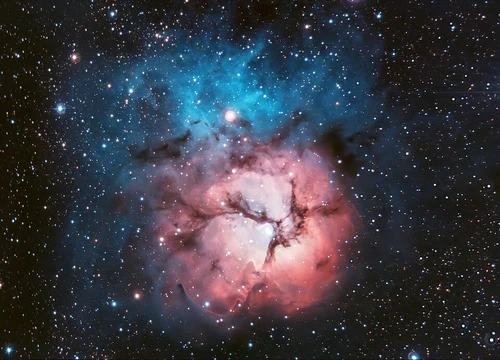
NGC 7094
A planetary nebula in Pegasus with a hot transitional central star.

NGC 7094 is a planetary nebula in the constellation Pegasus, first spotted by American astronomer Lewis Swift on October 10, 1884. Observing it requires a telescope with an aperture of at least 250 mm (9.8 inches), as its apparent visual magnitude is 13.4. It lies about 3.4 degrees northwest of the star Enif (Epsilon Pegasi) and roughly 1.8 degrees northeast of the globular cluster M15.
The nebula’s distance is given by several measurements. Parallax data from the Gaia Early Data Release 3 yields a distance of 1,655 parsecs (with an uncertainty of +97 and −87 parsecs). Other catalog values range from about 1,358 to 1,655 parsecs. Its apparent size is 1.57 arcminutes, corresponding to a physical diameter of about 2.34 light-years (with a radius of roughly 0.393 parsecs). Radial velocity estimates are highly uncertain, with one value of 2 ± 72 km/s and another of −1 ± 34 km/s.
The nebula is roughly 7,770 years old. Its central star is a PG 1159 type—a transitional object evolving toward a white dwarf. This star has a visual magnitude of 13.59, an estimated mass of 1.791 solar masses, a surface temperature of about 110,000 K (109,730 °C), and a luminosity of roughly 5,129 times that of the Sun.
Quick Facts
- Epoch
- J2000
- Ra
- 21/36/52.970
- Dec
- 12/47/19.10
- Dist Ly
- 5400 +320 · −285 ly
- Dist Pc
- 1655 +97 · −87 pc
- Appmag V
- 13.4
- Appdia
- 1.57′
- Constellation
- Pegasus
- Radius Pc
- 0.393
- Dimensions
- 2.34 +0.15 · −0.13 ly
- Absmag V
- 0.10 +0.54 · −0.72
Facts from the source article.
Lore & Background
NGC 7094 was discovered by American astronomer Lewis Swift on 10 October 1884. Observation requires a telescope with an aperture of at least 250 mm due to its apparent visual magnitude of 13.4. The nebula is located about 3.4 degrees northwest of Enif (Epsilon Pegasi) and about 1.8 degrees northeast of the globular cluster M15.
The distance to NGC 7094 is derived from Gaia Early Data Release 3 parallax of 0.6042 ± 0.0336 milliarcseconds, corresponding to a distance of 1655 +97−87 parsecs. Simbad lists four distance values, ranging from 1.358 kpc to 1.655 kpc, indicating some uncertainty. The apparent size of the nebula is 1.57 arcminutes, yielding a physical size of 2.34 +0.15−0.13 light-years, with a radius estimated at 0.393 parsecs. Two highly uncertain velocity values are reported: 2 ± 72 km/s and −1 ± 34 km/s.
The age of NGC 7094 is approximately 7770 years. Its central star is a PG 1159 star, a transitional object evolving toward a white dwarf. The star has a visual magnitude of 13.59, an estimated mass of 1.791 M⊙, a surface temperature of 110 kK, and a luminosity of 5129 L⊙.
Reader's Guide
NGC 7094 holds significance as a planetary nebula with a central star in a rare transitional phase—a PG 1159 star—which provides insight into stellar evolution toward white dwarfs. The star's extreme surface temperature (110 kK) and high luminosity (5129 L⊙) underscore its energetic nature. The nebula's age of about 7770 years places it among relatively young planetary nebulae. Distance measurements from Gaia EDR3 and Simbad show some variation, reflecting ongoing refinement in astrometric data. The nebula's location near Enif and the globular cluster M15 aids amateur observers in locating it, though its faint magnitude requires a telescope of at least 250 mm aperture. The reported velocity values are highly uncertain, indicating that radial motion data remain imprecise. Overall, NGC 7094 contributes to the study of post-asymptotic giant branch evolution and the properties of hot, massive central stars in planetary nebulae.
Did You Know?
- The central star of NGC 7094 is a PG 1159 star, a transitional stage evolving toward a white dwarf.
- The nebula's age is approximately 7770 years.
- Its distance from Earth is about 1655 parsecs, based on Gaia Early Data Release 3 parallax.
More in Planetary Nebulae, Part 2 1-24
Spotted an error? Know more?
Reader corrections go straight into our review queue. Suggest an edit · How this site is sourced