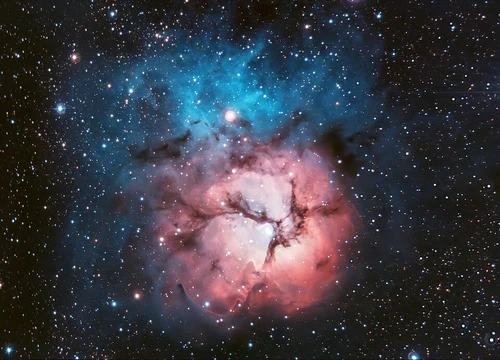
NGC 7027
A young, dense planetary nebula with complex structure and rich carbon chemistry.

NGC 7027—called the Jewel Bug Nebula or Magic Carpet Nebula—is a young, dense planetary nebula about 3,000 light-years away in Cygnus. Discovered in 1878 by Édouard Stephan with an 800 mm reflector at Marseille Observatory, it ranks among the smallest known planetary nebulae and is the most thoroughly studied.
Visually, it is one of the brightest planetary nebulae. Through a 6-inch telescope at roughly 50× magnification, it looks like a fairly bright bluish star; higher magnification gives the best view. In 1977, a small Schmidt-Cassegrain telescope at Yerkes Observatory was used to determine its precise optical position, matching photographs with radio maps. The Hubble Space Telescope has imaged it many times since 1990. Before those observations, astronomers thought NGC 7027 was a protoplanetary nebula whose central star was too cool to ionize its gas, but it is now recognized as a very early-stage planetary nebula.
The nebula is unusually small—only 0.2 by 0.1 light-years across, compared to the typical 1 light-year—and fairly young, about 600 years old. Its shape is complex: an elliptical region of ionized gas with an equatorial belt inside a massive neutral cloud, all wrapped in a translucent shroud of gas and dust. The inner structure is a prolate ellipsoidal shell containing a photodissociation region shaped like a clover leaf. Several shocks and X-ray jets puncture the inner shell, creating spike-like features. The nebula expands at 17 kilometers per second. Its central regions emit X-rays, indicating extremely high temperatures. Faint blue concentric shells surround the ellipsoid.
The expanding halo has about three times the Sun’s mass—roughly 100 times more massive than the ionized central region. This mass loss provided key evidence that stars a few times more massive than the Sun can avoid exploding as supernovae. The nebula is rich in carbon, making it valuable for studying carbon chemistry in dense molecular material exposed to strong ultraviolet radiation. Its spectrum shows fewer spectral lines from neutral molecules than typical planetary nebulae, because intense UV destroys those molecules. It also contains ions of very high ionization potential. In 2019, the helium hydride ion—thought to be the first molecule formed in the Universe, about 100,000 years after the Big Bang—was detected in space for the first time in NGC 7027.
Quick Facts
- Epoch
- J2000
- Ra
- 21 · 07 · 1.7
- Dec
- +42 · 14 · 11
- Dist Ly
- 3,000
- Appmag V
- 10
- Constellation
- Cygnus
- Dimensions
- 0.2 × 0.1 ly
- Notes
- Young (600 years) and unusually massive (3–4)
Facts from the source article.
Lore & Background
NGC 7027 is unusually small, measuring only 0.2 by 0.1 light-years, whereas the typical size for a planetary nebula is 1 light-year. It is fairly young, at about 600 years old. It has a very complex shape, consisting of an elliptical region of ionized gas and an equatorial belt within a massive neutral cloud. The inner structure is surrounded by a translucent shroud of gas and dust. The nebula is shaped like a prolate ellipsoidal shell and contains a photodissociation region shaped like a 'clover leaf'. The inner shell is also punctured by several shocks and X-ray jets, leading to 'spike'-like structures. Surrounding the ellipsoidal nebula are a series of faint, blue concentric shells.
The expanding halo of NGC 7027 has a mass of about three times the mass of the Sun, and is about 100 times more massive than the ionized central region. This mass loss provided important evidence that stars a few times more massive than the Sun can avoid being destroyed in supernova explosions. The nebula is rich in carbon, and its spectrum contains fewer spectral lines from neutral molecules than is usual for planetary nebulae, due to destruction by intense UV radiation. The helium hydride ion, thought to be the earliest molecule formed in the Universe, was detected in 2019 for the first time in space in NGC 7027. There is also evidence for the presence of nanodiamond.
Reader's Guide
NGC 7027 is notable as one of the visually brightest planetary nebulae, appearing as a relatively bright bluish star in a 6-inch telescope at 50× magnification. It has been photographed multiple times by the Hubble Space Telescope since its launch in 1990. Prior to these observations, it was thought to be a protoplanetary nebula with the central star too cool to ionize any gas, but it is now known to be a planetary nebula in the earliest stage of its development. The central star is suspected to be a binary system, with the secondary undetected, and interactions with that star may have produced the complex structure including jets and spikes. The nebula is currently in a short phase where molecules in its envelope are being dissociated into atoms, and atoms are being ionized. Its rich and highly ionized spectrum is caused by its hot central star, which radiates at 7,700 times the Sun's luminosity. The detection of helium hydride ion in 2019 marked the first time this molecule was found in space, providing a direct link to early Universe chemistry. The presence of nanodiamond further underscores its importance for studying carbon chemistry in dense molecular material exposed to strong ultraviolet radiation.
Did You Know?
- NGC 7027 is one of the smallest planetary nebulae, measuring only 0.2 by 0.1 light-years.
- The expanding halo of NGC 7027 has a mass about three times that of the Sun, 100 times more massive than its ionized central region.
- The central star of NGC 7027 is suspected to be a binary system, with the secondary star undetected.
More in Planetary Nebulae, Part 2 1-24
Spotted an error? Know more?
Reader corrections go straight into our review queue. Suggest an edit · How this site is sourced