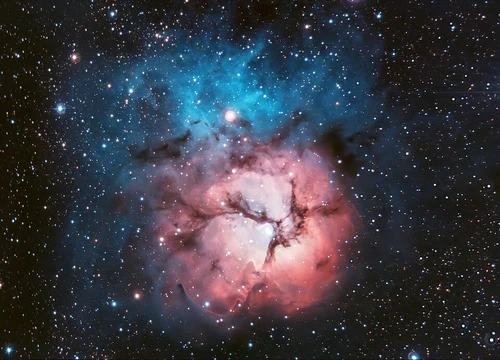
NGC 6905
A planetary nebula with broad OVI emission and a [WO2] central star.

NGC 6905, called the Blue Flash Nebula, lies in the constellation Delphinus. William Herschel first spotted it in 1784. Its distance is uncertain, with estimates ranging from about 1.7 to 2.6 kiloparsecs, typical for planetary nebulae.
The nebula’s structure features an inner shell measuring 47 by 34 arcseconds, with roughly cone-shaped extensions and ansae (small lobes) along its longer axis. The central star is a standout: it shows some of the broadest OVI emission lines known among planetary nebulae, and OVIII emission has also been detected. The ansae glow especially bright in NII light. The nebula’s total gas mass falls between 0.31 and 0.47 solar masses.
The central star, with an apparent magnitude of 14.0, is classified as spectral type [WO2], meaning its spectrum resembles that of a Wolf–Rayet star and is rich in oxygen. Its surface temperature is estimated at 150,000 K, and its spectrum also reveals neon emission lines. Currently about 60% the mass of the Sun, the star originally had a mass of roughly 1.07 solar masses before it became a planetary nebula. Data from the Gaia mission hints that the central star might be part of a binary system.
Under dark skies, NGC 6905 can be seen with a 4-inch telescope, though larger instruments provide better views.
- Discoverer
- William Herschel
- Discovery year
- 1784
- Constellation
- Delphinus
- Central star magnitude
- 14.0
- Distance range kpc
- 1.7–2.6
- Angular dimensions
- 47" × 34"
- Total mass range solar masses
- 0.31–0.47
- Central star spectral type
- [WO2]
- Central star surface temperature k
- 150000
- Progenitor mass solar masses
- 1.07
Lore & Background
NGC 6905 was discovered by William Herschel in 1784. Its shape is characterized by an internal shell with angular dimensions 47" × 34" and roughly conical extensions, with ansae-type formations along the major axis. The ansae were particularly intense in NII. The distance of the nebula is not well determined, with estimates ranging between 1.7 and 2.6 kpc. The total mass of gas in NGC 6905 falls between 0.31 and 0.47 solar masses.
The central star has a spectral type of [WO2], meaning its spectrum is similar to those of Wolf–Rayet stars and is rich in oxygen. It is estimated to have a surface temperature of 150,000 K. The spectrum also shows signs of neon emission lines. Currently about 60% the mass of the Sun, before becoming a planetary nebula it had a mass of about 1.07 solar masses. An analysis of Gaia data suggests that the central star may be a binary system.
Reader's Guide
NGC 6905 is significant for its central star's exceptionally broad OVI emission lines, among the most broad of any planetary nebula, and for the detection of OVIII emission. The central star's [WO2] spectral type, rich in oxygen and showing neon lines, places it among the rare oxygen-sequence Wolf–Rayet central stars. The nebula's structure includes an internal shell and ansae formations that were particularly intense in NII. The distance remains uncertain, with estimates from 1.7 to 2.6 kpc, and the total gas mass is between 0.31 and 0.47 solar masses. Gaia data suggests the central star may be a binary system. Under dark skies, NGC 6905 can be detected with a 4-inch telescope, but larger instruments provide better views.
Did You Know?
- NGC 6905 is also known as the Blue Flash Nebula.
- Its central star has a surface temperature of 150,000 K.
- The nebula's central star may be a binary system according to Gaia data.
- The ansae formations were particularly intense in NII.
More in Planetary Nebulae, Part 2 1-24
Spotted an error? Know more?
Reader corrections go straight into our review queue. Suggest an edit · How this site is sourced