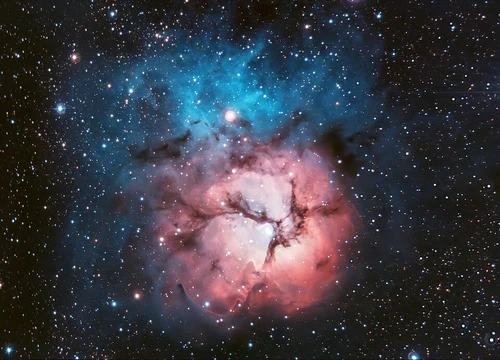
NGC 6891
Triple-shell planetary nebula in Delphinus with multiple ejection episodes.

NGC 6891 is a bright, asymmetrical planetary nebula in the northern constellation Delphinus. It has a triple-shell structure: a bright inner region, an attached intermediate shell, and a detached outer halo. High-resolution images show filaments, knots, and fine details around its central white dwarf star, HD 192563. The nebula contains at least two ellipsoidal shells oriented in different directions, plus a spherical outer halo that expands faster than the inner parts. The bright optical area spans about 15 arcseconds across. These features indicate that the progenitor star underwent several distinct mass ejection events.
The nebula has an apparent visual magnitude between 10.5 and 12. In amateur telescopes of 6 inches aperture or larger, it appears as a small, bluish disc, and under good conditions the central star can be seen faintly. It lies near the celestial equator in Delphinus, making it visible from both hemispheres. The Hubble Space Telescope has imaged it in detail, aiding studies of planetary nebula structure, formation, evolution, and distance. It was discovered on 22 September 1884 by Scottish astronomer Ralph Copeland, using visual spectroscopy with a 6.1-inch refractor at the Dun Echt Observatory in Aberdeen, Scotland.
Quick Facts
- Epoch
- J2000.0
- Constellation
- Delphinus
- Ra
- 20 · 15 · 08.84
- Dec
- +12 · 42 · 15.6
- Appmag V
- 12.51 · 0.23
- Dist Ly
- 12,400
- Names
- PN G054.1-12.1, PK 54-12.1, IRAS 20127+1233
Facts from the source article.
Lore & Background
NGC 6891 was discovered on 22 September 1884 by Scottish astronomer Ralph Copeland, who observed it using visual spectroscopy with a 6.1-inch refractor at the Dun Echt Observatory in Aberdeen, Scotland. The nebula displays a triple-shell structure, consisting of a bright inner nebula, an attached intermediate shell, and a detached outer halo. High-resolution imaging reveals filaments, knots, and intricate details in the interior surrounding the central white dwarf star named HD 192563, along with at least two ellipsoidal shells oriented differently and a spherical outer halo expanding faster than the inner regions. The bright optical regions have an apparent diameter of approximately 15 arcseconds. The nebula shows evidence of multiple mass ejection episodes from its progenitor star.
Reader's Guide
NGC 6891 has an apparent visual magnitude of around 10.5 to 12 and appears as a small, bluish disc in amateur telescopes of 6 inches aperture or larger, with the central star faintly visible under good conditions. It lies near the celestial equator in Delphinus and is observable from both hemispheres. The nebula has been imaged in detail by the Hubble Space Telescope, contributing to studies of planetary nebula structure, formation, evolution, and distance determination. Its triple-shell morphology and evidence of multiple mass ejection episodes make it a key object for understanding the late stages of stellar evolution. The asymmetrical shape and differing orientations of its shells provide insight into the complex dynamics of mass loss from the progenitor star. The Hubble Space Telescope imagery has allowed detailed analysis of filaments, knots, and the expanding outer halo, which expands faster than the inner regions, offering clues to the timing and mechanisms of the ejection events.
Did You Know?
- NGC 6891 was discovered on 22 September 1884 by Ralph Copeland using a 6.1-inch refractor at Dun Echt Observatory.
- Its central star is the white dwarf HD 192563.
- The outer halo expands faster than the inner regions of the nebula.
More in Planetary Nebulae, Part 2 1-24
Spotted an error? Know more?
Reader corrections go straight into our review queue. Suggest an edit · How this site is sourced