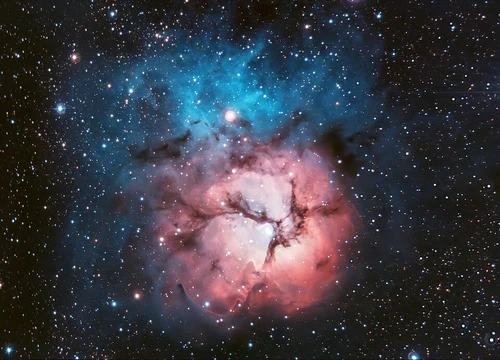
NGC 6818
Planetary nebula in Sagittarius with knotty filaments and layered structure.

NGC 6818, called the Little Gem Nebula, sits in the constellation Sagittarius, about 6,000 light-years away. This planetary nebula shines at magnitude 10, with an oval shape spanning 15 to 22 arcseconds, and hosts a central star of magnitude 15. William Herschel first spotted it in 1787.
The nebula forms when a Sun-like star nears the end of its life and casts off its outer layers, creating a glowing gas cloud. The ejection is uneven, leading to complex shapes. In NGC 6818, this shows up as knotty, filament-like structures and distinct layers: a bright, enclosed central bubble surrounded by a larger, fainter cloud. The whole glow measures just over half a light-year across.
Scientists think the central star’s stellar wind pushes the outflowing material, giving the nebula its elongated shape. As this wind plows through the slower-moving cloud, it creates especially bright patches in the bubble’s outer layers.
- Constellation
- Sagittarius
- Magnitude
- 10
- Diameter
- 15 to 22 arcseconds
- Central star magnitude
- 15
- Distance
- roughly 6000 light-years
- Size
- just over half a light-year across
- Discoverer
- William Herschel
- Discovery year
- 1787
Lore & Background
NGC 6818 was discovered by William Herschel in 1787. It is located in the constellation of Sagittarius (The Archer), roughly 6000 light-years away from Earth. The glow of the cloud is just over half a light-year across.
When stars like the Sun are near end of life, they send their outer layers into space to create glowing clouds of gas, a planetary nebula. This ejection of mass is uneven, and planetary nebulae can have complex shapes. NGC 6818 shows knotty filament-like structures and distinct layers of material, with a bright and enclosed central bubble surrounded by a larger, more diffuse cloud.
Scientists believe that the stellar wind from the central star propels the outflowing material, forming the elongated shape of NGC 6818. As this stellar wind moves through the slower-moving cloud it creates particularly bright spots in the bubble's outer layers.
Reader's Guide
NGC 6818, the Little Gem Nebula, holds significance as a well-studied example of a planetary nebula with a complex morphology. Its knotty filament-like structures and distinct layers of material illustrate the uneven ejection of mass from aging Sun-like stars. The bright central bubble and surrounding diffuse cloud provide insight into the dynamics of stellar winds interacting with slower-moving ejected material. The nebula's elongated shape is attributed to the stellar wind from its central star propelling outflowing gas, creating bright spots in the bubble's outer layers. Discovered by William Herschel in 1787, it has been a subject of observation for over two centuries. Its magnitude 10 and oval diameter of 15 to 22 arcseconds, with a 15th magnitude central star, make it a target for amateur astronomers. Located roughly 6000 light-years away in Sagittarius, its size of just over half a light-year across places it among the many planetary nebulae that reveal the final stages of stellar evolution. The nebula's legacy lies in its contribution to understanding the complex shapes and processes involved in planetary nebula formation.
Did You Know?
- It has a magnitude 10 and an oval diameter of 15 to 22 arcseconds.
- The central star of NGC 6818 has a magnitude of 15.
- The nebula is roughly 6000 light-years away from Earth.
More in Planetary Nebulae, Part 2 1-24
Spotted an error? Know more?
Reader corrections go straight into our review queue. Suggest an edit · How this site is sourced