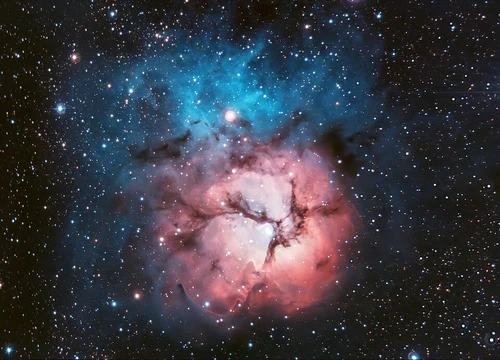
NGC 6778
A disrupted planetary nebula with a close binary core.

NGC 6778 is a planetary nebula roughly 10,300 light-years from the Sun in the constellation Aquila, about 5° south-southwest of the bright star Delta Aquilae. It was discovered by the German astronomer Albert Marth between 1863 and 1865. The English astronomer John Herschel may have mistakenly recorded it as NGC 6785, since no object now exists at the coordinates he listed. The New General Catalogue describes it as a "small, elongated, ill-defined disc."
The nebula has a disrupted shape: an irregular shell with a roughly S-shaped feature projecting outward, along with linear jet-like structures. Inside lies a highly distorted elliptical ring, oriented east–west. The nebula and ring span about 8.5″ across and are roughly 4,400 years old, while the jets are about 1,700 years old. The surrounding nebula is inclined about 85° to Earth’s line of sight.
At its center is a close binary star system with an orbital period of just 3.68 hours—one of the shortest known among binary central stars in planetary nebulae. Their extreme proximity suggests they passed through a common-envelope phase earlier in their evolution. The pair likely consists of a primary star of 0.6 solar masses and a red dwarf secondary of 0.3 solar masses, with a semimajor axis of only 0.005 AU (about 1.1 solar radii).
The nebula’s torus expands at a high velocity, up to 60–70 km/s. It shows collimated outflows, possibly from the common-envelope interaction or a short-lived accretion disk. The two jets lie at a position angle of 15° and have fast radial velocities around 100 km/s. The nebula is also rich in filamentary "low-ionization structures" (LIS), similar to wispy features seen in nova explosions, which may also result from the common-envelope phase.
Beyond an elevated helium abundance, the nebula displays unusually strong optical recombination lines from heavier elements—among the highest known in planetary nebulae. This may be due to a very late thermal pulse, or "final flash," after the initial ejection of the stellar envelope, which would have injected chemically enriched material into the older nebula and altered its abundances.
Quick Facts
- Credit
- ESO
- Epoch
- J2000
- Ra
- 19 · 18 · 25.0
- Dec
- −01 · 35 · 47
- Dist Ly
- 10,300
- Dist Pc
- 3,150
- Appmag V
- 11.9
- Constellation
- Aquila
- Names
- NGC 6778 or 6785, HD 180871
Facts from the source article.
Lore & Background
NGC 6778 was discovered by German astronomer Albert Marth during the period 1863–1865. English astronomer John Herschel may have mistakenly catalogued it as NGC 6785, as nothing can be found now at the coordinates he gave for it. In the New General Catalogue it was described as a 'small, elongated, ill-defined disc'.
The nebula displays a disrupted morphology, with a roughly S-shaped feature projecting out of an irregular shell, along with linear jet-like forms. The inner part contains a highly distorted elliptical ring oriented east–west. The nebula and ring have an angular size of 8.5″ and are about 4,400 years old, while the jets are around 1,700 years old. The surrounding nebula is inclined about 85° to the line of sight from Earth, and its torus has a high expansion velocity of up to 60–70 km/s.
At the center is a close binary star system with an orbital period of just 3.68 hours, one of the shortest known among binary central stars of planetary nebulae. Their proximity provides strong evidence they passed through a common-envelope phase. The pair may now consist of a primary star with 0.6 M☉ and a red dwarf secondary of 0.3 M☉, with a semimajor axis of only 0.005 AU. The nebula shows collimated outflows, possibly from the common-envelope behavior or a short-lived accretion disk. The jets are along a position angle of 15° with radial velocities around 100 km/s. The nebula is also notable for rich filamentary low-ionization structures resembling nova wispy structures, possibly from the common-envelope interaction.
Reader's Guide
NGC 6778 is significant for its extreme central binary system, with an orbital period of 3.68 hours—one of the shortest known among planetary nebula central stars. This close pair provides strong evidence for a common-envelope phase in their evolution, which likely shaped the nebula's disrupted morphology, including its S-shaped feature, irregular shell, and linear jets. The nebula's high torus expansion velocity (60–70 km/s) and fast jets (100 km/s) further indicate energetic interactions. Additionally, the nebula displays unusually strong optical recombination lines from heavier elements, among the highest known in planetary nebulae. These may result from a very late thermal pulse, or 'final flash,' that ejected chemically enriched material into the old nebula, altering its abundances. The presence of rich filamentary low-ionization structures, reminiscent of nova remnants, also points to the common-envelope interaction as a key driver of the nebula's complexity. Together, these features make NGC 6778 a valuable object for studying binary evolution, common-envelope processes, and chemical enrichment in planetary nebulae.
Did You Know?
- NGC 6778 is located about 10,300 light years away in the constellation Aquila.
- The nebula's torus expands at up to 60–70 km/s, and its jets have radial velocities of around 100 km/s.
More in Planetary Nebulae, Part 2 1-24
Spotted an error? Know more?
Reader corrections go straight into our review queue. Suggest an edit · How this site is sourced