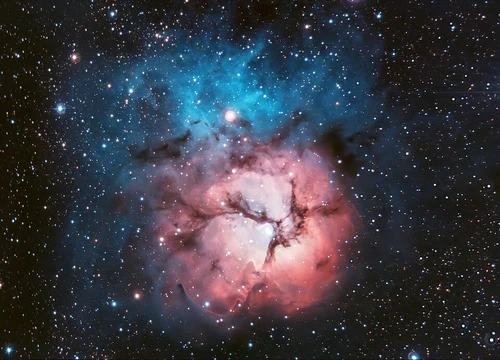
NGC 6751
A planetary nebula with a complex bipolar structure and a hot central star.

NGC 6751, commonly called the Glowing Eye Nebula, lies in the constellation Aquila, roughly 6,500 light-years away. Albert Marth first spotted it on 20 July 1863. John Louis Emil Dreyer, who compiled the New General Catalogue, noted it as “pretty bright, small.” The object also carries a duplicate designation, NGC 6748. In 2009, it became the target of the winning image in the Gemini School Astronomy Contest, a competition where Australian high school students chose an astronomical object for the Gemini telescopes to photograph. Deep-sky observers find it an easy telescopic target because it sits just southeast of the extremely red carbon star V Aquilae.
Like all planetary nebulae, NGC 6751 formed when a dying star shed its outer gas layers several thousand years ago. It spans about 0.8 light-years. Its structure is complex and bipolar: a bright inner bubble (visible in photos) is surrounded by two fainter halos. The outer halo, with a radius of 50 arcseconds, is extremely faint and broken, while the inner halo, radius 27 arcseconds, is roughly spherical. On the west and east sides of the inner shell, knots appear, each surrounded by faint lobes that actually form a ring; the eastern side is closer to us than the western. The entire system approaches the Solar System at a heliocentric radial velocity of −31.7 km/s.
The central star has a spectrum similar to a Wolf–Rayet star (spectral type [WC4]), with an effective temperature around 140,000 K and a radius of about 0.13 times that of the Sun. It loses mass at a rate of 1×10⁻⁶ solar masses per year, and its surface is mostly helium and carbon. The winning 2009 Gemini image also captured a smaller nebula at the top left of NGC 6751. That nebula, measuring 80 by 40 arcseconds, was discovered in 1990 by Hua and Louise using the Newton focus of the 120-centimeter Foucault telescope at the Observatoire de Haute Provence in Saint Michel l’Observatoire.
- Designations
- NGC 6751, NGC 6748, Glowing Eye Nebula
- Constellation
- Aquila
- Distance
- about 6,500 light-years (2.0 kiloparsecs)
- Diameter
- about 0.8 light-years
- Discoverer
- Albert Marth
- Discovery date
- 20 July 1863
- Central star type
- Wolf–Rayet-like (spectral type [WC4])
- Central star temperature
- about 140,000 K
- Central star radius
- about 0.13 R☉
- Heliocentric radial velocity
- −31.7 km/s
Lore & Background
NGC 6751, like all planetary nebulae, was formed when a dying star threw off its outer layers of gas several thousand years ago. It has a complex bipolar structure, with a bright inner bubble and two fainter halos. The outer halo, with a radius of 50″, is extremely faint and broken, while the inner halo with a radius of 27″ is roughly spherical. On both the west and east sides of the inner shell, knots can be seen that are surrounded by faint 'lobes'; these lobes are actually a ring, and the eastern side is nearer than the western side. As a whole, the system is approaching the Solar System with a heliocentric radial velocity of −31.7 km/s.
The central star of the nebula has a similar spectrum to a Wolf–Rayet star (spectral type [WC4]), with an effective temperature of about 140,000 K and a radius of about 0.13 R☉. It is losing mass at a rate of 1×10⁻⁶ M☉ per year, and its surface composition is mostly helium and carbon. John Louis Emil Dreyer, the compiler of the New General Catalogue, described the object as 'pretty bright, small'. The object was assigned a duplicate designation, NGC 6748.
NGC 6751 is an easy telescopic target for deep-sky observers because its location is immediately southeast of the extremely red-colored cool carbon star V Aquilae. The winning image of the 2009 Gemini Astronomy Contest shows a nebula at the top left of NGC 6751. This 80 x 40 arcsec nebula was discovered in 1990 by Hua & Louise at the Newton focus of the Foucault telescope, 120cm in diameter at Observatoire de Haute Provence (O.H.P.) Saint Michel l'Observatoire.
Reader's Guide
NGC 6751 is notable for its complex bipolar structure, including a bright inner bubble and two faint halos, one broken and one roughly spherical. Its central star, with a Wolf–Rayet-like spectrum, is extremely hot at about 140,000 K and is losing mass rapidly. The nebula's discovery by Albert Marth in 1863 and its duplicate NGC designation (NGC 6748) are part of its historical record. It gained modern recognition as the subject of the winning picture in the 2009 Gemini School Astronomy Contest, where Australian high school students selected it for imaging by the Gemini Observatory. That contest image also revealed a smaller nebula (80 x 40 arcsec) at the top left of NGC 6751, discovered in 1990 by Hua & Louise. The nebula's location near the carbon star V Aquilae makes it an easy target for amateur observers. Its heliocentric radial velocity of −31.7 km/s indicates it is approaching the Solar System.
Did You Know?
- NGC 6751 was discovered by Albert Marth on 20 July 1863.
- It has a duplicate designation, NGC 6748.
- The central star has a Wolf–Rayet-like spectrum (type [WC4]) and a temperature of about 140,000 K.
More in Planetary Nebulae, Part 2 1-24
Spotted an error? Know more?
Reader corrections go straight into our review queue. Suggest an edit · How this site is sourced