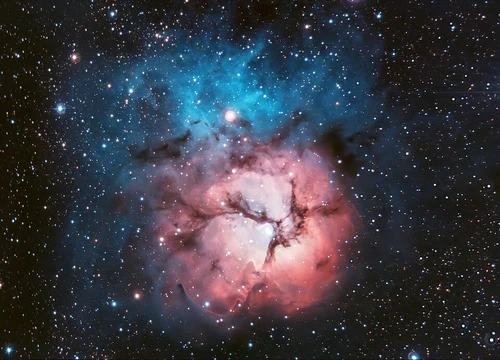
NGC 6572
A bright, young planetary nebula with multiple colorful nicknames.

NGC 6572 is a planetary nebula in the constellation Ophiuchus, discovered in 1825 by the German astronomer Friedrich Georg Wilhelm von Struve. It is notable for its high brightness at magnitude 8.1, making it an appealing target for amateur astronomers, and for its multiple nicknames including Blue Racquetball, Emerald Nebula, Green Nebula, and Turquoise Orb.
- Constellation
- Ophiuchus
- Discovery year
- 1825
- Discoverer
- Friedrich Georg Wilhelm von Struve
- Apparent magnitude
- 8.1
- Nicknames
- Blue Racquetball, Emerald Nebula, Green Nebula, Turquoise Orb
- Central star spectral type
- Of-WR(H)
- Central star temperature
- 68,000 K
- Central star luminosity
- 5,700 times solar
Lore & Background
NGC 6572 was discovered in 1825 by the German astronomer Friedrich Georg Wilhelm von Struve. According to several sources such as Sky & Telescope, this object received the nicknames Blue Racquetball, Emerald Nebula, Green Nebula, and Turquoise Orb. At magnitude 8.1, it is easily bright enough to make it an appealing target for amateur astronomers with telescopes. At low magnification, it will appear to be just a colored star, but higher magnification will reveal its shape.
NGC 6572 is a relatively young nebula, and began to shed its gases a few thousand years ago. Because of this, the material is still quite concentrated, which explains its abnormal brightness. The envelope of gas is currently racing out into space at a speed of around 15 kilometres per second. As it becomes more diffuse, it will dim. Its structure consists of two bipolar shells that are slightly misaligned from each other's axes, as well as a toroidal waist.
The central star of the planetary nebula has a spectral type of Of-WR(H). The central star has an effective temperature of 68,000 K and a luminosity about 5,700 times that of the Sun.
Reader's Guide
NGC 6572 is significant as a bright and young planetary nebula, easily observable by amateur astronomers due to its magnitude 8.1. Its multiple nicknames—Blue Racquetball, Emerald Nebula, Green Nebula, and Turquoise Orb—reflect its striking color and shape. The nebula's youth, having begun shedding its gases only a few thousand years ago, explains its concentrated material and abnormal brightness. Its structure of two slightly misaligned bipolar shells and a toroidal waist provides insight into the dynamics of early-stage planetary nebulae. The central star, with a spectral type Of-WR(H), a temperature of 68,000 K, and a luminosity 5,700 times that of the Sun, is a key feature for studying stellar evolution. The nebula's gas expands at 15 km/s, and as it diffuses, it will dim, marking a transient phase in its lifecycle. This object's legacy lies in its accessibility and its role in understanding the early stages of planetary nebula formation.
Did You Know?
- NGC 6572 was discovered in 1825 by Friedrich Georg Wilhelm von Struve.
- The nebula's gas is expanding at about 15 kilometres per second.
More in Planetary Nebulae, Part 2 1-24
Spotted an error? Know more?
Reader corrections go straight into our review queue. Suggest an edit · How this site is sourced