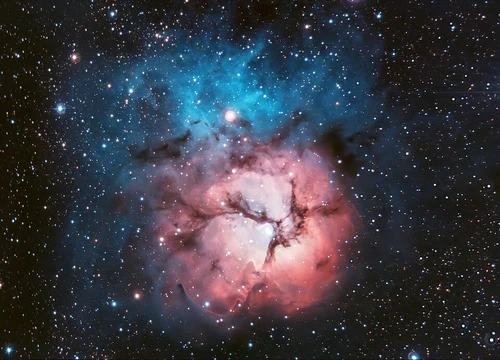
NGC 6565
A triaxial planetary nebula with three ionization zones.

NGC 6565, also cataloged as ESO 456-70, is a planetary nebula located in the constellation Sagittarius. It came into being when a star shed its outer layers near the end of its life. The leftover core, a white dwarf, gives off intense ultraviolet radiation that energizes the surrounding gas, causing the nebula to glow and become observable through a telescope. Over roughly 10,000 years, the white dwarf will cool significantly, causing the nebula to fade until it can only be captured in long-exposure photographs.
The nebula consists of three distinct regions. The innermost zone, appearing as a bright circle in images, contains heavily ionized gas. Around it lies a faint red envelope of gas that is less ionized. Beyond that, an extended halo—not visible in the featured image—is nearly neutral, meaning it is barely ionized at all. The inner zone is shaped like a triaxial ellipsoid and is seen almost pole-on, which is the part visible through a telescope. An unknown force has pushed gas outward at the poles, forming two faint cup-like structures at opposite ends of the ellipse. If viewed from a different angle, this inner zone would likely resemble NGC 6886. Indeed, NGC 6565 shares many traits with NGC 6886, including its nebular spectrum, structure, brightness, and the temperature of its central star.
John Louis Emil Dreyer added NGC 6565 to the New General Catalog in 1888. The nebula has a visual magnitude of about 13 and spans 8 by 10 arcseconds. It is moving toward the Sun at 4.9 kilometers (3 miles) per second. Distances to most planetary nebulae are hard to pin down; older estimates placed NGC 6565 at 6,500 light-years away, while newer ones suggest it could be as far as 15,000 light-years.
- Ngc designation
- NGC 6565
- Other designation
- ESO 456-70
- Constellation
- Sagittarius
- Visual magnitude
- about 13
- Diameter
- 8 x 10 arcseconds
- Radial velocity
- approaching the Sun at 4.9 km/s
- Distance (older estimate)
- 6500 light-years
- Distance (newer estimate)
- up to 15,000 light-years
Lore & Background
NGC 6565 was entered into the New General Catalog by John Louis Emil Dreyer in 1888. The nebula is thought to be composed of three different zones: an inner zone of heavily ionized gas appearing as a bright circle, a surrounding envelope of gas seen as a faint red glow that is less ionized, and an extended halo that is nearly neutral and invisible in the featured image. The inner zone is a triaxial ellipsoid seen nearly pole-on, and an unknown force pushed out gas at the poles, creating two faint cups at either end of the ellipse. It is thought that this inner zone would look like NGC 6886 if viewed from a different angle; NGC 6565 is very similar to NGC 6886 in nebular spectrum, structure, luminosity, and temperature of the central star.
Reader's Guide
NGC 6565 is notable for its three distinct ionization zones, which illustrate the complex structure of planetary nebulae. The inner zone, visible to the human eye through a telescope, is a triaxial ellipsoid seen nearly pole-on, with faint cups at the poles formed by an unknown force. Its similarity to NGC 6886 in spectrum, structure, luminosity, and central star temperature suggests a common evolutionary pathway. Over about 10,000 years, the white dwarf will cool dramatically, diminishing the nebula's light until it is only visible in long-exposure photographs. Distances to NGC 6565 remain uncertain, with older estimates at 6500 light-years and newer estimates up to 15,000 light-years, reflecting the general difficulty in measuring distances to planetary nebulae. The object's entry into the New General Catalog in 1888 by John Louis Emil Dreyer places it within the historical cataloging of deep-sky objects.
Did You Know?
- NGC 6565 is also known as ESO 456-70.
- The white dwarf will cool dramatically over about 10,000 years, making the nebula only visible in long-exposure photographs.
Frequently Asked Questions
What is NGC 6565?
NGC 6565 (also cataloged as ESO 456-70) is a small planetary nebula located in the Sagittarius constellation. It was created when a dying star expelled its outer envelope, leaving a hot white dwarf whose ultraviolet radiation excites the surrounding gas into a visible glow.
How big is NGC 6565 and how bright does it appear?
The nebula spans roughly 8 by 10 arcseconds on the sky and sits at an apparent visual magnitude near 13, making it a demanding target that calls for a solid aperture and dark observing conditions. Its triaxial geometry gives it a slightly elongated outline rather than a perfectly circular one.
What is special about NGC 6565's internal structure?
The nebula is organized into three separate ionization zones that radiate outward from the central white dwarf. This triaxial, three-region architecture distinguishes it from the simpler round or bipolar nebulae that many amateur astronomers more commonly observe.
How long will NGC 6565 remain visible to telescopes?
The central white dwarf will keep cooling over the next roughly 10,000 years, steadily reducing the ultraviolet output that keeps the surrounding gas glowing. Eventually the nebula will dim to the point where only long-exposure photographic plates can still capture its faint structure.
Is NGC 6565 moving toward or away from us?
Spectroscopic measurements indicate the nebula is drifting toward the Sun at about 4.9 km/s. That modest radial velocity is consistent with a young planetary nebula still expanding within its local stellar neighborhood.
More in Planetary Nebulae, Part 2 1-24
Spotted an error? Know more?
Reader corrections go straight into our review queue. Suggest an edit · How this site is sourced