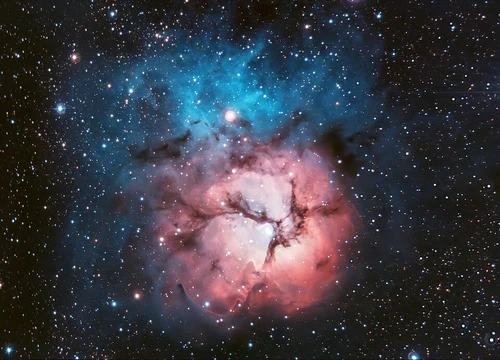
NGC 6563
A planetary nebula in Sagittarius, discovered by James Dunlop in 1826.

NGC 6563 is a planetary nebula in Sagittarius, discovered by Scottish astronomer James Dunlop in 1826. The observer and author Stephen James O'Meara called it a "hidden treasure."
The nebula’s distance is given in the SIMBAD database as either 1.665 ± 0.333 kpc (about 5,430 light-years) or roughly 1,646 pc (about 5,370 light-years). Its radial velocity is −31.0 ± 5.0 km/s. The apparent size is 0.795 ± 0.005 arcminutes, which corresponds to an actual diameter of about 1.26 ± 0.26 light-years.
Morphologically, NGC 6563 is an expanding ellipsoidal shell with a ring and two ear-like projections on opposite sides. The shell and ring have a kinematic age of roughly 3,700 years, while the ears are older, between 7,500 and 8,800 years. The expanding CO shell is nearly continuous around the minor axis waist, and the nebula is tilted relative to the plane of the sky. The shell is broken into a series of condensations.
The central star has a visual magnitude of 17.49 and a mass of about 2.932 solar masses. Its surface temperature is 123,000 K, and its luminosity is 69 times that of the Sun. The nebula’s radius is estimated at 0.122 pc, and its age is about 6,350 years.
- Constellation
- Sagittarius
- Discoverer
- James Dunlop
- Discovery year
- 1826
- Distance
- 1.665 ± 0.333 kpc (~5430 ly) or approximately 1646 pc (~5370 ly)
- Radial velocity
- −31.0 ± 5.0 km/s
- Apparent size
- 0.795 ± 0.005 arcminutes
- Central star magnitude
- 17.49
- Central star mass
- 2.932 solar masses
- Central star temperature
- 123 kK
- Central star luminosity
- 69 times solar
Lore & Background
NGC 6563 was discovered by Scottish astronomer James Dunlop in 1826. Renowned observer and author Stephen James O'Meara described it as a 'hidden treasure'. The SIMBAD database provides two fully compatible distances: 1.665 ± 0.333 kpc (~5430 ly) and approximately 1646 pc (~5370 ly), along with identical radial velocity values of −31.0 ± 5.0 km/s. Its apparent size is 0.795 ± 0.005 arcminutes, corresponding to an actual size of 1.26 ± 0.26 light-years.
The morphology of NGC 6563 is an expanding ellipsoidal shell with a ring and two ear-like projections on either side. The ellipsoidal shell and ring have a kinematic age of about 3,700 years, while the ears are older, between 7,500 and 8,800 years. Observations show the expanding CO shell is continuously distributed around the minor axis waist, and the nebula is tilted to the plane of the sky. The shell is fragmented into a series of condensations.
The central star has a visual magnitude of 17.49 and an estimated mass of 2.932 solar masses. Its surface temperature reaches 123 kK, and its luminosity is 69 times that of the Sun. The nebula's radius is estimated at 0.122 pc, and its age is 6,350 years.
Reader's Guide
NGC 6563 is notable as a planetary nebula discovered by James Dunlop in 1826 and highlighted by Stephen James O'Meara as a 'hidden treasure'. Its significance lies in its well-documented morphology: an expanding ellipsoidal shell with a ring and older ear-like projections, indicating multiple episodes of mass loss. The nebula's kinematic ages—3,700 years for the shell and ring, and 7,500–8,800 years for the ears—provide insight into its evolutionary history. The central star's high mass (2.932 solar masses) and temperature (123 kK) suggest a relatively massive progenitor. The fragmented CO shell and tilt relative to the sky plane offer clues about the nebula's three-dimensional structure. Its legacy is as a well-studied example of a planetary nebula with complex morphology and multiple age components, contributing to understanding of late stellar evolution.
Did You Know?
- Stephen James O'Meara described NGC 6563 as a 'hidden treasure'.
- The nebula has two ear-like projections that are 7,500 to 8,800 years old.
- The central star has a mass of 2.932 solar masses and a surface temperature of 123 kK.
Frequently Asked Questions
Who discovered NGC 6563 and when?
Scottish astronomer James Dunlop first identified this object back in 1826. It has carried its NGC catalogue number ever since.
What does NGC 6563 actually look like?
It presents as an expanding ellipsoidal shell that features a ring structure flanked by two ear-like projections. Its apparent diameter on the sky is only about 0.8 arcminutes, making it a small and delicate target.
How far away is NGC 6563?
SIMBAD lists its distance at roughly 1,665 parsecs (about 5,430 light-years), with a second estimate placing it near 1,646 parsecs or 5,370 light-years. Its radial velocity is measured at −31.0 ± 5.0 km/s.
What constellation does NGC 6563 belong to?
It resides in the southern constellation Sagittarius. Its true physical diameter works out to approximately 1.26 light-years across.
Why do some observers call NGC 6563 a 'hidden treasure'?
Author and observer Stephen James O'Meara gave it that nickname because, despite being a genuine planetary nebula, its faintness and tiny 0.8-arcminute footprint make it easy to overlook in the crowded Sagittarius sky.
More in Planetary Nebulae, Part 2 1-24
Spotted an error? Know more?
Reader corrections go straight into our review queue. Suggest an edit · How this site is sourced