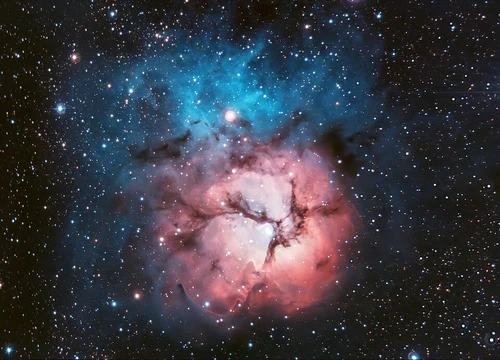
Abell 63
Planetary nebula with an eclipsing binary central star.

Abell 63 is a planetary nebula in the northern constellation of Sagitta, notable for hosting an eclipsing binary central star system. Its central star, the variable star UU Sagittae, is an O-type subdwarf that has passed through the asymptotic giant branch stage, and the system's deep eclipses and close binary nature make it a key object for studying post-AGB evolution.
Quick Facts
- Epoch
- J2000
- Ra
- 19 · 42 · 10.290
- Dec
- +17 · 05 · 14.46
- Dist Ly
- 2700 ±
- Dist Pc
- 2,700200
- Constellation
- Sagitta
Facts from the source article.
Lore & Background
The star H.V. 5452 was found to be a candidate eclipsing binary system in 1932 by Dorrit Hoffleit, and it was given the variable star designation UU Sagittae (UU Sge). In 1955, George O. Abell discovered a nebula in the same region of the sky from photographic plates taken by the National Geographic Society – Palomar Observatory Sky Survey. The identifier 'Abell 63' comes from a follow-up publication by Abell in 1966, which identified the nebula as a homogeneous disk 40″ in diameter with a central star of magnitude 14.67. In 1976, Howard E. Bond noted that the positions of the variable star and the center of the nebula coincide. That same year, J. S. Miller and associates confirmed that UU Sge is an eclipsing binary, finding a period of 11h 09.6m with an eclipse duration of 70 minutes. The deep eclipse decreased the brightness of the pair by ~4.3 magnitudes.
The general shape of this nebula appears to be a hollow tube with a prominent hyperbolic-shaped waist. The bright central rim has faint extensions leading to end caps; the primary axis of the tube being aligned along a position angle of 34°. The overall profile has a 7:1 aspect ratio spanning an angular size of 290 × 42 arcseconds, with the ends at an equal angular distance from the center. The nebula is expanding with a velocity of 17±1 km/s. Surrounding the bright central rim is a faint circular shell, which may be the remnant of the stellar wind produced as the central star passed through the asymptotic giant branch.
The central system is a close detached binary with an orbital period of 11.2 hours. The length of the total eclipse of the primary component by the secondary is 13.4 minutes. They have a projected separation of at least 2.45 times the radius of the Sun. The primary is an O-type subdwarf star (sdO) that has passed through the asymptotic giant branch stage, during which it ejected the surrounding planetary nebula. It has 63% of the mass of the Sun and 35% of the Sun's radius, with an effective temperature of ~78,000 K. The secondary has the mass of an M-type main-sequence star, or 29% of the mass of the Sun. However, the effective temperature of 6,136 K is much higher than expected for an M dwarf, and the radius of 56% of the Sun is too large. This is because the point on the secondary facing the primary is being heated by its much hotter companion. The hot primary is also providing the illumination of the surrounding nebula.
Reader's Guide
Abell 63 is significant as one of the few planetary nebulae known to contain an eclipsing binary central star, providing a rare opportunity to directly measure stellar parameters of the post-AGB primary and its companion. The discovery history spans from the 1932 identification of the variable star UU Sagittae by Dorrit Hoffleit to the 1976 confirmation of its binary nature by J. S. Miller and associates. The nebula's morphology—a hollow tube with a hyperbolic waist and faint end caps—along with its 7:1 aspect ratio and expanding shell, offers insights into the shaping mechanisms of planetary nebulae from binary interactions. The central binary's parameters, including the primary's mass (0.63 solar masses), radius (0.35 solar radii), and high temperature (~78,000 K), alongside the irradiated secondary, are directly constrained by the eclipses. The faint circular shell surrounding the bright rim may trace the remnant of the asymptotic giant branch wind. The system's legacy lies in its use as a benchmark for understanding close binary evolution, nebular shaping, and the heating effects of hot subdwarfs on cool companions.
Did You Know?
- The central star of Abell 63 is an eclipsing binary system designated UU Sagittae.
- The nebula has a hollow tube shape with a hyperbolic waist and a 7:1 aspect ratio.
- The primary star is an O-type subdwarf with an effective temperature of about 78,000 K.
- The secondary star's temperature of 6,136 K is much higher than expected for an M dwarf due to heating by the primary.
More in Planetary Nebulae, Part 2 1-24
Spotted an error? Know more?
Reader corrections go straight into our review queue. Suggest an edit · How this site is sourced