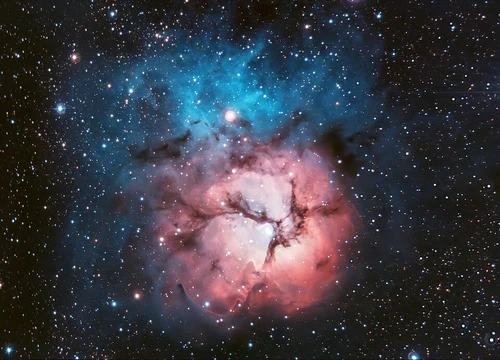
Abell 48
A heavily reddened planetary nebula with a rare [WN4] central star.

Abell 48 is a planetary nebula in the constellation Aquila, probably situated about 14,000 light-years from Earth. Its central star is a rare WN-type Wolf-Rayet star, classified as [WN4], and was originally mistaken for a genuine Wolf-Rayet star, earning the designation WR 120–6. The nebula itself consists of two rings around the star and appears very dim due to heavy reddening, with an E(B-V) of 2.14 and a visual extinction of 6.634 magnitudes.
If the distance is taken as 1.9 kiloparsecs (roughly 6,200 light-years), the nebula would measure about 0.38 parsecs (1.24 light-years) across and be around 6,500 years old. The central star, which began with a mass of roughly three times that of the Sun, would have left the asymptotic giant branch about 9,000 years ago. It would be approximately 5,500 times more luminous than the Sun, with a surface temperature near 70,000 Kelvin and a radius just under half the Sun’s. However, these figures may be somewhat off, as Gaia suggests a distance about 67% larger than the one used in that study.
- Distance
- likely around 14,000 light years
- Constellation
- Aquila
- Central star type
- [WN4]-type Wolf-Rayet star
- Alternative name
- WR 120–6
- E(b-v)
- 2.14
- Visual extinction
- 6.634 magnitudes
- Nebula structure
- two rings surrounding the central star
Lore & Background
Abell 48 is a planetary nebula likely located around 14,000 light years away in the constellation of Aquila. Its central star is a rare [WN4]-type Wolf-Rayet star, which was once thought to be a bona-fide Wolf-Rayet star and received the name WR 120–6. The nebula itself is made up of two rings surrounding the central star and is heavily reddened, with an E(B-V) value of 2.14 and a visual extinction of 6.634 magnitudes, which is why it appears so dim.
Reader's Guide
Assuming a distance of 1.9 kiloparsecs (about 6,200 light years), the nebula would have a diameter of 0.38 parsecs (~1.24 light years) and would be about 6,500 years old. The central star, with an initial mass of approximately 3 solar masses, would have left the asymptotic giant branch (AGB) approximately 9,000 years ago. The central star of this nebula would be about 5,500 times brighter than the Sun, with a surface temperature of around 70,000 Kelvins and a size just under half that of the Sun. However, these properties may be slightly inaccurate given the different distance suggested by Gaia, which is about 67% larger than the one used in the study to derive the aforementioned properties. The nebula's significance lies in its rare central star type and the uncertainty introduced by the Gaia distance measurement, which challenges the derived physical parameters.
Did You Know?
- Abell 48 is located in the constellation of Aquila.
- Its central star is a [WN4]-type Wolf-Rayet star, once designated WR 120–6.
- The nebula has a visual extinction of 6.634 magnitudes due to heavy reddening.
- Gaia suggests a distance about 67% larger than the 1.9 kiloparsecs used in one study.
More in Planetary Nebulae, Part 2 1-24
Spotted an error? Know more?
Reader corrections go straight into our review queue. Suggest an edit · How this site is sourced