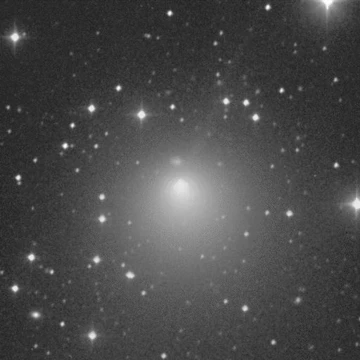
97P/Metcalf–Brewington
Lost comet rediscovered after 85 years via orbital matching.

97P/Metcalf–Brewington is a Jupiter-family comet first spotted by Joel H. Metcalf in 1906, then lost for decades. Howard J. Brewington rediscovered it in 1991, and once its orbit was recalculated, the comet was seen again during its perihelion returns in 2001, 2011, and 2022.
Metcalf found the comet on photographic plates taken November 15, 1906, shining at magnitude 12 in the constellation Eridanus. A close pass by Jupiter in September 1911—at about 0.86 AU (129 million km)—altered its orbit, forcing astronomers to revise predictions for the 1914 and 1922 returns. Henrietta Swan Leavitt thought she might have recovered it in 1915, but her two images turned out to be the asteroid 393 Lampetia instead. After the last confirmed sighting on January 16, 1907, and calculations showing unfavorable viewing conditions through 1975, the comet was declared lost in 1922.
For decades, its expected brightness never exceeded magnitude 18, and no one tried to find it. That changed on January 7, 1991, when Howard J. Brewington spotted a new comet in Cetus, confirmed that same night by Alan Hale. After additional observations by Katsuhito Ohtsuka and Robert H. McNaught from January 7 to 9, Brian G. Marsden noticed the orbit closely matched Metcalf’s 1906 comet, confirming they were the same object. It turned out the earlier calculations for the 1914 and 1922 returns were off by a few days and a couple of months, respectively, explaining why the comet had been missed.
Analysis of its light curve during the 1991 apparition showed a massive outburst that brightened the comet by 11 magnitudes—a factor of 25,000. The likely cause was thermal stress on an exposed pocket of hydrogen cyanide (HCN) ice, which cracked the nucleus’s crust near perihelion.
After rediscovery, revised orbital calculations revealed a close Jupiter encounter in March 1993 at just 0.11 AU (16 million km), and the comet was predicted to return around 2000 or 2001. In October 2021, another outburst ejected material out to 19,400 km (12,100 mi) from the nucleus, temporarily raising its apparent magnitude from 18 to 16.
Quick Facts
- Discoverer
- Joel H. Metcalf / Howard J. Brewington
- Discovery Site
- Taunton, Massachusetts / Cloudcroft, New Mexico
- Discovery Date
- 10 October 1906 / 7 January 1991
- Mpc Name
- P/1906 V2, P/1991 A1
- Designations
- 1906 VI, 1991 I · 1906h, 1991a
- Orbit Ref
- jpldata · MPC
- Epoch
- 31 March 2024 (JD 2460400.5)
- Obs
- 607
- Perihelion
- 2.572 AU
- Aphelion
- 6.960 AU
- Semimajor
- 4.766 AU
- Eccentricity
- 0.4593
Facts from the source article.
Lore & Background
On photographic plates taken on 15 November 1906, Joel H. Metcalf discovered the comet as a 12th-magnitude object within the constellation Eridanus. The comet passed about 0.86 AU from Jupiter in September 1911, perturbing its orbit enough for astronomers to revise calculations for the 1914 and 1922 apparitions. Henrietta Swan Leavitt reported a possible recovery in 1915, but the images were later confirmed to be of 393 Lampetia. The comet was never found after its last reported observation on 16 January 1907, and after orbital calculations showed unfavorable viewing conditions until 1975, it was declared lost after 1922.
On 7 January 1991, Howard J. Brewington discovered a new comet within the constellation Cetus, verified by Alan Hale that same night. Following additional observations by Katsuhito Ohtsuka and Robert H. McNaught, Brian G. Marsden noted the orbit strongly resembled that of Metcalf's comet in 1906, concluding they are the same object. It was later determined that previous calculations for the 1914 and 1922 apparitions were off by a few days and a couple months respectively, causing the failure of recovery. Analysis of its light-curve revealed a massive outburst in 1991 that brightened the comet by 11 magnitudes, possibly caused by thermal stresses on an exposed ice pocket rich in hydrogen cyanide gas.
Revised orbital calculations showed the comet made a close encounter with Jupiter at 0.11 AU in March 1993, and it was predicted to return by 2000 or 2001. In October 2021, the comet experienced an outburst that expelled material out to 19,400 km from its nucleus, temporarily raising its apparent magnitude from 18 to 16.
Reader's Guide
The significance of 97P/Metcalf–Brewington lies in its dramatic rediscovery story and the insights it provides into cometary outbursts. Originally discovered in 1906 and lost for decades due to orbital perturbations from Jupiter and calculation errors, its recovery in 1991 by an amateur astronomer demonstrated the value of matching historical and modern observations. The comet's 1991 outburst, which brightened it by a factor of 25,000, was attributed to thermal stresses on an exposed ice pocket rich in hydrogen cyanide, offering a rare glimpse into the volatile processes on cometary nuclei. Its close Jupiter encounter in 1993 at only 0.11 AU further highlights the dynamic nature of Jupiter-family comets. The 2021 outburst, which expelled material over 19,000 km, shows that such activity continues, making it a valuable object for studying cometary evolution and outburst mechanisms. The comet's legacy is also tied to the collaborative efforts of professional and amateur astronomers in its recovery and ongoing observation.
Did You Know?
- The comet was originally discovered by Joel H. Metcalf on 15 November 1906 as a 12th-magnitude object in Eridanus.
- In 1991, the comet experienced an outburst that brightened it by 11 magnitudes, possibly due to thermal stresses on an exposed hydrogen cyanide ice pocket.
- In October 2021, an outburst expelled material out to 19,400 km from the nucleus, temporarily raising its magnitude from 18 to 16.
More in Periodic Comets, Part 2 1-24
Spotted an error? Know more?
Reader corrections go straight into our review queue. Suggest an edit · How this site is sourced