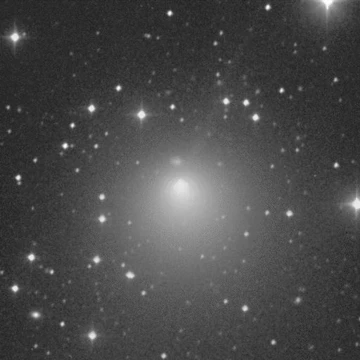
104P/Kowal
Jupiter-family comet discovered in 1979 with a history of outbursts.

104P/Kowal, also called Kowal 2, is a periodic comet from the Jupiter family. It was first spotted by Charles T. Kowal in 1979, and its orbit was confirmed following additional observations in 1991 and 1998. The comet is known for a major outburst in 1973, when it reached an apparent magnitude of 9.5, as noted by Leo Boethin—though this event was only linked to 104P/Kowal in 2003 by Gary Kronk and Brian Marsden. During its 1997–98 apparition, the comet was brighter than expected, reaching magnitude 13 in mid-January. It was not observed during the 2010 apparition. In 2022, it brightened to magnitude 9.2, as reported by Chris Wyatt. By July 2027, the comet is expected to be around magnitude 14, and at its perihelion on 12 October 2027, it should reach magnitude 11 with a solar elongation of 66 degrees, making it visible through small telescopes.
The comet’s orbit has changed significantly due to close encounters with Jupiter. Initially, it had a perihelion distance of 1.50 AU and an orbital period of 6.38 years. An approach to Jupiter on 15 January 1996 reduced these to 1.40 AU and 6.18 years. A closer encounter on 4 July 2007 (at 0.300 AU) further reduced the perihelion to 1.18 AU and the period to 5.90 years. Another approach on 30 May 2019 brought the perihelion down to 1.07 AU and the period to 5.74 years.
Quick Facts
- Discovery Ref
- IAUC_3321
- Discoverer
- Charles T. Kowal
- Discovery Date
- 13 January 1979
- Mpc Name
- P/1979 B1, P/1991 X1
- Designations
- Kowal 2 · 1979 II, 1991 XX · 1979a, 1991f1
- Epoch
- 2025-11-21
- Orbit Ref
- jpldata · MPC
- Earliest Precovery Date
- 11 January 1973IAUC_8255
- Obs
- 2,241
- Aphelion
- 5.345 AU
- Perihelion
- 1.072 AU
- Semimajor
- 3.209 AU
Facts from the source article.
Lore & Background
The observational history of 104P/Kowal includes a pre-discovery detection: in 2003, Gary Kronk and Brian Marsden noticed that an object observed by Leo Boethin in 1973 was actually 104P/Kowal. From Boethin's report, it was apparent that comet Kowal 2 had been in a short, major outburst to apparent magnitude 9.5 in 1973. During the 1997–98 apparition, the comet was brighter than expected, reaching an apparent magnitude of 13 in mid January. The comet was not observed during the 2010 apparition. During the 2022 apparition, it brightened to a magnitude of 9.2 according to Chris Wyatt.
The comet's orbit has been significantly altered by close approaches to Jupiter. Initially, it had a perihelion distance of 1.50 AU and an orbital period of 6.38 years. An approach to Jupiter on 15 January 1996 reduced both to 1.40 AU and 6.18 years. A further encounter with Jupiter on 4 July 2007 at a distance of 0.300 AU reduced the perihelion distance to 1.18 AU and the orbital period to 5.90 years. One more close approach to Jupiter on 30 May 2019 reduced the perihelion distance to 1.07 AU and orbital period to 5.74 years.
Reader's Guide
104P/Kowal is significant as a Jupiter-family comet whose orbit has been repeatedly altered by close encounters with Jupiter, providing a clear example of how gravitational interactions can reshape a comet's trajectory and visibility. Its pre-discovery observation in 1973, identified years later by Gary Kronk and Brian Marsden, highlights the value of archival data in linking historical sightings to known comets. The comet's outbursts—reaching magnitude 9.5 in 1973 and magnitude 9.2 in 2022—demonstrate its potential for sudden brightening, making it a target for amateur astronomers. The 2027 apparition, with a predicted magnitude of about 11 at perihelion on 12 October 2027 and a solar elongation of 66 degrees, should be observable with small telescopes. The comet's legacy lies in its well-documented orbital evolution and its history of unexpected brightness changes, which contribute to understanding the behavior of short-period comets.
Did You Know?
- 104P/Kowal was discovered by Charles T. Kowal in 1979.
- The comet was observed in a major outburst to magnitude 9.5 in 1973, years before its official discovery.
- Its orbital period has been reduced from 6.38 years to 5.74 years due to three close approaches to Jupiter.
- During the 2022 apparition, it brightened to magnitude 9.2 according to Chris Wyatt.
Frequently Asked Questions
Who discovered 104P/Kowal and when?
Astronomer Charles T. Kowal first detected this Jupiter-family comet in 1979, which is why it carries the nickname 'Kowal 2.' Its periodic nature was confirmed later through additional sightings in 1991 and 1998.
What is 104P/Kowal's current orbital period and perihelion?
After a gravitational encounter with Jupiter in 2019, the comet settled into a roughly 5.74-year orbit with a perihelion distance of about 1.07 AU.
What was the famous 1973 outburst of 104P/Kowal?
The comet flared to an apparent magnitude of 9.5 in 1973, a brightness Leo Boethin recorded at the time. It was not until 2003 that Gary Kronk and Brian Marsden linked that bright event to this specific comet.
Why did 104P/Kowal's orbit change in 2019?
A close pass by Jupiter in 2019 gravitationally perturbed the comet, shortening its orbital period to approximately 5.74 years and shifting its closest solar approach to 1.07 AU.
When is 104P/Kowal next expected to be visible?
The comet should reach perihelion in 2027, where it is projected to glow at roughly magnitude 11 with a solar elongation of about 66 degrees, making it a demanding but possible target for modest telescopes.
More in Periodic Comets, Part 2 1-24
Spotted an error? Know more?
Reader corrections go straight into our review queue. Suggest an edit · How this site is sourced