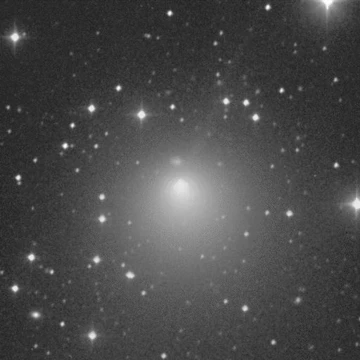
440P/Kobayashi
First amateur CCD comet discovery, 25-year orbit.

440P/Kobayashi is a periodic comet that orbits the Sun once every 25 years. It was first spotted by Japanese amateur astronomer Takao Kobayashi on January 30, 1997. This discovery marked a milestone: it was the first time an amateur astronomer had found a comet using a CCD camera, and at the time, it was also the faintest comet ever discovered by an amateur.
Kobayashi initially observed an object, designated P/1997 B1, and reported it to the IAU as a possible minor planet through S. Nakano. Within days, further observations showed it was following a cometary orbit, and W. Offutt confirmed it as a comet. This achievement highlights that amateur astronomers continue to make significant contributions to discovering astronomical objects.
The comet was recovered on January 11, 2022, by the Purple Mountain Observatory. It had also been captured in earlier images: Kitt Peak-Bok spotted it on November 29, 2021, and Pan-STARRS recorded it in November 2021 and January 2022. In those later images, the comet showed a highly condensed coma and a tail about two arcseconds long. It received the provisional designation P/2021 W2. The last observation used was from February 22, 2022. Its most recent perihelion occurred in 2022, and its next will be in 2047.
Quick Facts
- Discoverer
- Takao Kobayashi
- Discovery Date
- January 30, 1997
- Epoch
- November 21, 2025 / (2461000.5)
- Semimajor
- 8.588 AU
- Perihelion
- 2.051 AU
- Aphelion
- 15.11 AU
- Eccentricity
- 0.761
- Period
- 25.14 yr
- Inclination
- 12.35°
- Last P
- March 29, 2022 / March 2, 1997
- Next P
- June 5, 2047Horizons2047 · Yoshida
Facts from the source article.
Lore & Background
On January 30 and 31, 1997, Takao Kobayashi observed an object, initially thought to be a minor planet and reported to the IAU as such by S. Nakano. Over the next few days, the object was observed to be in a cometary orbit, and W. Offutt later showed it to be a comet. The comet was recovered on January 11, 2022, by the Purple Mountain Observatory. It was also spotted in images by Kitt Peak-Bok from November 29, 2021, and Pan STARRS from November 2021 and January 2022. In the latter, the comet exhibited a very condensed coma and a tail measuring two arcseconds in length. Its last observation used was on February 22, 2022.
Reader's Guide
The discovery of 440P/Kobayashi demonstrates that amateur astronomers still have an important role to play in the field of astronomical object discovery. For discovery of a comet with CCD, as well as the faintest discovery, Kobayashi ranks the first among amateur astronomers. The comet's recovery in 2022 by the Purple Mountain Observatory, and its earlier detection by Kitt Peak-Bok and Pan STARRS, highlight the ongoing collaboration between amateur and professional astronomers. Its 25-year orbital period and the fact that it was the first amateur CCD comet discovery underscore its significance in the history of cometary astronomy.
Did You Know?
- 440P/Kobayashi was the first comet discovered by an amateur astronomer using a CCD.
- It was initially reported as a minor planet by S. Nakano before being identified as a comet.
Frequently Asked Questions
Who discovered 440P/Kobayashi and when?
Japanese amateur astronomer Takao Kobayashi first observed the comet on January 30, 1997. He reported the object through S. Nakano to the IAU, initially flagging it as a possible minor planet before its cometary orbit was confirmed.
What makes 440P/Kobayashi's discovery historically significant?
It was the first comet ever found by an amateur astronomer using a CCD camera, a milestone for observational astronomy. At the time, it was also the faintest comet ever detected by an amateur observer.
How long is 440P/Kobayashi's orbital period?
The comet completes one full revolution around the Sun roughly every 25 years. Its most recent perihelion passage came in 2022, and the next is expected around 2047.
What provisional designations has 440P/Kobayashi carried?
At its 1997 discovery it was catalogued as P/1997 B1, and when it was picked up ahead of its 2022 return it went by P/2021 W2. Both provisional labels preceded its permanent 440P designation.
How was 440P/Kobayashi initially misidentified?
Kobayashi first submitted the object as a potential minor planet to the IAU via S. Nakano. Within days, follow-up observations revealed a distinctly cometary orbit, and W. Offutt confirmed its true cometary nature.
More in Periodic Comets, Part 2 1-24
Spotted an error? Know more?
Reader corrections go straight into our review queue. Suggest an edit · How this site is sourced