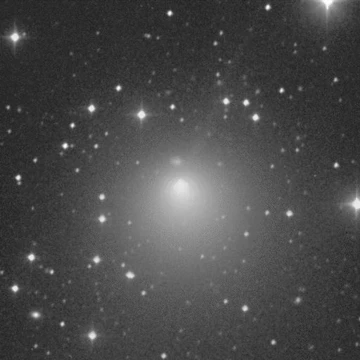
308P/Lagerkvist–Carsenty
Distant Jupiter-family comet with a 17-year orbit.

308P/Lagerkvist–Carsenty is a Jupiter-family comet that orbits the Sun at a considerable distance, taking about 17 years to complete one revolution. It was jointly discovered by European astronomers Claes-Ingvar Lagerkvist and Uri Carsenty.
The object was first spotted on photographic plates from a survey conducted by the Uppsala Astronomical Observatory and the European Southern Observatory on the night of 5 October 1997. Initially appearing as a faint, asteroid-like point of light in Pisces at magnitude 19, it was thought to be a Jupiter trojan. However, further orbital calculations showed it was not bound to Jupiter but instead followed a centaur-like path reaching as far out as Saturn's distance from the Sun. The comet showed very little cometary activity during this apparition. On 29 July 2014, Erwin Schwab and colleagues at the Tenerife Observatory recovered it during its second apparition, again exhibiting minimal cometary activity.
The comet's current orbit has a perihelion of 4.2 AU and an aphelion of 9.01 AU, placing it between the orbits of Jupiter and Saturn. Orbital reconstructions by the discoverers in 2000 revealed a close encounter with Saturn on 12 October 1954, when it passed within 0.0104 AU of the giant planet. This interaction transformed the former centaur into its present-day Jupiter-family comet orbit. The comet is predicted to make two close approaches to Jupiter, one by 2085 and another by 2188.
Initially classified as an asteroid, the object lacked a formal name. In January 1998, the IAU named it Lagerkvist–Carsenty after the two discoverers, who had recognized its cometary nature before the discovery was announced. The comet received its permanent numerical designation, 308P, in January 2017.
Quick Facts
- Discovery Ref
- IAUC_6754
- Discoverer
- Claes-Ingvar Lagerkvist / Uri Carsenty
- Discovery Site
- European Southern Observatory
- Discovery Date
- 5 October 1997
- Designations
- PJ97T030
- Orbit Ref
- jpldata · MPC
- Epoch
- 21 January 2022 (JD 2459600.5)
- Observation Arc
- 18.50 years
- Earliest Precovery Date
- 1 October 1997
- Obs
- 375
- Perihelion
- 4.199 AU
- Aphelion
- 9.005 AU
Facts from the source article.
Lore & Background
The comet was discovered as an asteroid-like object from photographic plates taken during a joint astronomical survey between the Uppsala Astronomical Observatory and the European Southern Observatory on the night of 5 October 1997. At the time, the comet formerly known as P/1997 T3, was a 19th-magnitude object within the constellation Pisces. It was initially thought to be a Jupiter trojan with no apparent activity, until further orbital calculations had shown it was not gravitationally bound to Jupiter itself, but in a centaur-like orbit as far away as Saturn's distance to the Sun.
On 29 July 2014, Erwin Schwab and his colleagues at the Tenerife Observatory later recovered the comet on its second apparition as P/2014 O2, where like its 1997 apparition, it exhibited very little cometary activity. Orbital reconstructions in 2000 by the discoverers themselves had revealed that the comet made a close encounter with Saturn on 12 October 1954, where it approached the giant planet at a distance of 0.0104 AU (1.56 million km). The encounter had turned the orbit of the former centaur into that of a Jupiter-family comet in the present day.
The comet initially did not have a formal name since it was thought to be an asteroid upon discovery. However, by January 1998, the International Astronomical Union (IAU) had decided to rename P/1997 T3 as Lagerkvist–Carsenty, after the two discoverers who recognized its cometary nature before its discovery was announced. The comet received its official numerical designation, 308P, in January 2017.
Reader's Guide
308P/Lagerkvist–Carsenty is significant as a Jupiter-family comet that originated as a centaur before a close encounter with Saturn in 1954 altered its orbit. Its discovery as an asteroid-like object with no apparent activity highlights the difficulty in distinguishing comets from asteroids at large distances. The comet's recovery in 2014 by Erwin Schwab and colleagues confirmed its low activity persists. The naming by the IAU in January 1998 honors the discoverers who recognized its cometary nature. The comet's orbit, with perihelion at 4.2 AU and aphelion at 9.01 AU, places it between Jupiter and Saturn, and it will make two close encounters with Jupiter by 2085 and 2188. Its legacy includes serving as an example of a former centaur transitioning to a short-period comet, similar to 450P/LONEOS.
Discovery and Confirmation of a Hidden Comet
In the winter of 2003, Brian A. Skiff was running routine CCD imaging for the Lowell Observatory Near-Earth-Object Search when an 18th-magnitude smudge caught his eye. On the plates it looked no different from a background star, yet its slight displacement between exposures was enough to trigger a request for follow-up. H. R. Miller at Perkins Observatory and J. Young at Table Mountain Observatory soon resolved the object and reported a faint coma roughly four arcseconds across, accompanied by a wispy tail stretching about ten arcseconds. That confirmation of cometary activity came while the body was already sitting at roughly 5.54 AU from the Sun, a distance where most comets are expected to be dormant. The Minor Planet Center published the first orbital elements on 13 January 2004, and precovery frames from Kitt Peak pushed the detection window back to mid-December 2003. The find added another name to LONEOS's growing list of comets identified through systematic sky surveys rather than visual serendipity.
A Saturn Flyby That Rewrote the Orbit
The comet's present 22-year period is not its original one. Orbital back-integration points to a dramatic gravitational encounter with Saturn in 1992, when the small body passed within just 0.031 AU—about 4.6 million kilometers—of the ringed giant. That close passage shaved a staggering 5.2 AU, or roughly 780 million kilometers, off the semimajor axis, yanking the object into a tighter solar orbit. Long-term numerical work suggests this was the comet's very first foray into the inner Solar System, marking its transition from a centaur-type body wandering the outer regions into what is now classified as a Jupiter-family comet. Its current trajectory is inclined about 10.65 degrees to the ecliptic, with perihelion near 5.45 AU and aphelion reaching 10.44 AU. The story is not finished: on 11 July 2026 the comet will swing past Jupiter at a distance of 0.5 AU, an encounter expected to compress its orbit even further and shorten its period once again.
Reading the Nucleus Through Dust and Gas
Pinpointing the true size of a distant, faintly active comet is notoriously difficult, and 450P/LONEOS proved no exception. A 2011 analysis of its dust output placed the nucleus radius somewhere between 0.5 and 3.5 kilometers—a wide range that reflected the uncertainty inherent in extrapolating from a single apparition. The comet then entered a quiet, inactive phase lasting from 2019 through 2024, during which both the Gemini Observatory and the James Webb Space Telescope captured thermal and reflected-light data. Those observations narrowed the estimate to approximately 1.8 ± 0.5 km, a far more constrained figure. During its 2004 apparition the nucleus produced an asymmetrical coma and a solar-directed anti-tail that stretched up to 150,000 km. By 2022, however, dust production had dropped to roughly 4.8 kilograms per second, a rate attributed primarily to carbon dioxide outgassing triggered when amorphous water ice crystallized at temperatures in the 140-to-160-kelvin range.
Recovery, Designation, and What Comes Next
After nearly two decades of silence, the comet was successfully tracked again in August 2022 using the Gemini North Observatory. Astronomers noted a notable discrepancy: the object was arriving about 4.5 magnitudes fainter than models had predicted, a reminder that long-period comets can behave in ways that challenge even refined activity models. The recovery confirmed the return predicted by its 22-year period and earned the body its second provisional label, P/2022 Q3, complementing the original P/2004 A1. In February 2023 the Minor Planet Center granted it the permanent numerical designation 450P, bestowed in the same batch as eight other comets that had completed their first full orbits. With the 2026 Jupiter encounter now on the calendar, observers will be watching closely to see how the orbit tightens and whether the already modest dust output changes character as the comet settles into an even shorter period around the Sun.
Frequently Asked Questions
Who discovered 308P/Lagerkvist–Carsenty and when?
European astronomers Claes-Ingvar Lagerkvist and Uri Carsenty jointly identified the comet on 5 October 1997. It was picked up on photographic plates from a survey run by the Uppsala Astronomical Observatory and the European Southern Observatory.
What kind of comet is 308P/Lagerkvist–Carsenty?
It is classified as a Jupiter-family comet with a roughly 17-year orbital period. Its orbit stretches from about 4.2 AU at perihelion out to roughly 9.01 AU at aphelion, making it one of the more distant members of that family.
How was 308P/Lagerkvist–Carsenty first spotted?
It appeared as a faint, asteroid-like smudge at magnitude 19 in the constellation Pisces on a night of 5 October 1997. At first glance it was mistaken for a Jupiter trojan, but follow-up orbital calculations revealed it was actually a long-period comet.
What is 308P/Lagerkvist–Carsenty's numerical designation?
Its official numerical designation is 308P, reflecting its status as the 308th periodic comet catalogued. The 'P' simply marks it as a periodic object rather than a long-period or hyperbolic visitor.
Why is 308P/Lagerkvist–Carsenty interesting to comet fans?
It stands out because it was initially misidentified as a Jupiter trojan before its true cometary nature was confirmed through orbital work. Its relatively distant orbit and 17-year cycle also make it a useful reference point for studying the outer reaches of the Jupiter-family comet population.
More in Periodic Comets, Part 2 1-24
Spotted an error? Know more?
Reader corrections go straight into our review queue. Suggest an edit · How this site is sourced