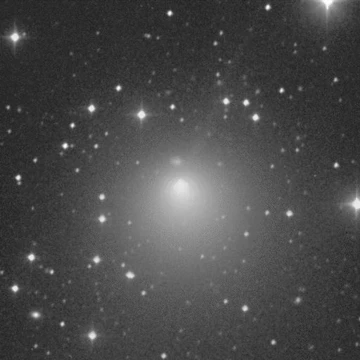
143P/Kowal–Mrkos
A periodic comet lost and later recovered.

143P/Kowal–Mrkos is a periodic comet orbiting the Sun. Its history involves an initial identification as an asteroid, later confirmation as a comet, a period of being lost, and eventual recovery.
The comet was first reported as an asteroid, designated 1984 JD, by Antonín Mrkos after he observed it as a 16th-magnitude object on the night of 2 May 1984. Later, in September 1984, Charles T. Kowal examined photographic plates from 23 April 1984 and described the object as almost star-like but with a faint coma. Brian G. Marsden quickly recognized that Kowal's object was the same as Mrkos's discovery, enabling him to calculate an elliptical orbit. This calculation allowed Mrkos to see faint cometary activity in his own images from 19 May. However, the comet was not observed after that date, was considered lost, and was redesignated D/1984 H1.
The comet was not seen during its predicted return in 1992. In 1997, Shuichi Nakano revised the orbital calculations, predicting a possible return by 2000. It was successfully recovered on 9 March 2000, when the LINEAR and LONEOS surveys detected an asteroid-like object with a comet-like orbit, designated 2000 ET90. Marsden noted that this object's orbit matched the predictions for Kowal–Mrkos.
Quick Facts
- Discovery Ref
- IAUC_3988
- Discoverer
- Charles T. Kowal / Antonín Mrkos
- Discovery Site
- Palomar Observatory / Klet' Observatory
- Discovery Date
- 2 May 1984
- Designations
- 1984 X, 1984n
- Orbit Ref
- jpldata · MPC
- Epoch
- 5 May 2025 (JD 2460800.5)
- Observation Arc
- 40.83 years
- Earliest Precovery Date
- 23 April 1984
- Obs
- 1,231
- Perihelion
- 2.942 AU
- Aphelion
- 6.618 AU
Facts from the source article.
Lore & Background
Antonín Mrkos first reported the discovery of this comet as an asteroid named 1984 JD, after spotting it as a 16th-magnitude object on the night of 2 May 1984. In September 1984, Charles T. Kowal analyzed photographic plates exposed on the night of 23 April 1984 and he noted the comet as almost stellar-like, with a faint but discernible coma. Brian G. Marsden immediately recognized that Kowal's object is identical to that of Mrkos' discovery, allowing him to calculate an elliptical orbit for the object, which allowed Mrkos to notice that he indeed captured faint cometary activity on images he took on 19 May. However, it was not observed beyond that date, and was initially considered lost, subsequently redesignated as D/1984 H1.
It was not observed during the comet's predicted apparition in 1992. Shuichi Nakano later revised his orbital calculations for the comet in 1997, which allowed him to predict that the comet may next return by 2000. It was successfully recovered on 9 March 2000, when LINEAR and LONEOS spotted an asteroid-like object with a comet-like orbit (2000 ET90), which Marsden noted matched those predicted for Kowal–Mrkos.
Reader's Guide
The significance of 143P/Kowal–Mrkos lies in its history of discovery, loss, and recovery, illustrating the challenges of tracking small Solar System bodies. Initially found as an asteroid by Mrkos and independently as a comet by Kowal, it was lost after its first apparition due to insufficient observations. The comet's recovery in 2000, facilitated by revised orbital calculations from Nakano and observations by LINEAR and LONEOS, demonstrates the importance of improved orbital modeling and survey programs. Its legacy includes serving as an example of how comets can be misidentified as asteroids and the collaborative effort required to confirm their nature. The comet's periodic return and eventual recovery highlight the persistence needed in cometary astronomy.
Did You Know?
- The comet was first reported as an asteroid named 1984 JD by Antonín Mrkos on 2 May 1984.
- Charles T. Kowal noted a faint coma on photographic plates from 23 April 1984.
- The comet was initially considered lost and redesignated D/1984 H1.
- It was recovered on 9 March 2000 by LINEAR and LONEOS as object 2000 ET90.
Frequently Asked Questions
What is 143P/Kowal–Mrkos?
It is a periodic comet that orbits the Sun, first catalogued as a faint asteroid-like body before its cometary nature was confirmed. It later went through a period of being lost and was eventually recovered.
Who discovered 143P/Kowal–Mrkos?
Antonín Mrkos first spotted it as a 16th-magnitude object on 2 May 1984, while Charles T. Kowal had already noted a faint coma on photographic plates from 23 April 1984. Brian G. Marsden was the one who recognized the two reports referred to the same object.
Why does 143P/Kowal–Mrkos carry two surnames?
Because two independent observers—Mrkos, who logged it as asteroid 1984 JD, and Kowal, who identified it as a comet—each had a claim to the discovery. The combined name honors both contributions to its identification.
Was 143P/Kowal–Mrkos ever lost?
Yes. After its initial detection it slipped out of view and was given the provisional lost-comet designation D/1984 H1. It was subsequently recovered and reclassified as the periodic comet 143P.
How was 143P/Kowal–Mrkos initially misidentified?
Mrkos recorded it as a minor planet (1984 JD) because it appeared as a mere point of light. Even Kowal's plate work described it as almost star-like with only a barely perceptible coma, so its true cometary identity was not immediately obvious.
More in Periodic Comets, Part 2 1-24
Spotted an error? Know more?
Reader corrections go straight into our review queue. Suggest an edit · How this site is sourced