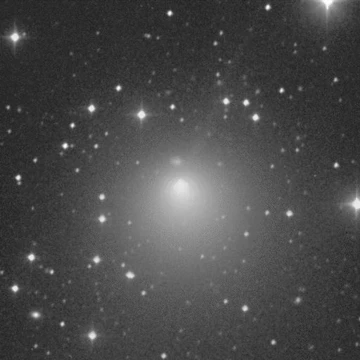
144P/Kushida
Jupiter-family comet discovered by Yoshio Kushida in January 1994.

144P/Kushida is a Jupiter-family comet first spotted by Japanese amateur astronomer Yoshio Kushida in January 1994. It marked the first comet find of that year and was Kushida’s second discovery in the span of a month. Its most recent perihelion occurred on 25 January 2024, when it reached a brightness of roughly magnitude 10.
Using observations from January 9–11, 1994, Syuichi Nakano calculated that the comet had passed perihelion on 5 December 1993 at a distance of 1.36 AU. The orbit’s low inclination to the ecliptic led Nakano to suspect it was a short-period comet. On 14 January 1994, Daniel W. E. Green confirmed this classification in IAU Circular 5922, publishing a short-period orbit based on 29 positions from January 9–13. Green’s solution gave a perihelion date of 12 December 1993, a perihelion distance of 1.37 AU, and an orbital period of 7.20 years. Later, Patrick Rocher refined the figures using more than 300 positions from January 7 to July 9, 1994, yielding a perihelion distance of 1.367 AU, a perihelion date of 12 December 1993.862, and an orbital period of 7.366 years.
Quick Facts
- Discoverer
- Yoshio Kushida
- Discovery Site
- Yatsugatake, Japan
- Discovery Date
- 8 January 1994
- Mpc Name
- P/1994 A1, P/2000 O2
- Designations
- 1993 XX, 1994a
- Orbit Ref
- jpldata · MPC
- Epoch
- 21 November 2025 (JD 2461000.5)
- Observation Arc
- 30.41 years
- Earliest Precovery Date
- 7 January 1994
- Obs
- 5,919
- Perihelion
- 1.399 AU
- Aphelion
- 6.269 AU
Facts from the source article.
Lore & Background
Discovered by Japanese amateur astronomer Yoshio Kushida in January 1994, 144P/Kushida was the first comet discovery of that year and Kushida's second discovery within a month. Based on data from January 9–11, 1994, Syuichi Nakano calculated the perihelion date as 1993 December 5.33 and the perihelion distance as 1.36 AU. The low inclination to the ecliptic suggested to Nakano that the comet could be a short period type. On January 14, 1994, Daniel W. E. Green confirmed Nakano's suggestion and published a short-period orbit on IAU Circular 5922, using 29 positions from January 9–13 to determine a perihelion date of 1993 December 12.99, a perihelion distance of 1.37 AU, and an orbital period of 7.20 years. Later, using over 300 positions obtained between January 7 and July 9, 1994, Patrick Rocher refined the calculations, determining the perihelion distance as 1.367 AU, the perihelion date as 1993 December 12.862, and the orbital period as 7.366 years.
Reader's Guide
144P/Kushida is notable as the first comet discovery of 1994 and as the second discovery within a month by amateur astronomer Yoshio Kushida. Its orbit was initially calculated by Syuichi Nakano, who noted its low inclination to the ecliptic as evidence of a short-period type. This was confirmed by Daniel W. E. Green, who published the first short-period orbit on IAU Circular 5922. The orbital parameters were later refined by Patrick Rocher using a much larger dataset of over 300 positions, yielding a perihelion distance of 1.367 AU and an orbital period of 7.366 years. The comet last came to perihelion on 25 January 2024, brightening to about magnitude 10. The entry also references 147P/Kushida–Muramatsu in the 'See also' section, indicating a connection to another comet discovered by Kushida.
Frequently Asked Questions
Who discovered 144P/Kushida and when?
Japanese amateur astronomer Yoshio Kushida first observed the comet in January 1994, making it his second comet find within a single month. It also carried the distinction of being the first new comet identified in 1994.
What type of comet is 144P/Kushida?
It is classified as a Jupiter-family comet with a low orbital inclination relative to the ecliptic plane. Its perihelion sits at roughly 1.37 AU, well inside Jupiter's orbit, which is typical for this family.
How bright did 144P/Kushida get at its most recent perihelion?
During its 25 January 2024 perihelion passage, the comet reached an apparent magnitude of about 10, placing it well below naked-eye visibility and requiring at least binoculars or a small telescope to spot.
What is 144P/Kushida's perihelion distance?
Refined orbital calculations place the perihelion at approximately 1.367 AU from the Sun. This relatively tight solar approach is consistent with its Jupiter-family classification and short orbital period.
Why is 144P/Kushida notable among periodic comets?
Beyond being the first comet found in 1994, it was Kushida's second discovery in just a month, showcasing the productivity of dedicated amateur observers. Its short-period, Jupiter-family orbit makes it a recurring target for sky surveys and follow-up observations.
More in Periodic Comets, Part 2 1-24
Spotted an error? Know more?
Reader corrections go straight into our review queue. Suggest an edit · How this site is sourced