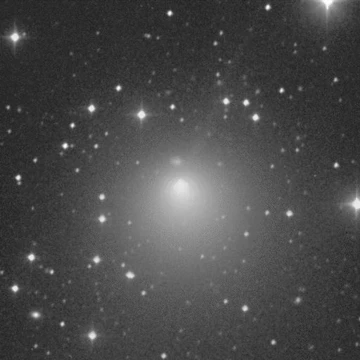
255P/Levy
Jupiter-family comet with disputed recovery and α Cepheids association.

255P/Levy is a Jupiter-family comet with an orbital period of 5.25 years. It was originally designated P/2006 T1 and later P/2011 Y1 before being numbered. The comet is notable for a disputed recovery in 2011, a subsequent confirmed recovery, and its association with the α Cepheids meteor shower.
Quick Facts
- Discovery Ref
- MPEC-2006-T21
- Discoverer
- David H. Levy
- Discovery Date
- 2 October 2006
- Mpc Name
- P/2006 T1 / P/2011 Y1
- Designations
- Levy 2,nasa-pds PK06T010
- Orbit Ref
- mpc
- Observation Arc
- 5,484 days (15 years)
- Obs
- 590
- Epoch
- 21 November 2025 (JD 2461000.5)
- Semimajor
- 2.94 AU
- Perihelion
- 0.847 AU
- Aphelion
- 5.04 AU
Facts from the source article.
Lore & Background
255P/Levy was first observed during its 2006 passage, when it reached an apparent magnitude of about 9.5. A recovery was believed to have occurred on 3 June 2011 at magnitude 19.8, but other observatories could not confirm it, and it was most likely a false positive due to large residuals. The comet was then successfully recovered on 17 December 2011 at magnitude 19.8, earning the second designation 2011 Y1, after which it was numbered.
The comet came to perihelion on 14 January 2012 at a distance of 1.007 AU from the Sun, and passed Earth on 26 January 2012 at a distance of 0.2359 AU. During the 2012 passage, the comet was originally expected to reach magnitude 7, but because it had been in outburst in 2006, it was much dimmer than expected. After the 2011 recovery, MPC estimates predicted a magnitude of 17 with an elongation of 90°, but CCD images on 30 December 2011 showed it was diffuse and estimated at magnitude 14.1. The comet was not observed during the 2017 or 2022 perihelion passages, and at opposition in August 2016 it would have been dimmer than magnitude 19.
The comet has a minimum orbit intersection distance with Earth of about 0.0088 AU (1.32 million km) and has been associated with the α Cepheids meteor shower, which peaks on 2 January.
Reader's Guide
255P/Levy is a Jupiter-family comet with a short orbital period of 5.25 years, making it a frequent visitor to the inner solar system. Its history includes a notable false-positive recovery in June 2011, which was later attributed to large residuals, followed by a confirmed recovery in December 2011 that allowed it to be numbered. The comet's 2006 passage was marked by an outburst that brightened it to magnitude ~9.5, but subsequent returns were much dimmer: the 2012 passage reached only magnitude 14.1 despite initial predictions of magnitude 7, and the comet was not observed at all during the 2017 and 2022 perihelions. Its next perihelion on 25 September 2027 is expected to produce only magnitude 20 brightness. The comet's close minimum orbit intersection distance with Earth (0.0088 AU) and its association with the α Cepheids meteor shower, which peaks on 2 January, link it to a potential meteor stream. The comet's legacy lies in its demonstration of the challenges of recovering faint periodic comets and the variability of cometary brightness, as well as its connection to a meteor shower.
Did You Know?
- 255P/Levy has an orbital period of 5.25 years.
- A recovery on 3 June 2011 was likely a false positive due to large residuals.
Frequently Asked Questions
What is 255P/Levy?
It is a Jupiter-family comet with an orbital period of about 5.25 years. Before earning its permanent number, it was catalogued under the provisional designations P/2006 T1 and P/2011 Y1.
What is the famous "disputed recovery" of 255P/Levy?
In 2011 an initial claim of having re-located the comet was challenged by other observers, leaving the identification in doubt. A second, widely accepted recovery was then confirmed on 17 December 2011, when the object was detected at magnitude 19.8.
Which meteor shower is 255P/Levy linked to?
The comet is associated with the α Cepheids meteor shower, meaning the dust and debris it sheds along its orbit are thought to be the parent material for that annual stream.
How bright was 255P/Levy when it was first spotted in 2006?
At discovery it reached an apparent magnitude of roughly 9.5, placing it within reach of modest amateur telescopes under dark skies.
When and how close to the Sun did 255P/Levy come in its 2012 perihelion passage?
It passed perihelion on 14 January 2012 at a distance of 1.007 AU, or about 150.6 million kilometres, from the Sun.
More in Periodic Comets, Part 2 1-24
Spotted an error? Know more?
Reader corrections go straight into our review queue. Suggest an edit · How this site is sourced