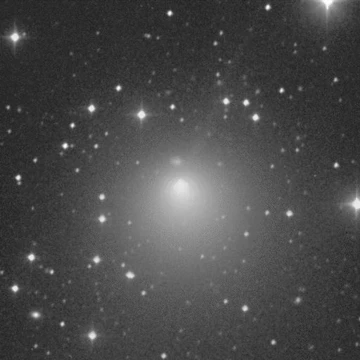
88P/Howell
Jupiter-family comet discovered by Ellen Howell in 1981.

88P/Howell is a Jupiter-family comet that orbits the Sun once every 5.5 years. It holds the distinction of being the only comet discovered independently by American astronomer Ellen Howell.
American astronomer Ellen Howell first spotted the comet on 29 August 1981. Before its next return, Alan C. Gilmore and Pamela M. Kilmartin recovered it on 6 March 1987, when it appeared as a faint, diffuse object of 18th magnitude. During its 2009 pass, it brightened to about magnitude 8.
The comet’s most recent perihelion occurred on 18 March 2026. Its next perihelion is due on 8 September 2031, and just six days later, on 14 September 2031, it will fly within 0.074 AU (about 11.1 million km) of Mars. Between 2000 and 2050, its closest approach to Earth will happen in June 2042, at a distance of 0.76 AU (roughly 114 million km). In 2020, the comet reached about magnitude 9, and during its 2026 apparition it peaked near magnitude 10. On 19 May 2026, it crossed the celestial equator, becoming more visible from the Northern Hemisphere at magnitude 11.
As of 2026, 88P/Howell travels between 1.36 and 4.86 AU from the Sun. Brian G. Marsden first calculated two orbital solutions on 8 September 1981, finding a period of about 5.94 years. Before its discovery, the comet had a wider orbit until a close encounter with Jupiter—passing 0.58 AU from the giant planet—shrunk it. On 14 September 2031, it will also pass 0.073 AU from Mars.
Initial estimates placed the comet’s nucleus at roughly 4.4 km in diameter, but infrared observations by the Spitzer Space Telescope in 2006 indicated a smaller size of about 1.92 km.
In response to NASA’s New Frontiers program call for Mission 4, the Applied Physics Laboratory proposed a sample-return mission called CORSAIR (Comet Rendezvous, Sample Acquisition, Investigation, and Return) targeting 88P/Howell. The plan involved a harpoon-based sampling system while the spacecraft hovered a few meters above the surface. In 2019, CORSAIR was not selected; instead, the Dragonfly mission to Titan was chosen. In 2026, 88P/Howell was selected as a backup target for another proposed NASA/JPL sample-return mission, Gelato, which could launch and rendezvous with the comet by 2030 and 2038 respectively if its primary target, 67P/Churyumov–Gerasimenko, becomes unreachable.
Quick Facts
- Discovery Ref
- IAUC_3631
- Discoverer
- Ellen S. Howell
- Discovery Site
- Palomar Observatory
- Discovery Date
- 29 August 1981
- Mpc Name
- P/1981 Q1, P/1987 E1
- Orbit Ref
- jpldata · MPC
- Epoch
- 9 June 2026 (JD 2461200.5)
- Earliest Precovery Date
- 22 May 1955
- Obs
- 5,478
- Perihelion
- 1.358 AU
- Aphelion
- 4.860 AU
- Semimajor
- 3.109 AU
Facts from the source article.
Lore & Background
88P/Howell was discovered on 29 August 1981 by American astronomer Ellen Howell. Alan C. Gilmore and Pamela M. Kilmartin recovered the comet ahead of its next apparition on 6 March 1987 as a diffuse 18th-magnitude object. During the 2009 apparition the comet became as bright as apparent magnitude 8. The comet most recently came to perihelion on 18 March 2026. It will next come to perihelion on 8 September 2031 and on 14 September 2031 it will pass 0.074 AU from Mars. Between 2000–2050 the closest approach to Earth will be 0.76 AU in June 2042. During the 2020 apparition the comet reached about magnitude 9, and during the 2026 apparition it reached about magnitude 10. It crossed the Celestial equator on 19 May 2026 becoming more visible from the Northern hemisphere at magnitude 11. As of 2026, its orbit takes it between 1.36–4.86 AU from the Sun. Brian G. Marsden first computed two orbital solutions on 8 September 1981, determining a period of 5.94 years. Prior to discovery, the comet had a larger orbit until a close encounter with Jupiter reduced it after passing at a distance of 0.58 AU from Jupiter. Initial estimates of its nucleus size placed it at about 4.4 km in diameter, but infrared observations from the Spitzer Space Telescope in 2006 reveal a smaller nucleus of only about 1.92 km.
Reader's Guide
88P/Howell holds significance as the only comet independently discovered by Ellen Howell, and as a target for proposed sample-return missions. In response to the New Frontiers program call for Mission 4, a team from Applied Physics Laboratory submitted a mission concept called CORSAIR (Comet Rendezvous, Sample Acquisition, Investigation, and Return) that would perform a sample return from 88P/Howell using a harpoon-based acquisition system while the spacecraft hovers above the surface. In 2019, CORSAIR was not selected in favor of the Dragonfly mission to Titan. In 2026, 88P/Howell was selected as a backup target for another proposed NASA/JPL sample-return mission called Gelato, which could launch and rendezvous to the comet by 2030 and 2038 respectively if its primary target, 67P/Churyumov–Gerasimenko, is unreachable. The comet's upcoming close approach to Mars in 2031 (0.074 AU) also makes it a scientifically interesting object for potential future study.
Did You Know?
- 88P/Howell is the only comet independently discovered by American astronomer Ellen Howell.
- Brian G. Marsden computed the first two orbital solutions for the comet on 8 September 1981.
- The Spitzer Space Telescope in 2006 revealed a nucleus diameter of only 1.92 km, smaller than initial estimates of 4.4 km.
- On 14 September 2031, 88P/Howell will pass 0.073 AU from Mars.
Frequently Asked Questions
Who discovered 88P/Howell and when?
Ellen Howell, an American astronomer, first observed the comet on 29 August 1981. It remains the only comet she has ever discovered independently.
What type of comet is 88P/Howell and how long is its orbit?
It is classified as a Jupiter-family comet with an orbital period of roughly 5.5 years, swinging between a perihelion of 1.36 AU and an aphelion of 4.86 AU.
How large is the nucleus of 88P/Howell?
Measurements from the Spitzer Space Telescope in 2006 estimated the nucleus diameter at about 1.92 kilometres.
When is 88P/Howell's next perihelion?
Its most recent perihelion passage occurred on 18 March 2026, and the next one is expected on 8 September 2031.
Why is 88P/Howell considered notable among periodic comets?
Beyond being the sole independent discovery of Ellen Howell, it gained visibility during its 2009 apparition when it brightened to roughly magnitude 8, making it observable with modest telescopes after a much fainter 18th-magnitude recovery in 1987.
More in Periodic Comets, Part 2 1-24
Spotted an error? Know more?
Reader corrections go straight into our review queue. Suggest an edit · How this site is sourced