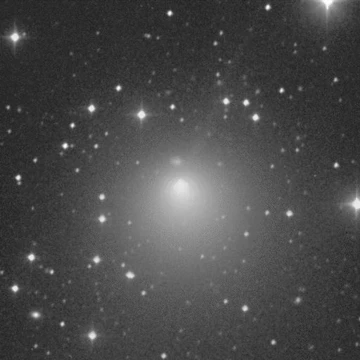
449P/Leonard
Rediscovered lost comet from 1987, now a Jupiter-family periodic comet.

449P/Leonard is a Jupiter-family comet with an orbital period of 6.83 years. Its orbit has been heavily reshaped by repeated close encounters with Jupiter, and it was identified in 2022 as the same object as a lost comet first seen in 1987.
Gregory J. Leonard first spotted this comet on 29 September 2020 using the 1.5-meter telescope at Mount Lemmon Observatory, when it had an apparent magnitude of about 21.5. Orbital calculations placed its most recent perihelion on 23 November 2020. The comet’s orbit had been drastically shortened by a 1983 pass within 0.064 AU of Jupiter, which reduced its orbital period from 13.2 years to 6.82 years. In 2022, Maik Meyer connected 449P to the lost comet X/1987 A2, discovered by Robert H. McNaught and Malcolm Hartley on 5 January 1987 at Siding Spring Observatory. That comet’s precovery image was not found until March 1987, preventing precise follow-up. Scientists later recognized P/2013 Y6, observed from Mauna Kea Observatory between 2013 and 2014, as another apparition of the same object. The comet received its official numerical designation, 449P, alongside nine others in February 2023. Its next return to the inner Solar System is predicted for 25 September 2027.
Photometric data from the Asteroid Terrestrial-impact Last Alert System (ATLAS), collected from October 2020 to February 2021, indicate a dust production rate of ≤2.0 kg/s, corresponding to a maximum Afρ value of 8.2±0.6 cm roughly 28 days before and after perihelion.
Quick Facts
- Discovery Ref
- CBET_4868 · MPEC_2020-U151
- Discoverer
- Gregory J. Leonard
- Discovery Site
- Mount Lemmon Observatory
- Discovery Date
- 29 September 2020
- Mpc Name
- X/1987 A2, P/2013 Y3 · P/2020 S6
- Orbit Ref
- jpl
- Epoch
- 20 October 2020 (JD 2459142.5)
- Earliest Precovery Date
- 5 January 1987IAUC_4355
- Obs
- 294
- Perihelion
- 1.875 AU
- Aphelion
- 5.322 AU
- Semimajor
- 3.598 AU
Facts from the source article.
Lore & Background
On 29 September 2020, Gregory J. Leonard discovered a new comet about 21.5 in apparent magnitude from images taken from the 1.5 m telescope of the Mount Lemmon Observatory. Orbital calculations showed it had reached its most recent perihelion on 23 November 2020, and it has frequent close passes with Jupiter. The comet had passed about 0.064 AU from the giant planet in 1983, reducing its orbital period from 13.2 years to just 6.82 years.
In 2022, Maik Meyer linked 449P with the previously lost comet, X/1987 A2, which was discovered by Robert H. McNaught and Malcolm Hartley from the Siding Spring Observatory on 5 January 1987. This precovery image of the comet was not found until March 1987, hence precise follow-up observations were not possible at the time. Subsequently, scientists have also identified P/2013 Y6 as another previous apparition of the comet, which was observed from the Mauna Kea Observatory between 2013 and 2014. The comet later received its official numerical designation (449P) alongside nine other comets on February 2023.
Photometric observations conducted by the Asteroid Terrestrial-impact Last Alert System (ATLAS) between October 2020 and February 2021 revealed that 449P/Leonard has a dust production rate about ≤2.0 kg/s, which corresponds to a maximum Afρ value of 8.2±0.6 cm about 28 days before and after perihelion.
Reader's Guide
449P/Leonard's significance lies in its rediscovery of a lost comet, X/1987 A2, which was first observed in 1987 but lost due to delayed precovery imaging. The comet's orbital history is marked by a close pass with Jupiter in 1983 at 0.064 AU, which shortened its orbital period from 13.2 years to 6.82 years, making it a typical Jupiter-family comet. Its frequent close passes with Jupiter continue to influence its orbit. The comet was also linked to a previous apparition, P/2013 Y6, observed from Mauna Kea Observatory between 2013 and 2014, showing that it had been observed but not recognized as the same object. The official numerical designation 449P was assigned in February 2023 alongside nine other comets. Photometric data from ATLAS between October 2020 and February 2021 provided a dust production rate of ≤2.0 kg/s and an Afρ value of 8.2±0.6 cm, indicating modest activity. The comet's next return to the inner Solar System is predicted for 25 September 2027.
Did You Know?
- 449P/Leonard was discovered by Gregory J. Leonard on 29 September 2020 using the 1.5 m telescope of the Mount Lemmon Observatory.
- The comet's dust production rate was measured by ATLAS as ≤2.0 kg/s between October 2020 and February 2021.
Frequently Asked Questions
Who discovered 449P/Leonard and when?
Gregory J. Leonard first spotted the comet on 29 September 2020 using the 1.5-meter telescope at Mount Lemmon Observatory, where it was a faint object at roughly magnitude 21.5.
What is 449P/Leonard's orbital period?
The comet takes about 6.83 years to complete one full circuit of the Sun, which places it squarely in the Jupiter-family periodic comet category.
How was 449P/Leonard linked to a lost comet?
Orbital back-calculation in 2022 showed that the 2020 object was the same body first recorded in 1987, meaning it had been missing from surveys for roughly three and a half decades before Leonard's observation.
Why is Jupiter so central to 449P/Leonard's story?
A very tight 1983 flyby within 0.064 AU of Jupiter yanked the comet into a much shorter orbit, and repeated gravitational nudges from the gas giant have since kept reshaping its path into the under-seven-year period it has today.
When did 449P/Leonard last swing past the Sun?
Its most recent perihelion passage came on 23 November 2020, only a couple of months after Leonard's discovery observation in late September of that same year.
More in Periodic Comets, Part 2 1-24
Spotted an error? Know more?
Reader corrections go straight into our review queue. Suggest an edit · How this site is sourced