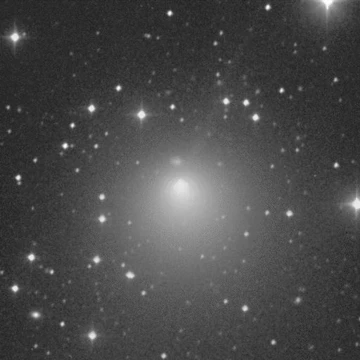
126P/IRAS
Jupiter-family comet discovered by IRAS in 1983.

126P/IRAS is a Jupiter-family comet that takes about 13.4 years to orbit the Sun. It was first spotted in images from the Infrared Astronomical Satellite (IRAS) on July 28, 1983, by J. Davies, and the sighting was later confirmed using the 1.2-meter Schmidt telescope at Palomar Observatory.
When discovered, the comet appeared as a star-like object with a brightness of magnitude 15. By mid-September 1983, it had brightened to magnitude 11 and displayed a tail stretching 3.5 arcminutes. Brian G. Marsden calculated its orbit, determining it was a short-period comet with a period of 13.32 years. The comet was next seen during its 1996 return, when it again reached about magnitude 11 in September and faded to magnitude 12 by October. It was also observed during its 2010 and 2023 apparitions.
During the 1996 apparition, the Infrared Space Observatory (ISO) studied the comet near perihelion, noting a tail 15 arcminutes long in mid-infrared light. The Midcourse Space Experiment (MSX) satellite also observed it in infrared.
The comet’s surface is covered in dust grains smaller than 5 microns, similar in size to those on Halley’s Comet. Estimates of its dust mass loss rate during the 1996 apparition range from 150 to 600 kg per second, with the comet shedding 3.3 times more dust mass than gas mass—though another study put the rate much lower, at just 50 kg per second. The dust grains in the tail have an estimated albedo of 0.15 ± 0.03. Based on infrared observations, the nucleus has a radius of about 1.57 ± 0.14 km (0.976 ± 0.087 miles).
It has been suggested that meteoroids ejected from the comet roughly 13,000 years ago could reach Earth, producing a diffuse meteor shower.
Quick Facts
- Discovery Ref
- IAUC_3833 · IAUC_3837
- Discoverer
- Infrared Astronomical Satellite
- Discovery Date
- 26 July 1983
- Mpc Name
- P/1983 M1, P/1996 P1
- Designations
- 1983 XIV, 1983j
- Orbit Ref
- jpldata · MPC
- Epoch
- 27 May 2021 (JD 2459361.5)
- Earliest Precovery Date
- 30 June 1983
- Obs
- 1,902
- Perihelion
- 1.713 AU
- Aphelion
- 9.573 AU
- Semimajor
- 5.640 AU
Facts from the source article.
Lore & Background
Upon discovery, the comet had an apparent magnitude of 15 and appeared stellar. It brightened to magnitude 11 by mid-September 1983, with a tail 3.5 arcminutes long. Brian G. Marsden computed its orbit, finding it a short-period comet with an orbital period of 13.32 years. The comet was observed again during its 1996 apparition, brightening to about magnitude 11 in September 1996 and fading to about 12 in October. It was also observed during its 2010 and 2023 apparitions.
During the 1996 apparition, the Infrared Space Observatory (ISO) observed the comet near perihelion, revealing a 15-arcminute-long tail in mid-infrared. The Midcourse Space Experiment (MSX) satellite also observed it in infrared. The comet's surface is covered with dust grains smaller than 5 microns, a grain size similar to Halley's Comet. Estimates of the dust mass loss rate during the 1996 apparition range from 150–600 kg/s, with the comet shedding 3.3 times more dust mass than gas mass; however, other studies show a much lower rate of only 50 kg/s. The albedo of dust grains in the tail is 0.15±0.03, and the nucleus radius is estimated at 1.57 ± 0.14 km based on infrared observations.
It has been proposed that meteoroids expelled from the comet about 13,000 years ago could reach Earth, producing a diffuse meteor shower.
Reader's Guide
126P/IRAS holds significance as a Jupiter-family comet discovered by the Infrared Astronomical Satellite, marking one of the early comet discoveries from space-based infrared surveys. Its observational history spans multiple apparitions, with notable infrared studies by the Infrared Space Observatory and the Midcourse Space Experiment satellite during the 1996 apparition. These observations provided detailed data on dust grain properties, including a grain size distribution similar to Halley's Comet and an albedo of 0.15±0.03. The comet's dust mass loss rate during that apparition is disputed, with estimates ranging from 50 kg/s to 600 kg/s, and a dust-to-gas mass ratio of 3.3. The nucleus radius of 1.57 ± 0.14 km was derived from infrared observations. Additionally, the comet may be the source of a diffuse meteor shower from meteoroids ejected about 13,000 years ago, linking it to potential Earth-crossing debris streams. Its legacy lies in the multi-wavelength infrared characterization of a short-period comet and the unresolved questions about its mass loss.
Did You Know?
- 126P/IRAS was discovered on 28 July 1983 by J. Davies using images from the Infrared Astronomical Satellite.
- During its 1996 apparition, the Infrared Space Observatory observed a 15-arcminute-long tail in mid-infrared.
- The comet's dust grains are smaller than 5 microns, similar in size to those of Halley's Comet.
- Meteoroids expelled from the comet about 13,000 years ago may produce a diffuse meteor shower on Earth.
Frequently Asked Questions
What is 126P/IRAS?
126P/IRAS is a Jupiter-family comet that completes one full orbit around the Sun roughly every 13.4 years. It took its name from the Infrared Astronomical Satellite, the space-based instrument whose archival images first revealed its presence.
Who discovered 126P/IRAS and how was it confirmed?
J. Davies identified the comet in IRAS satellite imagery captured on July 28, 1983. The detection was subsequently verified with the 1.2-meter Schmidt telescope at Palomar Observatory.
How bright did 126P/IRAS appear during its 1983 apparition?
At initial detection the comet was a faint, star-like smudge at magnitude 15. By mid-September 1983 it had brightened to magnitude 11 and grown a tail spanning about 3.5 arcminutes.
Who calculated the orbit of 126P/IRAS?
Brian G. Marsden worked out the comet's orbital elements and determined a period of 13.32 years. His calculations confirmed that 126P/IRAS belongs to the Jupiter-family group of short-period comets.
Why is 126P/IRAS notable among periodic comets?
It was one of the first comets identified through infrared satellite surveys rather than traditional visual or photographic searches, showcasing the value of space-based infrared astronomy. Its 13.4-year orbit and Jupiter-family classification make it a useful benchmark for studying short-period cometary dynamics.
More in Periodic Comets, Part 2 1-24
Spotted an error? Know more?
Reader corrections go straight into our review queue. Suggest an edit · How this site is sourced