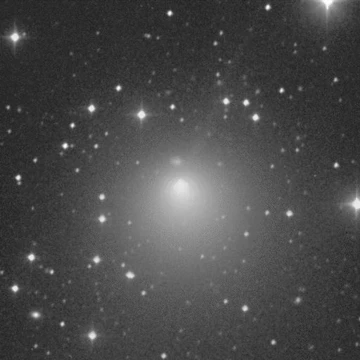
158P/Kowal–LINEAR
A lost comet rediscovered after 24 years.

158P/Kowal–LINEAR is a Jupiter-family comet that takes 10.3 years to orbit the Sun. It is one of six comets found by American astronomer Charles T. Kowal and also one of several discovered by the LINEAR survey.
Charles T. Kowal reported a comet discovery to the IAU in August 1979, based on photographic plates taken at Palomar Observatory on 24 July 1979. He described it as a diffuse 19th-magnitude object without condensation or a tail, located in the constellation Sagitta. Eleanor F. Helin calculated that the comet was periodic, and Brian G. Marsden confirmed her work, but noted that it had not been observed since 27 July, making it a lost comet.
In November 2003, A. E. Gleason reported cometary activity on an asteroid-like object designated P/2001 RG100, first detected by the LINEAR program on 12 September 2001. Marsden and later Shuichi Nakano calculated its orbit and found it matched Kowal's lost comet from 1979. After confirming they were the same object, the IAU Committee on Small-Body Nomenclature renamed it 158P/Kowal–LINEAR on 8 December 2003.
Observations from the Sloan Digital Sky Survey in 2012 showed the comet's nucleus has a radius of about 5.42 km (3.37 mi).
The Minor Planet Center listed the comet's perihelion as 9 May 2021, while JPL gave 12 May 2021. A close approach to Jupiter on 24 July 2022 will raise the orbit and lengthen the orbital period. The next perihelion will occur in 2036 at a distance of 5.2 AU (780 million km) from the Sun.
Quick Facts
- Discovery Ref
- IAUC_3395 · IAUC_8244
- Discoverer
- Charles T. Kowal / LINEAR
- Discovery Site
- Palomar Observatory
- Discovery Date
- 24 July 1979 / 12 September 2001
- Mpc Name
- P/1979 O1 / P/2001 RG · 100
- Designations
- 1979h
- Orbit Ref
- jpldata · MPC
- Epoch
- 12 July 2012 (JD 2456120.5)
- Observation Arc
- 45.51 years
- Obs
- 1,093
- Perihelion
- 4.576 AU
- Aphelion
- 4.865 AU
Facts from the source article.
Lore & Background
In August 1979, Charles T. Kowal reported to the IAU that he had discovered a comet from photographic plates taken at Palomar Observatory on 24 July 1979. He described it as a diffuse 19th-magnitude object with no condensation nor tail within the constellation Sagitta. Orbital calculations by Eleanor F. Helin indicated it was periodic, and Brian G. Marsden confirmed this, but noted it had not been observed since 27 July 1979, classifying it as lost.
In November 2003, A. E. Gleason reported cometary activity on an asteroid-like object found by the LINEAR program called P/2001 RG100, first detected on 12 September 2001. Orbital calculations by Marsden and later Shuichi Nakano showed its orbit was identical to Kowal's lost comet. The IAU Committee on Small-Body Nomenclature agreed to rename it 158P/Kowal–LINEAR on 8 December 2003.
Observations from the Sloan Digital Sky Survey in 2012 indicated the nucleus radius is approximately 5.42 km. The Minor Planet Center and JPL gave slightly different perihelion dates for 2021 (9 May and 12 May, respectively). A close approach to Jupiter on 24 July 2022 will lift the orbit and increase the orbital period. The next perihelion passage will be in 2036 at 5.2 AU from the Sun.
Reader's Guide
158P/Kowal–LINEAR is significant as a comet that was discovered, lost, and then rediscovered decades later, illustrating the challenges of tracking small solar system bodies. Its rediscovery in 2003 by the LINEAR program, after being lost since 1979, demonstrates the value of automated sky surveys in recovering objects that were once considered lost. The comet's dual name honors both its original discoverer, Charles T. Kowal, and the LINEAR program that found it again. The slight discrepancy between the Minor Planet Center and JPL perihelion dates for 2021 highlights the inherent uncertainties in orbital calculations. Its upcoming close approach to Jupiter in 2022, which will alter its orbit and increase its period, shows how gravitational interactions with giant planets can reshape cometary paths. The nucleus size estimate from SDSS in 2012 provides a rare physical measurement for a Jupiter-family comet.
Did You Know?
- Charles T. Kowal discovered six comets, of which 158P/Kowal–LINEAR is one.
- The comet was lost for 24 years after its initial discovery in 1979.
- Its nucleus radius is approximately 5.42 km, as measured by the Sloan Digital Sky Survey in 2012.
- A close approach to Jupiter on 24 July 2022 will lift its orbit and increase its orbital period.
Frequently Asked Questions
Who discovered 158P/Kowal–LINEAR?
American astronomer Charles T. Kowal first identified the comet on Palomar Observatory plates in July 1979, and the LINEAR survey program later re-confirmed it in 2003. It stands as one of six comets credited to Kowal and also belongs to the LINEAR discovery catalog.
How long does 158P/Kowal–LINEAR take to orbit the Sun?
This Jupiter-family comet completes a full revolution in approximately 10.3 years. Its most recent perihelion passage took place in May 2021, though the Minor Planet Center and JPL recorded the exact date a few days apart.
How was 158P/Kowal–LINEAR found again after being lost?
After Kowal's 1979 detection, the comet vanished from view for roughly two decades until it was flagged as an asteroid-like object on 12 September 2001. The LINEAR program then formally matched it to its original 1979 designation in 2003, ending its lost-comet status.
How big is 158P/Kowal–LINEAR's nucleus?
The nucleus has an estimated radius of about 5.42 kilometers (roughly 3.37 miles), making it a solid mid-range body among Jupiter-family comets. That diameter of nearly 11 km is large enough to host a substantial dust and gas envelope during perihelion.
When is 158P/Kowal–LINEAR's next perihelion and how close will it get?
The comet is expected to swing past the Sun in 2036 at a distance of about 5.2 AU, well outside Earth's orbital path. Because of that relatively distant perihelion, it is unlikely to become a bright naked-eye object for ground-based observers.
More in Periodic Comets, Part 2 1-24
Spotted an error? Know more?
Reader corrections go straight into our review queue. Suggest an edit · How this site is sourced