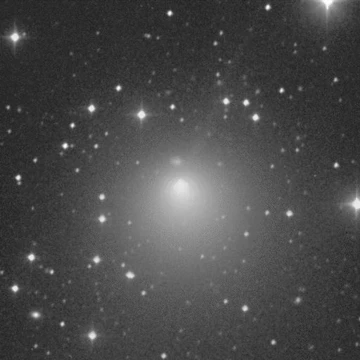
332P/Ikeya–Murakami
A fragmenting short-period comet discovered visually by two Japanese amateurs.

332P/Ikeya–Murakami (P/2010 V1) is a short-period comet that orbits the Sun roughly once every 5.4 years. It was discovered on November 3, 2010, by two Japanese amateur astronomers working independently: Kaoru Ikeya and Shigeki Murakami. The comet never gets closer to the Sun than about 1.57 AU—roughly the distance of Mars—and its tendency to break apart may be driven by fast rotation. The last sighting of the comet was in October 2020; during its 2021 perihelion, it sat only 7 degrees from the Sun, making observation impossible. Its next perihelion will occur in January 2027, when it will be 100 degrees away from the Sun.
Ikeya spotted the comet using a 25-centimeter reflector at 39× magnification, while Murakami used a 46-centimeter reflector at 78×. Photographic confirmation came from Ernesto Guido and Giovanni Sostero, who used a Global-Rent-a-Scope telescope in New Mexico. Both discoverers found the comet by manually looking through optical telescopes—a method that has become very unusual in recent years. Shortly after its discovery, in early November 2010, it became clear that the comet had undergone a major outburst between October 31 and November 3, just a few weeks past its perihelion. After that 2010 pass, the comet was observed for only about 80 days.
The comet was recovered on December 31, 2015, at magnitude 20, and the recovery was announced on January 2, 2016, under the designation P/2015 Y2. A second fragment, B, was confirmed and announced on January 5, 2016. The comet now consists of two main components, A and B, each with its own coma, envelope, and tail. Around January 11, 2016, two fainter potential fragments—C and D—were found, likely broken off from fragment B. By January 29, fragments B and D had nearly completely disintegrated, while fragment C had flared up in an outburst, becoming as bright as fragment A.
Fragment A has been tracked over a 124-day observation arc. Fragment F has the least reliable orbit, with only an 11-day arc. Most fragments have an estimated orbital period of about 1,980 days, but fragment F is estimated to take roughly 2,050 days. After two orbits (about 11 years), the divergence between fragments becomes clear: fragment F is predicted to reach perihelion 4 months and 18 days after fragment A.
Quick Facts
- Discoverer
- Kaoru Ikeya / Shigeki Murakami
- Discovery Date
- 3 November 2010
- Mpc Name
- P/2010 V1, P/2015 Y2
- Epoch
- 2016 Jan. 13
- Observation Arc
- 124 days (fragment A)
- Perihelion
- 1.573 AU (q)
- Eccentricity
- 0.4904
- Period
- 5.42 yr / (1980 days)
- Inclination
- 9.387°
- Earth Moid
- 0.59 AU (A)
- Jupiter Moid
- 0.46 AU (A) / 0.34 AU (F)
- Physical Ref
- Jewitt_2016 · Hui_2017
Facts from the source article.
Lore & Background
Ikeya identified the comet using a 25-centimeter reflector at 39×, while Murakami used a 46 cm reflector at 78×. Photographic confirmation was obtained by Ernesto Guido and Giovanni Sostero using a Global-Rent-a-Scope telescope in New Mexico. At the start of November 2010, a few weeks past perihelion, the comet had undergone a major outburst between October 31 and November 3. After the 2010 perihelion, the comet had only about an 80-day observation arc.
The recovery of P/2010 V1 on December 31, 2015, at magnitude 20 was announced on January 2, 2016, and designated as P/2015 Y2. A secondary fragment (B) was confirmed on January 5, 2016. The comet is now composed of component A and B with two different comas, envelopes and tails. Around January 11, 2016, two fainter potential fragments, designated C and D, were located, both likely fragmented from B. As of January 29, fragments B and D had nearly entirely disintegrated, and fragment C had undergone an outburst, making it as bright as A.
Fragment A has a 124-day observation arc, and fragment F has the poorest orbit determination with only an 11-day arc. Most fragments have an estimated orbital period of about 1980 days, while fragment F is estimated at around 2050 days. After two orbits (11 years) of becoming divergent, fragment F is estimated to come to perihelion 4 months and 18 days after fragment A.
Reader's Guide
332P/Ikeya–Murakami is significant as a rare example of a comet discovered visually by amateur astronomers in the modern era, highlighting the continued role of manual observation. Its fragmentation events, observed in detail during its 2015–2016 recovery, provide insights into comet disintegration processes, possibly driven by rapid rotation due to its close approach to the Sun at 1.57 AU (roughly Mars distance). The comet's multiple fragments—A, B, C, D, and F—with varying orbital periods and observation arcs, illustrate the complex dynamics of cometary breakup. The divergent orbit of fragment F, estimated to arrive at perihelion 4 months and 18 days after fragment A after 11 years, underscores the long-term evolution of such fragments. The comet's last observation in October 2020 and its upcoming perihelion in January 2027 with a favorable solar elongation of 100 degrees offer future study opportunities. Its legacy is tied to the collaborative efforts of amateur and professional astronomers in tracking its fragmentation and recovery.
Did You Know?
- The comet was discovered independently by two Japanese amateur astronomers on the same day, November 3, 2010.
- A major outburst occurred between October 31 and November 3, 2010, just weeks after perihelion.
- As of January 29, 2016, fragments B and D had nearly entirely disintegrated, while fragment C had brightened to match fragment A.
- Fragment F has an estimated orbital period of about 2050 days, longer than the ~1980-day period of most other fragments.
Frequently Asked Questions
Who discovered 332P/Ikeya–Murakami and how?
The comet was spotted visually on November 3, 2010, by two Japanese amateur astronomers—Kaoru Ikeya and Shigeki Murakami—who each identified it independently. Because both observers found it on the same night, the comet carries both of their surnames in its designation.
How long is 332P/Ikeya–Murakami's orbital period?
It completes one full circuit around the Sun in roughly 5.4 years, which places it firmly in the short-period comet category.
How close does 332P/Ikeya–Murakami get to the Sun at perihelion?
Its perihelion distance is about 1.57 AU, roughly the same orbital radius as Mars, meaning it never ventures into the innermost solar system.
Why was 332P/Ikeya–Murakami so difficult to observe in 2021?
During its 2021 perihelion the comet hung only about 7 degrees from the Sun in the sky, rendering it effectively unobservable from Earth. The last confirmed detection came in October 2020, just before that lost window.
When will 332P/Ikeya–Murakami next reach perihelion?
Its next perihelion passage is expected in January 2027, giving observers a fresh opportunity to track the comet as it swings back through the inner solar system.
More in Periodic Comets, Part 2 1-24
Spotted an error? Know more?
Reader corrections go straight into our review queue. Suggest an edit · How this site is sourced