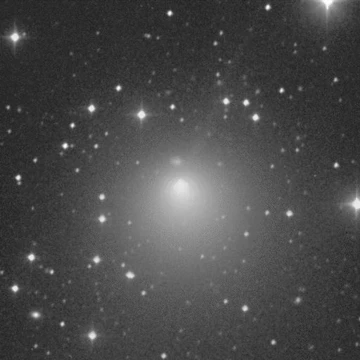
147P/Kushida–Muramatsu
A quasi-Hilda comet captured by Jupiter as an irregular moon.

147P/Kushida–Muramatsu is a quasi-Hilda comet first spotted in 1993 by Japanese astronomers Yoshio Kushida and Osamu Muramatsu. Its most unusual trait is that, between 1949 and 1962, it was briefly pulled into orbit around Jupiter as an irregular moon, making it the fifth known object to have undergone such a capture. The comet was last seen in 2016, and its next closest approach to the Sun (perihelion) is predicted for 19 December 2031.
Quick Facts
- Discovery Ref
- IAUC_5903
- Discoverer
- Yoshio Kushida / Osamu Muramatsu
- Discovery Site
- Yatsugatake, Japan
- Discovery Date
- 8 December 1993
- Mpc Name
- P/1993 X1 / P/2000 T2
- Designations
- 1993 XIX, 1993tICQ1
- Orbit Ref
- jpldata · MPC
- Epoch
- 17 October 2024 (JD 2460600.5)
- Observation Arc
- 22.09 years
- Earliest Precovery Date
- 7 December 1993
- Obs
- 290
- Perihelion
- 3.159 AU
Facts from the source article.
Lore & Background
The comet was discovered photographically by Yoshio Kushida and Osamu Muramatsu from the Yatsugatake South Base Observatory on the night of 8 December 1993. Several orbital calculations by Shuichi Nakano later determined its periodic nature; at that time, it had an orbital period of 7.40 years. It was later recovered at the Saji Observatory in October 2000, where Brian G. Marsden and other astronomers were able to identify it as the same object that was observed by Kushida and Muramatsu in 1993.
According to calculations made by Katsuhiko Ohtsuka of the Tokyo Meteor Network and David Asher of Armagh Observatory, Kushida–Muramatsu was temporarily captured by Jupiter as an irregular moon between 14 May 1949, and 15 July 1962, (12.17+0.29−0.27 years). It is the fifth such object known to have been captured. It is thought that quasi-Hilda comets may be escaped Hilda asteroids. Comet Shoemaker–Levy 9, which collided with Jupiter in 1994, is a more famous example of a quasi-Hilda comet.
Reader's Guide
147P/Kushida–Muramatsu holds significance as a quasi-Hilda comet, a class of objects thought to be escaped Hilda asteroids. Its most notable feature is its temporary capture by Jupiter as an irregular moon for over 12 years, from 1949 to 1962, as calculated by Katsuhiko Ohtsuka and David Asher. This makes it the fifth known object to have undergone such a capture. The comet's discovery in 1993 by Japanese astronomers Yoshio Kushida and Osamu Muramatsu, and its subsequent recovery in 2000 by Brian G. Marsden and others, established its periodic nature with an orbital period of 7.40 years. Its legacy is tied to understanding the dynamics of quasi-Hilda comets and their relationship to Jupiter's gravitational influence, similar to the more famous Comet Shoemaker–Levy 9. The comet was last observed in 2016 and is predicted to next reach perihelion on 19 December 2031.
Did You Know?
- 147P/Kushida–Muramatsu was discovered photographically on 8 December 1993 from the Yatsugatake South Base Observatory.
- It is the fifth known object to have been captured by Jupiter as an irregular moon.
Frequently Asked Questions
What is 147P/Kushida–Muramatsu?
It is a quasi-Hilda periodic comet with an orbital period of roughly 7.4 years at the time of its discovery. The name honors the two Japanese astronomers who first detected it in December 1993.
Why is 147P/Kushida–Muramatsu considered unusual?
Between 1949 and 1962, the comet was temporarily gravitationally captured by Jupiter and orbited it as an irregular satellite. This makes it the fifth known body to have experienced such a capture event.
Who discovered 147P/Kushida–Muramatsu and where?
Yoshio Kushida and Osamu Muramatsu identified the comet on 8 December 1993 using equipment at Yatsugatake South Base Observatory in Japan.
When will 147P/Kushida–Muramatsu next appear?
After its last confirmed observation in 2016, the comet is expected to return to perihelion on 19 December 2031. Until then it remains lost against the glare of the Sun.
What does the 'quasi-Hilda' classification mean for this comet?
The designation indicates the comet's orbit resembles that of Hilda asteroids, which sit in a 3:2 mean-motion resonance with Jupiter, but it is not permanently locked into that configuration. Its period of about 7.4 years places it in that resonant neighborhood.
More in Periodic Comets, Part 2 1-24
Spotted an error? Know more?
Reader corrections go straight into our review queue. Suggest an edit · How this site is sourced