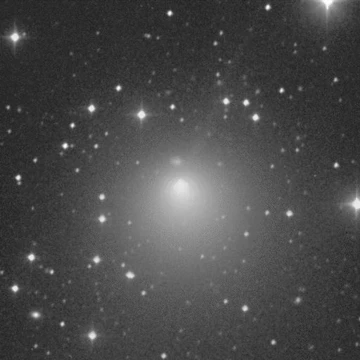
96P/Machholz
Sunskirting comet with unusual composition and sungrazer families.

96P/Machholz, also called Machholz 1, is a periodic comet that swings extremely close to the Sun. It was spotted on May 12, 1986, by amateur astronomer Donald Machholz from Loma Prieta peak in central California, using 130 mm binoculars. The comet is the source of the Kracht and Marsden families of sungrazers. It stands out for its odd chemistry: measurements taken in 2007 showed it is severely lacking in both carbon and cyanogen, a composition almost unique among known comets. This has led to speculation that it may have originated outside our solar system. The comet's orbit is also unusual—it has the smallest perihelion distance of any numbered short-period comet (aside from tiny SOHO discoveries), bringing it closer to the Sun than Mercury, and it is the only short-period comet with both a high orbital tilt and a highly stretched orbit. Its estimated diameter is about 6.4 km. The most recent perihelion occurred on January 31, 2023.
Quick Facts
- Discoverer
- Donald E. Machholz
- Discovery Site
- Loma Prieta, California
- Discovery Date
- 12 May 1986
- Mpc Name
- P/1986 J2
- Designations
- Machholz 1 · 1986 VII, 1991 XII, 1986e
- Orbit Ref
- jpldata · MPC
- Epoch
- 21 November 2025 (JD 2461000.5)
- Observation Arc
- 38.17 years
- Obs
- 1,559
- Aphelion
- 5.946 AU
- Semimajor
- 3.031 AU
- Eccentricity
- 0.96173
Facts from the source article.
Lore & Background
96P/Machholz was discovered on 12 May 1986 by amateur astronomer Donald Machholz using 130 mm binoculars from Loma Prieta peak in central California. On 6 June 1986, it passed 0.404 AU from Earth. The comet last came to perihelion on January 31, 2023, and has an estimated diameter of around 6.4 km. It is the parent body of both the Kracht and Marsden sungrazer families.
The comet is unusual in several aspects. Its highly eccentric 5.29-year orbit has the smallest perihelion distance known among numbered short-period comets, bringing it closer to the Sun than Mercury. It is the only known short-period comet with both high orbital inclination and high eccentricity. In 2007, it was found to be carbon-depleted and cyanogen-depleted, a composition nearly unique among comets. The orbit corresponds to the Arietids and the Marsden and Kracht comet groups. Its Tisserand parameter with respect to Jupiter is 1.94, and orbital integrations indicate it was greater than 2 about 2500 years ago. It is currently in a 9:4 orbital resonance with Jupiter.
Reader's Guide
96P/Machholz holds significance as the parent body of the Kracht and Marsden sungrazer families, linking it to multiple meteor streams and comet groups. Its unusual chemical composition—carbon-depleted and cyanogen-depleted—was measured during the 2007 apparition as part of the Lowell Observatory comet composition program, showing far fewer carbon molecules than 150 other comets. Only two other comets, C/1988 Y1 (Yanaka) and C/2025 K1 (ATLAS), show similar depletion but with different orbits. Three hypotheses explain this: it may be an interstellar comet captured from outside the Solar System; it may have formed in an extremely cold region; or repeated baking by the Sun may have stripped its cyanogen. The comet has been observed by SOHO's LASCO instrument during perihelion passages in 1996, 2002, 2007, 2012, 2017, and 2023. Fragments detected in 2012 likely broke off during the 2007 passage. Its orbit is gradually dropping from 0.17 AU to 0.09 AU between 1897 and 2102, with 2081 being the first perihelion below 0.1 AU. It may eventually be ejected from the Solar System.
Did You Know?
- In 2007, it was found to be both carbon-depleted and cyanogen-depleted, a nearly unique composition.
- The comet has been observed by SOHO during six perihelion passages: 1996, 2002, 2007, 2012, 2017, and 2023.
More in Periodic Comets, Part 2 1-24
Spotted an error? Know more?
Reader corrections go straight into our review queue. Suggest an edit · How this site is sourced