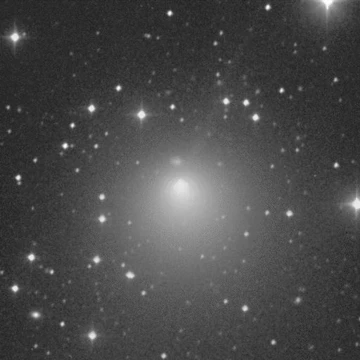
93P/Lovas
Jupiter-family comet discovered in 1980 by Miklós Lovas.

93P/Lovas, designated Comet Lovas 1, is a Jupiter-family comet with a diameter of about 5 kilometers and an orbital period of 9.1 years. Hungarian astronomer Miklós Lovas discovered it in 1980. Its current orbit never brings it closer to Earth than roughly 0.76 AU (114 million km).
Miklós Lovas first spotted the comet on photographic plates taken December 5, 1980, estimating its apparent magnitude at 17. The discovery was announced on December 8, but by December 15 the International Astronomical Union Circular noted that no confirmation had been reported. Charles T. Kowal independently found the comet on December 14. Because only a few observations were available, calculating a preliminary orbit proved difficult, and a reliable orbit was not computed until February 1981.
The comet was recovered on July 7, 1989, by Tsutomu Seki, who described it as diffuse with a central concentration and an apparent magnitude of 17.5. He also located it on plates from July 5 and 13. A few observations followed in August and September, including a visual sighting by David H. Levy, who used a 154 cm reflector telescope on August 24 and estimated magnitude 16.3. The comet reached perihelion on October 10.5, 1989. In November, Alan Hale reported magnitudes around 13. On December 11, 1989, the comet approached Earth to 0.892 AU, appearing at magnitude 13 to 14 with a coma 0.7 arcminutes across. It was last seen on January 24, 1990.
For its next apparition, the comet was recovered in June 1998 at Whipple Observatory at magnitude 17.44. It brightened to 13th magnitude in late 1989 to early 1990.
During the 2009 apparition, the Spitzer Space Telescope observed the comet in infrared. These observations yielded an effective nucleus radius of 2.59 ± 0.26 km. The rotational period was also estimated, with the most likely values being 18.2 and 13.2 hours.
Quick Facts
- Discoverer
- Miklós Lovas
- Discovery Date
- 5 December 1980
- Mpc Name
- P/1980 X1 / P/1989 N2
- Designations
- Lovas 1 · 1980 V, 1989 XIII · 1980s, 1989p
- Epoch
- 30 April 2026
- Observation Arc
- 45 years
- Obs
- 3618
- Aphelion
- 7.06 AU
- Perihelion
- 1.69 AU
- Semimajor
- 4.37 AU
- Eccentricity
- 0.6138
- Period
- 9.14 years
Facts from the source article.
Lore & Background
Miklós Lovas discovered the comet in photographic plates exposed on 5 December 1980, estimating an apparent magnitude of 17. Although the discovery was announced on 8 December, on 15 December the International Astronomical Union Circular announced that no confirmation had been reported. Charles T. Kowal independently discovered the comet on 14 December. The low number of available observations made a preliminary orbit difficult to calculate; the orbit was reliably computed in February 1981.
The comet was recovered on 7 July 1989 by Tsutomu Seki, who described it as diffuse with central concentration and an apparent magnitude of 17.5. Few observations were recorded in August and September, including a visual observation by David H. Levy, who estimated magnitude 16.3 on 24 August using a 154 cm reflector telescope. The comet passed perihelion on 10.5 October 1989, brightened in November (Alan Hale reported magnitudes around 13), and approached Earth to 0.892 AU on 11 December 1989, with a coma 0.7 arcminutes across. It was last seen on 24 January 1990. During its next apparition it was recovered in June 1998 at magnitude 17.44 at Whipple Observatory, brightening to 13th magnitude in late 1989 to early 1990.
The comet was observed by the Spitzer Space Telescope in infrared during the 2009 apparition, yielding an effective nucleus radius of 2.59±0.26 km. The rotational period was estimated, with the most possible values being 18.2 and 13.2 hours.
Reader's Guide
93P/Lovas is notable as a Jupiter-family comet with a well-documented observational history spanning multiple apparitions. Its discovery involved initial uncertainty and independent confirmation, highlighting the challenges of early orbit determination. The comet's recovery in 1989 and 1998 provided opportunities for visual and photometric monitoring, with brightness variations recorded by experienced observers. Infrared observations by the Spitzer Space Telescope in 2009 allowed precise measurement of the nucleus size, and rotational period estimates (18.2 or 13.2 hours) added to its physical characterization. The comet's orbit keeps it at a safe distance from Earth (minimum 0.76 AU), and its predictable 9.1-year period makes it a regular target for study. The entry underscores the collaborative nature of comet discovery and follow-up, from initial photographic plates to space-based infrared analysis.
Did You Know?
- The comet was independently discovered by Charles T. Kowal on 14 December 1980, after the initial discovery by Miklós Lovas.
- David H. Levy made a visual observation of the comet on 24 August 1989 using a 154 cm reflector telescope.
- The Spitzer Space Telescope observed the comet in infrared during the 2009 apparition, estimating a nucleus effective radius of 2.59±0.26 km.
- The rotational period of the nucleus was estimated to be either 18.2 or 13.2 hours.
More in Periodic Comets, Part 2 1-24
Spotted an error? Know more?
Reader corrections go straight into our review queue. Suggest an edit · How this site is sourced