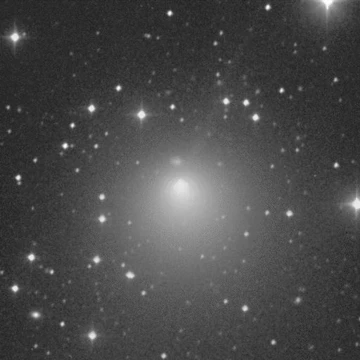
160P/LINEAR
Jupiter-family comet discovered by LINEAR in 2004.

160P/LINEAR is a Jupiter-family comet that orbits the Sun once every 7.35 years. It belongs to the group of comets first spotted by the Lincoln Near-Earth Asteroid Research (LINEAR) survey.
The object was initially detected on 15 July 2004 as a faint, asteroid-like point of light (magnitude 19) by LINEAR. Orbital calculations led the Minor Planet Center to suggest it might be a new comet, at which point it was designated 2004 NL21. Robert H. McNaught confirmed its cometary nature on 6 September 2004, after observing weak activity. It received the official number 160P after Maik Meyer identified precovery images taken by the Near-Earth Asteroid Tracking (NEAT) survey in 1996. The comet was later re-observed during its next two returns, in 2012 and 2019.
In 2006, while 160P/LINEAR was about 4.0 AU (600 million km) from the Sun, observations with the Isaac Newton Telescope measured its nucleus radius at roughly 0.87 ± 0.07 km. However, a background galaxy in the field prevented direct analysis of the chemical makeup of its surrounding coma.
Quick Facts
- Discovery Ref
- CBET_87 · IAUC_8408
- Discoverer
- LINEAR
- Discovery Date
- 15 July 2004
- Mpc Name
- P/2004 NL · 21
- Orbit Ref
- jpldata · MPC
- Epoch
- 21 November 2025 (JD 2461000.5)
- Earliest Precovery Date
- 8 September 1996IAUC_8414 · MPEC_2004-S18
- Obs
- 991
- Perihelion
- 1.796 AU
- Aphelion
- 5.765 AU
- Semimajor
- 3.781 AU
- Eccentricity
- 0.52491
Facts from the source article.
Lore & Background
160P/LINEAR was first detected as a faint 19th-magnitude asteroid-like object from LINEAR observations on 15 July 2004. Calculations of its orbit informed the Minor Planet Center that the object, formerly labeled as 2004 NL21, was a possible new comet. Robert H. McNaught confirmed its cometary nature after detecting some weak activity on 6 September 2004.
The comet later received its official numerical designation (160P) after Maik Meyer confirmed its precovery photographic plates taken by the Near-Earth Asteroid Tracking (NEAT) survey in 1996. It was subsequently re-observed in its next two apparitions in 2012 and 2019 respectively.
In 2006, observations from the Isaac Newton Telescope while it was approximately 4.0 AU (600 million km) away from the Sun revealed that its nucleus has an effective radius of roughly 0.87 ± 0.07 km. However, the presence of a background galaxy at the time prevented direct measurements of the chemical composition of its surrounding coma.
Reader's Guide
160P/LINEAR is significant as a Jupiter-family comet discovered by the LINEAR survey, which has found many comets. Its discovery history illustrates the collaborative process of comet identification: first detected as an asteroid-like object, then confirmed as a comet by Robert H. McNaught, and later receiving its numerical designation after Maik Meyer identified precovery plates from the NEAT survey. The comet's orbit, with a period of roughly 7.35 years, places it in the Jupiter-family category. Physical characterization was attempted in 2006 using the Isaac Newton Telescope, yielding a nucleus radius estimate of 0.87 ± 0.07 km, though a background galaxy prevented chemical analysis of its coma. The comet has been observed in subsequent apparitions in 2012 and 2019, allowing continued study of its behavior. Its legacy lies in demonstrating how multiple surveys and individual astronomers contribute to the cataloging and understanding of periodic comets.
Did You Know?
- Maik Meyer confirmed precovery photographic plates from the NEAT survey in 1996.
- In 2006, its nucleus was measured to have an effective radius of roughly 0.87 ± 0.07 km.
Frequently Asked Questions
What is 160P/LINEAR?
160P/LINEAR is a Jupiter-family comet that circles the Sun roughly every 7.35 years. It was originally spotted by the LINEAR automated survey and later verified as a true comet by Robert H. McNaught.
When and how was 160P/LINEAR first detected?
The object appeared on 15 July 2004 as a dim, asteroid-like smudge at magnitude 19, picked up by the Lincoln Near-Earth Asteroid Research system. It was given the provisional label 2004 NL21 before its cometary identity was later established.
Who confirmed 160P/LINEAR as a comet?
Robert H. McNaught verified its cometary nature on 6 September 2004 after observing faint signs of outgassing activity. That confirmation prompted the Minor Planet Center to assign it the official periodic-comet number 160P.
What is 160P/LINEAR's orbital period?
As a Jupiter-family comet, 160P/LINEAR completes one full orbit around the Sun in approximately 7.35 years. Jupiter's gravitational influence keeps it confined to the inner solar system rather than sending it on long, distant excursions.
Why is 160P/LINEAR notable among periodic comets?
It is a member of the expanding catalog of comets identified by the LINEAR survey, which has greatly broadened our awareness of small near-Earth objects. Its 2004 discovery demonstrated how faint, asteroid-like detections can conceal entirely new comets waiting to be confirmed.
More in Periodic Comets, Part 2 1-24
Spotted an error? Know more?
Reader corrections go straight into our review queue. Suggest an edit · How this site is sourced