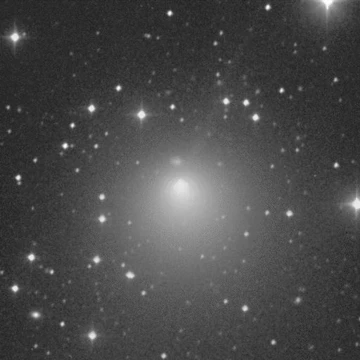
483P/PanSTARRS
A split main-belt asteroid pair showing recurrent cometary activity.

483P/PanSTARRS, originally labeled P/2016 J1, consists of two active asteroids in the main belt that separated from each other around the start of 2010. The brighter and larger fragment, P/2016 J1-A, was spotted first on 5 May 2016 by the Pan-STARRS 1 survey at Haleakalā Observatory. The following day, the Canada-France-Hawaii Telescope on Mauna Kea found the second piece, P/2016 J1-B. Neither asteroid reaches a full kilometer across—P/2016 J1-A measures roughly 0.6 km in diameter, while P/2016 J1-B is about 0.3 km. Both objects repeatedly show cometary behavior when they draw close to the Sun at perihelion, indicating that volatile substances like water ice are sublimating and driving the activity.
Quick Facts
- Discoverer
- Pan-STARRS 1
- Discovery Site
- Haleakalā Observatory
- Discovery Date
- 5 May 2016
- Designations
- P/2016 J1 (PanSTARRS)
- Observation Arc
- 153 days (A) / 140 days (B)
- Earliest Precovery Date
- 4 March 2016
- Orbit Ref
- (fragment A)
- Orbit
- main-belt (outer)Encke-typeperiodic
- Epoch
- 21 June 2016 / (JD 2457560.5)
- Aphelion
- 3.896 AU
- Perihelion
- 2.448 AU
- Semimajor
- 3.172 AU
Facts from the source article.
Lore & Background
483P/PanSTARRS consists of two components, P/2016 J1-A and P/2016 J1-B, which split apart from each other in early 2010. The brighter and larger component, P/2016 J1-A, was discovered first by the Pan-STARRS 1 survey at Haleakalā Observatory on 5 May 2016. Follow-up observations by the Canada-France-Hawaii Telescope at Mauna Kea Observatory discovered the second component, P/2016 J1-B, on 6 May 2016. Both asteroids are smaller than 1 kilometer in diameter, with P/2016 J1-A being roughly 0.6 km and P/2016 J1-B roughly 0.3 km in diameter.
The two components recurrently exhibit cometary activity as they approach the Sun near perihelion, suggesting that their activity is driven by sublimation of volatile compounds such as water. In 2018, an orbit analysis by Hsieh et al. found that both components are related to the Theobalda asteroid family of C-, F-, and X-type asteroids. The Theobalda family likely originated as fragments from an impact event that shattered a 78 ± 9 km-diameter parent body 6.9±2.3 million years ago. Another ice-sublimating active asteroid, 427P/ATLAS (P/2017 S5), was also identified as part of the Theobalda family, suggesting that some members of this family were able to retain subsurface water ice since the collision that formed them.
Reader's Guide
483P/PanSTARRS is significant as a rare example of an active main-belt asteroid that split into two components, both of which exhibit cometary activity driven by sublimation of volatiles like water. Its discovery and analysis provide insight into the processes of asteroid fragmentation and the retention of subsurface ice in the main belt. The 2018 orbit analysis by Hsieh et al. linking both components to the Theobalda asteroid family—along with another active asteroid, 427P/ATLAS—suggests that some members of this family have preserved water ice since the impact that formed them roughly 6.9 million years ago. This challenges the assumption that main-belt asteroids are entirely dry and supports the idea that volatile-driven activity can persist long after a catastrophic collision. The pair's recurrent activity near perihelion underscores the role of solar heating in triggering sublimation, making 483P/PanSTARRS a key object for studying the transition between asteroids and comets. Its legacy lies in demonstrating that split asteroid pairs can remain active years after separation, offering a natural laboratory for understanding the physical and dynamical evolution of small solar system bodies.
Did You Know?
- 483P/PanSTARRS split into two components in early 2010.
- The larger component, P/2016 J1-A, is roughly 0.6 km in diameter.
- Both components exhibit cometary activity near perihelion due to sublimation of volatiles.
- The pair belongs to the Theobalda asteroid family, which formed about 6.9 million years ago.
More in Periodic Comets, Part 2 1-24
Spotted an error? Know more?
Reader corrections go straight into our review queue. Suggest an edit · How this site is sourced