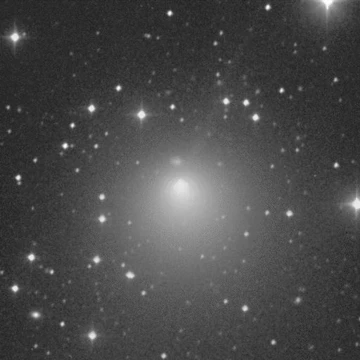
455P/PanSTARRS
Encke-type comet and active asteroid in the main belt.

455P/PanSTARRS is an Encke-type comet that orbits the Sun every 5.6 years, staying within the main asteroid belt. It is also classified as an active asteroid, and its orbit suggests it might be a member of the Theobalda collisional family.
The comet was first spotted by Robert Weryk in CCD images taken on 30 September 2017 with the PanSTARRS 1 telescope at Haleakala Observatory. Earlier observations from 19 September 2017 were later found. After the Minor Planet Center posted it on the PCCP report, follow-up observations from various observatories through October 2017 confirmed it was a comet, showing an elongated coma and a short tail roughly 10 arcseconds across. Astrometric measurements from those observations later showed the object—initially called P/2017 S9—followed a periodic orbit of about 5.6 years.
The comet was successfully recovered in 2022, a year before its next predicted return in 2023, under the temporary designation P/2022 R7. Precovery images from as early as 2011 were also found, but those showed little to no cometary activity. In February 2023, it received its permanent number, 455P, along with eight other comets.
Quick Facts
- Discovery Ref
- CBET_4448a
- Discoverer
- Pan-STARRS
- Discovery Site
- Haleakala Observatory
- Discovery Date
- 30 September 2017
- Orbit Ref
- jpldata · MPC
- Mpc Name
- P/2011 Q5 · P/2017 S9 · P/2022 R7
- Designations
- PanSTARRS 71,nasa-pds P10E2ep
- Epoch
- 25 February 2023 (JD 2460000.5)
- Observation Arc
- 11.03 years
- Earliest Precovery Date
- 21 August 2011
- Obs
- 71
- Perihelion
- 2.192 AU
Facts from the source article.
Lore & Background
Robert Weryk reported the discovery of this comet from CCD exposures taken by the Haleakala Observatory's PanSTARRS 1 telescope on 30 September 2017, with precovery observations found as far back as 19 September of that year. Following its announcement at the Minor Planet Center's PCCP report, follow-up observations from various observatories around the globe until October 2017 confirmed the object's cometary nature, with an elongated coma and a fairly short tail about 10 arcseconds across. Further astrometric measurements of recorded observations at the time later determined that the orbit of this new comet, previously known as P/2017 S9, is periodic with an orbital period of about 5.6 years.
It was successfully recovered in 2022, a year ahead of its next apparition in 2023 as P/2022 R7, with precovery observations as early as 2011 were found, however with little to no cometary activity. The comet later received its official numerical designation (455P) alongside eight other comets on February 2023.
Reader's Guide
455P/PanSTARRS is significant as an Encke-type comet that resides within the main asteroid belt, blurring the line between comets and asteroids. Its orbit suggests a possible membership in the Theobalda collisional family, indicating it may be a fragment from a larger body. The comet's discovery by Robert Weryk using PanSTARRS 1 on 30 September 2017, with precovery observations back to 19 September 2017, and later precovery images from 2011 showing little to no cometary activity, highlight its intermittent activity. Its recovery in 2022, a year before its 2023 apparition, and official numbering in February 2023 alongside eight other comets, underscore its recognition as a periodic object. The comet's elongated coma and short tail about 10 arcseconds across, confirmed by global follow-up observations in October 2017, demonstrate its cometary nature despite its asteroid-like orbit.
Did You Know?
- 455P/PanSTARRS was discovered by Robert Weryk from PanSTARRS 1 images taken on 30 September 2017.
- Its orbit suggests it may belong to the Theobalda collisional family.
- Precovery observations from 2011 showed little to no cometary activity.
- The comet received its official numerical designation 455P in February 2023.
More in Periodic Comets, Part 2 1-24
Spotted an error? Know more?
Reader corrections go straight into our review queue. Suggest an edit · How this site is sourced