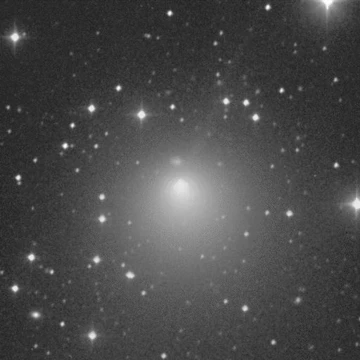
450P/LONEOS
Distant periodic comet transitioning from centaur to Jupiter-family.

450P/LONEOS (formally designated P/2004 A1 and P/2022 Q3) is a periodic comet that orbits the Sun once every 22 years, staying relatively far from our star. It was discovered as part of the Lowell Observatory Near-Earth-Object Search (LONEOS) program, which has found several other comets.
The comet was first spotted as an 18th-magnitude object in CCD images taken by Brian A. Skiff during the LONEOS survey. Though it appeared star-like in those images, its motion led Skiff to request follow-up observations. H. R. Miller at Perkins Observatory and J. Young at Table Mountain Observatory later detected a coma roughly 4 arcseconds across and a very faint tail about 10 arcseconds long, confirming it was a comet. At that time, it was about 5.54 AU (829 million km) from the Sun. Initial orbital calculations were posted on the Minor Planet Center’s website on 13 January 2004, along with precovery images from Kitt Peak Observatory dating back to 18 December 2003.
The comet was recovered in August 2022 by the Gemini North Observatory, appearing 4.5 magnitudes fainter than predicted. It received its permanent numerical designation, 450P, in February 2023, alongside eight other comets.
As of 2024, 450P/LONEOS orbits the Sun with an inclination of about 10.65 degrees to the ecliptic. Its perihelion is roughly 5.45 AU (815 million km), and its aphelion reaches 10.44 AU (1.562 billion km). Orbital calculations show it had a close encounter with Saturn in 1992, passing within 0.031 AU (4.6 million km) of the giant planet. This encounter reduced its semimajor axis by 5.2 AU (780 million km). Long-term orbital studies suggest this is likely its first trip into the inner Solar System, as it transitions from a centaur into a Jupiter-family comet. On 11 July 2026, it will approach Jupiter at 0.5 AU (75 million km), further tightening its orbit around the Sun.
Physical characteristics: A 2011 study estimated the nucleus radius between 0.5 km and 3.5 km, based on dust activity. Later observations from Gemini and the James Webb Space Telescope, when the comet was inactive between 2019 and 2024, revised this to about 1.8 ± 0.5 km. During its 2004 apparition, its asymmetrical coma and anti-tail extended up to 150,000 km (93,000 mi) sunward.
Quick Facts
- Discovery Ref
- IAUC_8267 · MPEC_2004-A51
- Discovery Site
- LONEOS
- Discovery Date
- 13 January 2004
- Mpc Name
- P/2004 A1, P/2022 Q3
- Designations
- LONEOS 8nasa-pds
- Orbit Ref
- jpldata · MPC
- Epoch
- 5 May 2024 (JD 2460800.5)
- Earliest Precovery Date
- 25 October 2003
- Obs
- 988
- Perihelion
- 5.449 AU
- Aphelion
- 10.442 AU
- Semimajor
- 7.945 AU
Facts from the source article.
Lore & Background
The comet was discovered as an 18th-magnitude object on CCD images taken by Brian A. Skiff as part of the Lowell Observatory's LONEOS program. The LONEOS images showed the object with a stellar-like appearance, but its motion prompted Skiff to request additional observations. H. R. Miller (Perkins Observatory) and J. Young (Table Mountain Observatory) later found a coma about 4 arcseconds in diameter and a very faint tail about 10 arcseconds in length, confirming its cometary nature. At the time its cometary activity was detected, 450P/LONEOS (then known as P/2004 A1) was about 5.54 AU from the Sun. The first orbital calculations were published on the Minor Planet Center's website on 13 January 2004, alongside precovery images from Kitt Peak Observatory dating back to 18 December 2003.
The comet was successfully recovered from observations taken by the Gemini North Observatory in August 2022, where it was noted to be 4.5 magnitudes fainter than previously predicted. It received its official numerical designation (450P) alongside 8 other comets in February 2023. Orbital calculations indicated that it made a close encounter with Saturn in 1992, coming within 0.031 AU of the giant planet, which decreased its semimajor axis by 5.2 AU. A long-term orbital investigation indicated that this is likely its first sojourn to the inner Solar System as it transitions from a centaur into a Jupiter-family comet. On 11 July 2026, the comet approached Jupiter at a distance of 0.5 AU, further sending it into a closer orbit around the Sun.
A 2011 study revealed that based on its measured dust activity, the nucleus may be between 0.5 km and 3.5 km in radius. At the time it was in an inactive state between 2019 and 2024, further observations from both the Gemini Observatory and the James Webb Space Telescope revised this to roughly 1.8±0.5 km. Its asymmetrical coma and anti-tail during its 2004 apparition extended up to 150,000 km in the solar direction. During its 2022 apparition, it had a low dust production rate of about ~4.8 kg/s, primarily driven by CO2 outgassing from amorphous water ice crystallization at temperatures between 140–160 K.
Reader's Guide
450P/LONEOS holds significance as a comet that has undergone a dramatic orbital transformation due to a close encounter with Saturn in 1992, which reduced its semimajor axis by 5.2 AU and likely brought it into the inner Solar System for the first time. This transition from a centaur to a Jupiter-family comet makes it a valuable object for studying the dynamical evolution of small bodies. Its recovery in 2022, 4.5 magnitudes fainter than predicted, and subsequent observations by the Gemini Observatory and the James Webb Space Telescope provided refined estimates of its nucleus size (1.8±0.5 km) and revealed that its low dust production is driven by CO2 outgassing rather than water. The comet's 2026 approach to Jupiter will further alter its orbit, offering a rare opportunity to observe the ongoing reshaping of a comet's trajectory. Its legacy includes being one of the comets discovered by the LONEOS program and serving as a case study for the physical and orbital changes that occur as centaurs evolve into Jupiter-family comets.
Did You Know?
- 450P/LONEOS was discovered as an 18th-magnitude object by Brian A. Skiff as part of the LONEOS program.
- Its nucleus size was revised to roughly 1.8±0.5 km based on observations from the Gemini Observatory and the James Webb Space Telescope.
- During its 2022 apparition, its dust production was primarily driven by CO2 outgassing at temperatures between 140–160 K.
More in Periodic Comets, Part 2 1-24
Spotted an error? Know more?
Reader corrections go straight into our review queue. Suggest an edit · How this site is sourced