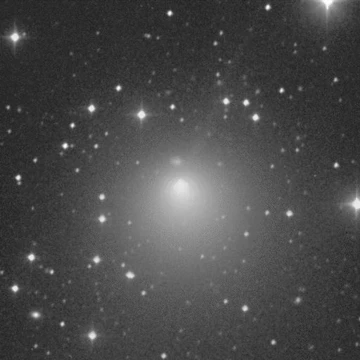
373P/Rinner
First comet discovered by French astronomer Claudine Rinner.

373P/Rinner is a Jupiter-family comet that orbits the Sun once every 7.42 years. It holds the distinction of being the first comet discovered by French astronomer Claudine Rinner, and it is also the first comet discovered from France since C/1997 J2 (Meunier–Dupouy).
Claudine Rinner first spotted the comet on CCD images taken at the Oukaïmeden Observatory on 28 November 2011. The object, then nearly 18th magnitude in Canis Minor, showed a faint tail roughly one arcminute long. Follow-up observations from around the world over the next few days confirmed the discovery, and the comet was initially designated P/2011 W2. Gareth V. Williams calculated the preliminary orbital elements for the Minor Planet Center, suggesting a roughly 10-year orbit around the Sun.
The comet was recovered on 14 September 2018 by Krisztián Sárneczky and Róbert Szakáts at the Konkoly Observatory, appearing almost stellar in their images. It was then designated P/2018 R2. Gareth V. Williams linked the two apparitions from 2011 and 2019 through orbital calculations. In December 2018, along with 11 other comets, it received its permanent numerical designation, 373P.
Observations from the Sierra Nevada Observatory (OSN) in Spain between December 2011 and January 2012 allowed astronomers to study the comet's dust environment. Analysis of the photographic plates showed a mass loss rate of 2.0 kg/s (4.4 lb/s) when the comet was 1.45 AU (217 million km) from the Sun—a level of activity comparable to other low-activity comets like 115P/Maury and 157P/Tritton. This low activity also enabled astronomers to estimate the comet's nucleus radius, which is no greater than 2.2 km (1.4 mi).
Quick Facts
- Discovery Ref
- CBET_2922 · IAUC_9244
- Discoverer
- Claudine Rinner
- Discovery Site
- Oukaïmeden, Morocco
- Discovery Date
- 28 November 2011
- Mpc Name
- P/2011 W2, P/2018 R2
- Designations
- PK11W020
- Orbit Ref
- jpldata · MPC
- Epoch
- 17 December 2020 (JD 2459200.5)
- Obs
- 921
- Perihelion
- 2.313 AU
- Aphelion
- 5.296 AU
- Semimajor
- 3.805 AU
Facts from the source article.
Lore & Background
The comet was first discovered on CCD images taken from the Oukaïmeden Observatory on 28 November 2011. Claudine Rinner noted a faint tail about an arcminute in length, nearly an 18th-magnitude object in the constellation Canis Minor. Additional observations across the globe in the following days confirmed the existence of the comet, which was subsequently designated as P/2011 W2. Gareth V. Williams provided the preliminary orbital elements on the Minor Planet Center's site, indicating a roughly 10-year periodic orbit.
Krisztián Sárneczky and Róbert Szakáts recovered the comet from the Konkoly Observatory as P/2018 R2 on 14 September 2018, where its appearance was reported to be almost stellar-like. Gareth V. Williams calculated the orbit linking the two apparitions in 2011 and 2019. The comet received its official numerical designation, 373P, in December 2018 alongside 11 other comets.
Observations from the Sierra Nevada Observatory (OSN) in Spain between December 2011 and January 2012 helped determine the dust environment. Analysis determined a mass loss rate of 2.0 kg/s while it was 1.45 AU from the Sun, comparable to other low-activity comets like 115P/Maury and 157P/Tritton. The low activity enabled astronomers to estimate its nucleus radius as no greater than 2.2 km.
Reader's Guide
373P/Rinner holds significance as the first comet discovered by French astronomer Claudine Rinner and the first comet discovery from France since C/1997 J2 (Meunier–Dupouy). Its discovery on CCD images from the Oukaïmeden Observatory on 28 November 2011, with a faint tail and 18th-magnitude brightness, led to global confirmation. The comet's preliminary orbital elements, provided by Gareth V. Williams, initially suggested a roughly 10-year orbit, though later calculations established a 7.42-year period. Recovery by Krisztián Sárneczky and Róbert Szakáts in September 2018 linked the two apparitions, leading to its official numbering in December 2018. Physical studies at the Sierra Nevada Observatory revealed a low mass loss rate of 2.0 kg/s at 1.45 AU, comparable to other low-activity comets, and a nucleus radius no greater than 2.2 km. These characteristics place it among comets with modest activity, contributing to understanding of such bodies.
Did You Know?
- The comet's nucleus radius is estimated to be no greater than 2.2 km.
- Its mass loss rate was measured at 2.0 kg/s when 1.45 AU from the Sun.
More in Periodic Comets, Part 2 1-24
Spotted an error? Know more?
Reader corrections go straight into our review queue. Suggest an edit · How this site is sourced