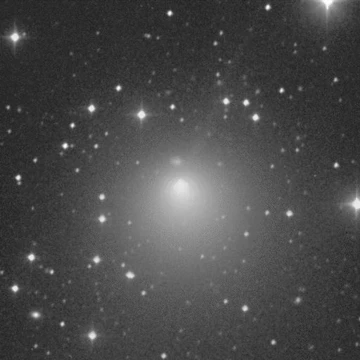
311P/PanSTARRS
An active asteroid with six comet-like tails.

311P/PanSTARRS (also cataloged as P/2013 P5) is an active asteroid and Encke-type comet first spotted by Bryce T. Bolin using the Pan-STARRS telescope on August 27, 2013. Its most striking feature is six comet-like tails, which the Hubble Space Telescope revealed. Scientists think these tails are streams of material flung off the asteroid as it spins rapidly—a rubble pile rotating fast enough to shed debris. This behavior resembles that of 331P/Gibbs, another fast-spinning rubble pile.
Jessica Agarwal of the Max Planck Institute for Solar System Research in Lindau, Germany, built three-dimensional models showing the tails likely formed through a series of short, periodic dust-ejection events. After ejection, radiation pressure from the Sun stretched the dust into long streams. Precovery images from the Sloan Digital Sky Survey, dating back to 2005, show the object had negligible cometary activity at that time.
The asteroid has a radius of about 240 meters (790 feet). Initial Pan-STARRS images caught an unusual sight: instead of a typical point of light, P/2013 P5 appeared fuzzy. Hubble observed the multiple tails on September 10, 2013, and returned on September 23 to find the structure had completely swung around. Hubble continued tracking the object until February 11, 2014. Its comet-like appearance led to it being classified as a comet. The object has a low orbital inclination and always stays outside Mars’s orbit.
On April 19, 2018, light-curve observations hinted at a possible satellite around 311P/PanSTARRS, approaching 200 meters in size. If confirmed, it would be one of the few minor planets designated as a comet known to host a moon.
The Tianwen-2 spacecraft, launched on May 28, 2025, is planned to orbit 311P/PanSTARRS in the mid-2030s. It will first visit and sample asteroid 469219 Kamoʻoalewa from late 2026 to early 2027, return those samples to Earth, then use a gravity assist from Earth to reach 311P/PanSTARRS. Once there, it will enter orbit and conduct remote sensing studies.
Quick Facts
- Discovery Ref
- CBET_3639
- Discoverer
- Bryce T. Bolin
- Discovery Site
- Haleakala Observatory / (Pan-STARRS)
- Discovery Date
- 27 August 2013
- Mpc Name
- P/2013 P5
- Designations
- PanSTARRS 23nasa-pds
- Orbit Ref
- MPC
- Epoch
- 21 November 2025 / (JD 2461000.5)
- Observation Arc
- 20.29 years
- Obs
- 271
- Earliest Precovery Date
- 17 January 2005
- Perihelion
- 1.936 AU
Facts from the source article.
Lore & Background
The object was first identified as fuzzy-looking by Pan-STARRS, unusual for an asteroid. Hubble Space Telescope observations on 10 September 2013 revealed six tails; by 23 September its appearance had totally changed, as if the entire structure had swung around. Hubble continued tracking it through 11 February 2014. Three-dimensional models by Jessica Agarwal of the Max Planck Institute for Solar System Research in Lindau, Germany, showed the tails could have formed by periodic impulsive dust-ejection events, with solar radiation pressure stretching the dust into streams. Precovery images from the Sloan Digital Sky Survey from 2005 showed negligible cometary activity in 2005. The comet-like appearance led to its designation as a comet. On 19 April 2018, light-curve observations suggested a possible satellite around 311P/PanSTARRS approaching 200 meters, which would make it one of the few minor planets designated as a comet known to harbor a satellite.
Reader's Guide
311P/PanSTARRS is significant as an active asteroid that exhibits multiple tails, a rare phenomenon linked to its nature as a quickly-spinning rubble pile. This behavior is similar to 331P/Gibbs, another rubble pile asteroid. The Hubble Space Telescope's observations revealed dramatic structural changes over weeks, providing insight into the dynamics of material ejection from small bodies. The possible satellite, suggested by light-curve data in 2018, adds to its uniqueness among comet-designated minor planets. The planned Tianwen-2 spacecraft, launched on 28 May 2025, is set to orbit 311P/PanSTARRS in the mid-2030s after sampling asteroid 469219 Kamoʻoalewa, enabling remote sensing study. The object's low orbital inclination and position outside Mars's orbit make it accessible for such exploration. Its discovery and study have advanced understanding of how rubble pile asteroids can lose mass due to rapid rotation, a process related to the Yarkovsky–O'Keefe–Radzievskii–Paddack (YORP) effect.
Did You Know?
- 311P/PanSTARRS has six comet-like tails observed by the Hubble Space Telescope.
- Its tails are thought to result from a rubble pile asteroid spinning fast enough to eject material.
- Precovery images from 2005 showed negligible cometary activity.
More in Periodic Comets, Part 2 1-24
Spotted an error? Know more?
Reader corrections go straight into our review queue. Suggest an edit · How this site is sourced