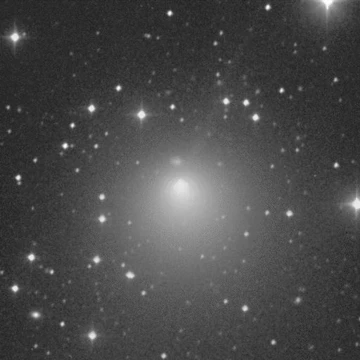
260P/McNaught
Jupiter-family comet discovered by Robert H. McNaught in 2005.

260P/McNaught, designated Comet McNaught 4, is a Jupiter-family comet that circles the Sun once every 6.9 years. It belongs to a group of periodic comets spotted by Australian astronomer Robert H. McNaught. Its most recent perihelion occurred in August 2026, with the next one scheduled for July 2033.
McNaught first observed this comet on 20 May 2005 using the 0.5-meter telescope at Siding Spring Observatory. He noted a slightly diffuse head and a narrow tail stretching about 30 arcseconds. Initially labeled P/2005 K3, it was rediscovered between 15 and 18 May 2012 at the Pierre Auger Observatory as P/2012 K2, and confirmed a few days later as a recovery of the same comet. During its 2019 return, a small outburst briefly increased its brightness from magnitude 13.78 to 13.59.
Photometric analysis from August 2012 to January 2013 revealed that the nucleus rotates on a single axis, completing one stable rotation every 0.34 ± 0.01 days (8.16 ± 0.240 hours). Its effective radius was measured at 1.54 ± 0.09 km, though near-infrared observations by the Spitzer Space Telescope suggested a smaller effective radius of about 0.322 ± 0.04 km, indicating the nucleus may be elongated.
Quick Facts
- Discovery Ref
- CBET_0161 · IAUC_8535
- Discoverer
- Robert H. McNaught
- Discovery Site
- Siding Spring Observatory
- Discovery Date
- 20 May 2005
- Mpc Name
- P/2005 K3, P/2012 K2
- Designations
- McNaught 4nasa-pds
- Orbit Ref
- jpldata · MPC
- Epoch
- 9 June 2026 (JD 2461200.5)
- Obs
- 7,210
- Perihelion
- 1.418 AU
- Aphelion
- 5.829 AU
- Semimajor
- 3.623 AU
Facts from the source article.
Lore & Background
Comet McNaught 4 was first observed on 20 May 2005 by Robert H. McNaught using the 0.5 m telescope at Siding Spring Observatory. He reported a slightly diffuse head with a narrow tail about 30 arcseconds in length. It was later rediscovered between 15–18 May 2012 from the Pierre Auger Observatory as P/2012 K2, and confirmed a few days later as a recovery of the comet.
Photometric analysis conducted between August 2012 and January 2013 determined that its nucleus rotates on a single axis, completing one stable rotation every 0.34 ± 0.01 days (8.16 ± 0.240 hours). The nucleus has an effective radius of 1.54 ± 0.09 km from photometric data, but near-infrared observations from the Spitzer Space Telescope found a smaller effective radius of about 0.322 ± 0.04 km, suggesting the nucleus may have an elongated shape.
During its 2019 apparition, a small outburst temporarily brightened the comet from magnitude 13.78 to 13.59.
Reader's Guide
260P/McNaught is notable as one of several periodic comets discovered by Robert H. McNaught, contributing to the catalog of Jupiter-family comets with a well-defined 6.9-year orbit. Its observational history includes an initial discovery in 2005, a recovery in 2012 from the Pierre Auger Observatory, and a small outburst during its 2019 apparition that briefly increased its brightness. The comet's physical characteristics show a discrepancy in measured nucleus size: photometric analysis gives an effective radius of 1.54 km, while Spitzer Space Telescope near-infrared observations indicate a much smaller radius of about 0.322 km, suggesting an elongated shape. This size uncertainty highlights the challenges in characterizing comet nuclei. The comet's rotation period of 8.16 hours was determined from stable single-axis rotation. Its next perihelion in July 2033 will provide further opportunities for study.
More in Periodic Comets, Part 2 1-24
Spotted an error? Know more?
Reader corrections go straight into our review queue. Suggest an edit · How this site is sourced