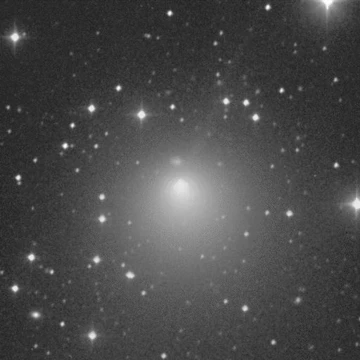
252P/LINEAR
Jupiter-family comet that made the fifth closest Earth approach.

252P/LINEAR is a Jupiter-family comet and near-Earth object first spotted on 7 April 2000 by the Lincoln Near-Earth Asteroid Research (LINEAR) survey. At some point, it split from a second object, 460P/PanSTARRS, which was found in January 2016. That fragment has a 1 km wide nucleus—larger than 252P’s estimated 600 m core—but is less active. On 21 March 2016, 252P came within 0.0356 AU (5.33 million km) of Earth, the fifth closest comet flyby ever recorded.
**Observational history** The comet was discovered as a fast-moving object using a 1.0 m f/2.15 reflector telescope. Lisa Brown-Manguso noted its diffuse tail, confirming it as a comet. Its magnitude was 17–18 at discovery. Follow-up observations gave a short-period orbit of 5.4 years, with perihelion at 1.00293 AU. During its 2000 apparition, it approached Earth to 0.10 AU. The comet was recovered on 9 June 2011 by the Spacewatch Project at Kitt Peak Observatory, Arizona, at magnitude 22.7.
The 2016 apparition was especially favorable: on 21 March it passed 0.0356 AU from Earth. It became more active than predicted, brightening to magnitude 4.5 and becoming faintly visible to the naked eye. The Hubble Space Telescope observed it on 4 April 2016—the closest object (other than the Moon) Hubble has ever imaged. Those images revealed a narrow, well-defined dust jet from the nucleus.
In the 2021 apparition, the comet was again brighter than expected. On 8 August its visual magnitude was about 10.5; by 10 August, CCD photometry gave magnitude 13.1, with a coma 3.6 arcminutes across and no tail detected.
**Orbit** 252P/LINEAR is an Earth-Jupiter family comet, meaning it passes near both planets, causing frequent orbital perturbations. Its inclination is 10.4°, orbital period 5.33 years (epoch July 2021), and perihelion 1.0005 AU. For epoch November 2026, perihelion will be 1.0037 AU. The nominal orbit suggests Jupiter nudged it into near-Earth space in the 1800s, possibly its first close approach to the Sun. Its Jupiter MOID is currently 0.2 AU, and Jupiter will remain the main driver of orbital changes. The comet will approach Jupiter at 0.76 AU on 22 December 2033 and at 0.11 AU on 3 August 2046. Another close Earth flyby will occur on 18 March 2032, at 0.050 AU.
**Physical characteristics** Hubble’s 2016 images showed a narrow sunward jet from the nucleus.
Quick Facts
- Discovery Ref
- IAUC_7396
- Discovery Site
- LINEAR
- Discovery Date
- 7 April 2000
- Mpc Name
- P/2000 G1, P/2011 L5
- Designations
- LINEAR 12nasa-pds / PK11L050MPEC_2011-L41
- Orbit Ref
- jpl1 · MPC
- Epoch
- 5 July 2021 (JD 2459400.5)
- Obs
- 1,889
- Perihelion
- 1.000 AU
- Aphelion
- 5.099 AU
- Semimajor
- 3.049 AU
- Eccentricity
- 0.67197
Facts from the source article.
Lore & Background
The comet was discovered on 7 April 2000 by the LINEAR survey using a 1.0 m f/2.15 reflector telescope. Lisa Brown-Manguso noted its diffuse tail, confirming it as a comet. Initial magnitude was 17–18, and its short-period orbit of 5.4 years with perihelion at 1.00293 AU was calculated. During the 2000 apparition it approached Earth to 0.10 AU. It was recovered on 9 June 2011 by the Spacewatch Project at Kitt Peak Observatory at magnitude 22.7.
The 2016 apparition was highly favorable: the comet passed 0.0356 AU from Earth on 21 March 2016, reaching magnitude 4.5 and becoming faintly visible to the naked eye. Hubble Space Telescope observed it on 4 April 2016, revealing a narrow, well-defined dust jet. The nucleus was estimated at 600 m (2,000 ft) across. The comet separated from a second object, 460P/PanSTARRS (nucleus 1 km wide), discovered in January 2016. 460P/PanSTARRS is larger but less active.
During the 2021 apparition the comet was again brighter than expected. On 8 August visual magnitude was about 10.5; on 10 August CCD photometry gave magnitude 13.1 with a coma 3.6 arcminutes across and no tail detected.
Reader's Guide
252P/LINEAR is significant as a Jupiter-family comet that undergoes frequent orbital perturbations due to close passes by both Earth and Jupiter. Its 2016 flyby was the fifth closest comet approach to Earth, enabling detailed study by Hubble, which measured a rotation period of 7.24±0.07 hours from the jet, though light-curve data suggested 5.41±0.07 hours, and CN features indicated a period around 22 hours or a sub-multiple, with other features repeating every ~95.5 hours, implying a possible non-principal-axis rotator. Its near-infrared spectrum revealed H2O, CH3OH, C2H6, and HCN, with higher methanol and ethane abundances and lower formaldehyde than typical short-period comets. The dust-to-gas mass ratio of 0.025 is among the lowest observed. The comet is predicted to produce a weak meteor shower from the constellation Lepus on March 28–29, 2016, with slow geocentric velocity 11.1 km/s, but no dust trail encounters from 1850 onward; instead a diffuse cloud of meteoroids ejected 1894–1926 may be encountered. A meteor shower with similar orbit, the March Lyncids, is known but not confirmed as related. The comet will approach Earth again on 18 March 2032 at 0.050 AU.
Did You Know?
- The comet's nucleus is estimated to be 600 m (2,000 ft) across, while its separated fragment 460P/PanSTARRS is 1 km wide.
- Hubble Space Telescope observed 252P/LINEAR on 4 April 2016, making it the closest celestial object (other than the Moon) Hubble has imaged.
More in Periodic Comets, Part 2 1-24
Spotted an error? Know more?
Reader corrections go straight into our review queue. Suggest an edit · How this site is sourced