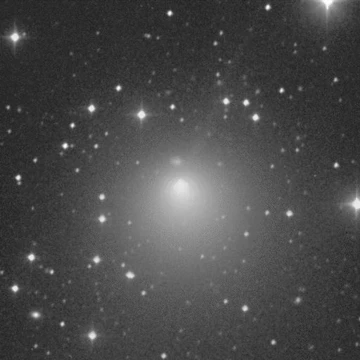
240P/NEAT
Jupiter-family comet with a fragment split from its nucleus.

240P/NEAT is a Jupiter-family comet with an orbital period of 7.61 years, discovered by the Near Earth Asteroid Tracking (NEAT) program on 7 December 2002. It is notable for a close approach to Jupiter in 2007 that altered its orbit, and for the later discovery of a fragment, 240P-B, which split from the main nucleus.
Quick Facts
- Discovery Ref
- IAUC_8029
- Discoverer
- K. J. Lawrence
- Discovery Site
- NEAT–Palomar
- Discovery Date
- 7 December 2002
- Mpc Name
- P/2002 X2, P/2010 P1
- Orbit Ref
- MPC
- Epoch
- 21 November 2025 (JD 2461000.5)
- Earliest Precovery Date
- 5 October 2002
- Obs
- 7,754
- Semimajor
- 3.861 AU
- Perihelion
- 2.12163 AU (A)Horizons2025 / 2.12167 AU (B)Horizons2025-B
- Aphelion
- 5.602 AU
Facts from the source article.
Lore & Background
The comet was discovered on 7 December 2002 by NEAT at an apparent magnitude of 18.4, with a coma 8 arcseconds across and a tail 14 arcseconds long. Prediscovery images from 5 October and 6 December 2002 by LONEOS and from 5 November 2002 by NEAT helped establish it as a periodic comet with an initial orbital period of 8.1 years. It was recovered independently by H. Taylor, H. Sato, Leonid Elenin, and T. Yusa on 9, 10, 11, and 11 August 2010 respectively at magnitude around 17, and received its official numerical designation 240P in August 2010.
A close approach to Jupiter on 10 July 2007 at 0.252 AU reduced the orbital period to 7.6 years and the perihelion distance from 2.5 to 2.1 AU. The comet experienced three significant brightening events lasting three to six months during its next two perihelia: March–April 2011, July–August 2017, and November–December 2018. These events are likely due to warming of previously insulated material after the perihelion distance reduction, with new activity occurring in one or two locations on the nucleus.
On 3 October 2025, fragment 240P-B was imaged by Kitt Peak and reported by V. Carvajal. It came to perihelion on 19 December 2025, about 51 minutes after the main body and about 0.00004 AU (6,000 km) farther from the Sun. The separation (∼108 m) and rate of change (∼1 m s−1) suggest splitting at least three years earlier. The radius of 240P-B is uncertain, with a best estimate ∼300 m and an absolute lower limit 50 m. Its mass loss peaked at ∼35 kg s−1 around perihelion, with total ejected mass 2.3×10^8 kg. The likely cause is rotational instability from outgassing torques, and both fragments are liable to further breakup.
Reader's Guide
240P/NEAT holds significance as a Jupiter-family comet whose orbital evolution was dramatically altered by a close approach to Jupiter in 2007, reducing its orbital period and perihelion distance. This change likely triggered repeated brightening events lasting months, attributed to the warming of previously insulated material. The discovery of fragment 240P-B in 2025 provides a rare opportunity to study cometary splitting in detail. The separation dynamics and mass loss rates indicate rotational instability driven by outgassing torques as the cause, rather than sublimation. The fragment's uncertain radius (best estimate ∼300 m, lower limit 50 m) and its peak mass loss of ∼35 kg s−1 around perihelion offer quantitative insights into the breakup process. The article notes that both the main nucleus and fragment are liable to further destruction on timescales shorter than those from sublimation alone, highlighting the dynamic fragility of such bodies. This case underscores how gravitational encounters with Jupiter can reshape comet orbits and trigger cascading fragmentation events.
Did You Know?
- 240P/NEAT was discovered on 7 December 2002 by the Near Earth Asteroid Tracking (NEAT) program.
- The comet's orbital period was reduced from 8.1 to 7.6 years after a close approach to Jupiter on 10 July 2007.
- Fragment 240P-B was first imaged on 3 October 2025 by Kitt Peak and reported by V. Carvajal.
- The separation between 240P-A and 240P-B is about 108 m, with a rate of change of about 1 m/s.
More in Periodic Comets, Part 2 1-24
Spotted an error? Know more?
Reader corrections go straight into our review queue. Suggest an edit · How this site is sourced