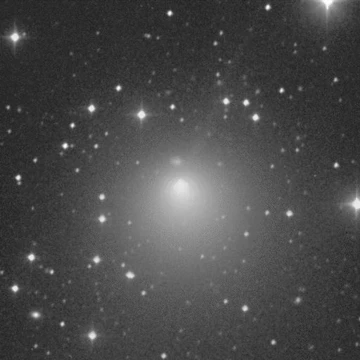
226P/Pigott–LINEAR–Kowalski
Jupiter-family comet discovered in 1783, lost, then recovered.

226P/Pigott–LINEAR–Kowalski is a Jupiter-family comet that orbits the Sun once every 7.3 years. English astronomer Edward Pigott first spotted it on 19 November 1783, in the constellation Cetus, describing it as a faint nebula with a barely visible nucleus. After Pigott’s initial observations, the comet faded and was last seen on 21 December 1783. Early orbit calculations assumed a parabolic path, but in 1860 Christian Heinrich Friedrich Peters derived an elliptical orbit with a period of 5.89 years—though the comet remained lost.
More than two centuries later, on 5 January 2003, the Lincoln Near-Earth Asteroid Research (LINEAR) survey recovered an object initially thought to be an asteroid. Further observations revealed a diffuse coma 8 arcseconds across, and it was designated C/2003 A1. During its next return, Richard Kowalski of the Catalina Sky Survey recovered it again on 10 September 2009, at an apparent magnitude of around 18. Additional orbital calculations linked this object to both P/1783 W1 and 2003 A1, and in October 2009 it received the official numerical designation 226P. During the 2016 apparition, the comet brightened to magnitude 13.9. Its most recent perihelion occurred on 27 December 2023, when it reached an apparent magnitude of about 15. Infrared observations from the WISE spacecraft indicate the comet’s nucleus is roughly 2.15 kilometers (1.34 miles) in diameter.
Quick Facts
- Discovery Ref
- Pigott_1783 · IAUC_8044 · IAUC_9072
- Discoverer
- Edward Pigott · LINEAR · Richard Kowalski
- Discovery Date
- 19 November 1783 · 5 January 2003 · 11 September 2009
- Mpc Name
- D/1783 W1, P/2003 A1 · P/2009 R2
- Designations
- 1783 IICQ1
- Orbit Ref
- jpldata · MPC
- Epoch
- 21 November 2025 (JD 2461000.5)
- Obs
- 1,888
- Perihelion
- 1.775 AU
- Aphelion
- 5.756 AU
- Semimajor
- 3.766 AU
- Eccentricity
- 0.52871
Facts from the source article.
Lore & Background
The comet was discovered by English astronomer Edward Pigott from York, England, on 19 November 1783, located in the constellation of Cetus. He described it as a nebula with faint nucleus not visible in a good opera glass. It was observed by Pierre Méchain on 26 November and Charles Messier the next day, who noted it was not visible to the naked eye and appeared as extremely faint nebulosity about 4 arcmin across with strong central condensation. The comet dimmed and was last observed on 21 December 1783. Initial parabolic orbits did not fit well, and an elliptical orbit calculated by Christian Heinrich Friedrich Peters in 1860 indicated an orbital period of 5.89 years.
The comet was recovered on 5 January 2003 by LINEAR, initially thought to be an asteroid but later showing a coma 8 arcseconds across with an apparent magnitude of 18.4. It was named C/2003 A1. During the next apparition, Richard Kowalski of Catalina Sky Survey recovered it on 10 September 2009 at magnitude around 18. It was identified as the same comet as P/1783 W1 and 2003 A1, and given the official numerical designation 226P in October 2009. During the 2016 apparition it brightened to magnitude 13.9.
Infrared observations from the Wide-field Infrared Survey Explorer (WISE) spacecraft indicated the nucleus is about 2.15 km in diameter.
Reader's Guide
The significance of 226P/Pigott–LINEAR–Kowalski lies in its long observational history spanning over two centuries, from its initial discovery in 1783 by Edward Pigott to its recovery in the 21st century by LINEAR and Richard Kowalski. This comet exemplifies the challenges of tracking periodic comets with uncertain orbits, as early calculations by Christian Heinrich Friedrich Peters in 1860 suggested a period of 5.89 years, while modern observations established a period of 7.3 years. Its recovery in 2003 and 2009 allowed astronomers to link the historical observations with modern data, leading to its official numerical designation. The comet's nucleus diameter of 2.15 km, measured by WISE, provides physical context. Its last perihelion on 27 December 2023 at apparent magnitude 15 continues its legacy as a regularly observed Jupiter-family comet.
Did You Know?
- The comet was discovered by Edward Pigott on 19 November 1783.
- It was recovered by LINEAR on 5 January 2003 and by Richard Kowalski on 10 September 2009.
- Its nucleus is about 2.15 km in diameter, as measured by the WISE spacecraft.
- The comet last came to perihelion on 27 December 2023 at apparent magnitude 15.
More in Periodic Comets, Part 2 1-24
Spotted an error? Know more?
Reader corrections go straight into our review queue. Suggest an edit · How this site is sourced