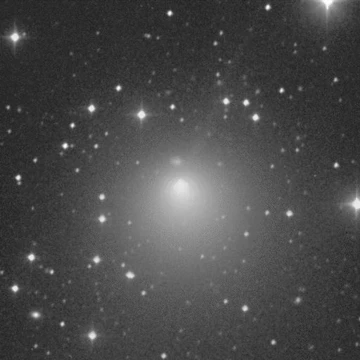
220P/McNaught
Jupiter-family comet with two major outbursts in 2026.

220P/McNaught is a Jupiter-family comet with a 5.5-year orbit around the Sun, discovered by Australian astronomer Robert H. McNaught. It is notable for undergoing two major outbursts in 2026, the first brightening as much as 8,000 times and the second by a factor of about 600.
Quick Facts
- Discovery Ref
- IAUC_8348
- Discoverer
- Robert H. McNaught
- Discovery Site
- Siding Spring Observatory
- Discovery Date
- 20 May 2004
- Mpc Name
- P/2004 K2, P/2009 H2
- Designations
- McNaught 1nasa-pds
- Orbit Ref
- MPC
- Epoch
- 21 November 2025 / (JD 2461000.5)
- Obs
- 1,599
- Perihelion
- 1.559 AU
- Aphelion
- 4.68 AU
- Semimajor
- 3.12 AU
Facts from the source article.
Lore & Background
Robert McNaught discovered 220P/McNaught on 20 May 2004 using CCD images from the Uppsala Southern Schmidt Telescope at Siding Spring Observatory, Australia. The comet had an estimated magnitude of 17.7, a coma 8–10 arcseconds across without central concentration, and a narrow tail 20 to 30 arcseconds long. The discovery was confirmed by J. Young at Table Mountain Observatory on May 25. The comet was later recovered by Spacewatch on 28 April 2009 and independently by G. Muler, J. M. Ruiz and R. Naves at Nazaret Observatory on May 1, appearing stellar at magnitude 20.2, after which it received the permanent number 220P.
In 2026, the comet underwent a large outburst reported on 1 June by Mike Kelley using Zwicky Transient Facility data, brightening by about 7 magnitudes (from roughly magnitude 18 to 11) within a 13-hour window between May 30 and May 31. Other observations reported a peak magnitude of 8.2, representing up to an 8,000-fold increase. The coma expanded to 6.5 arcminutes across with a tail about 2 arcminutes long, and deeper exposures revealed a fainter ion tail about two degrees long. Follow-up measurements from the TRAPPIST-North Telescope indicated a significant drop in dust production rate after the outburst, which appeared enriched in C2 relative to CN, suggesting a fragmentation event. A second outburst on 5 August 2026 brightened the comet by a factor of about 600, from magnitude 14 to magnitude 7.
The outbursts are caused by the sudden release of heated gases breaking through the crust, creating a massive dust plume that increases the coma's column density and surface area. For comparison, in 2007, Comet 17P/Holmes brightened as much as a million-fold.
Reader's Guide
220P/McNaught's significance lies in its dramatic outburst behavior, which provides insight into the internal structure and volatile composition of Jupiter-family comets. The 2026 outbursts, with brightness increases of up to 8,000-fold and 600-fold, are rare events that allow astronomers to study the sudden release of gases and dust from beneath the comet's crust. The enrichment of C2 relative to CN observed after the first outburst suggests a fragmentation event, offering clues about the comet's chemical heterogeneity. The comet's orbit, with a period of 5.5 years and an Earth–Minimum orbit intersection distance of 0.54 AU, makes it accessible for observation during its returns. Its legacy includes being one of several comets discovered by Robert H. McNaught and being monitored by facilities like the Zwicky Transient Facility and TRAPPIST-North Telescope, which captured the outburst details. The comparison to Comet 17P/Holmes' million-fold brightening in 2007 places 220P's outbursts in context of extreme cometary activity, though less intense.
Did You Know?
- 220P/McNaught was discovered by Robert H. McNaught on 20 May 2004 using the Uppsala Southern Schmidt Telescope at Siding Spring Observatory.
- The comet's first 2026 outburst brightened it as much as 8,000 times, from roughly magnitude 18 to a peak of magnitude 8.2.
More in Periodic Comets, Part 2 1-24
Spotted an error? Know more?
Reader corrections go straight into our review queue. Suggest an edit · How this site is sourced