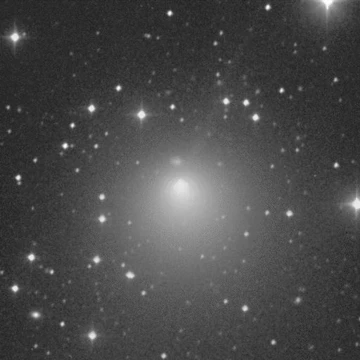
209P/LINEAR
A low-activity periodic comet possibly evolving into extinction.

209P/LINEAR is a periodic comet with an orbital period of 5.1 years, discovered on 3 February 2004 by the Lincoln Near-Earth Asteroid Research (LINEAR) survey. It is notable for its extremely low activity for its size, suggesting it is probably evolving into an extinct comet, and for producing the most detailed radar image of a comet nucleus to that date during its close approach to Earth in 2014.
Quick Facts
- Discoverer
- LINEAR / 1.0-m reflector
- Discovery Date
- 3 February 2004 (asteroidal) / 30 March 2004 (tail)
- Mpc Name
- P/2004 CB, P/2008 X2
- Epoch
- 2014-May-23 / (JD 2456800.5)
- Earliest Precovery Date
- 3 December 2003
- Obs
- 2,883
- Earth Moid
- 0.05 AU
- Semimajor
- 2.961 AU (a)
- Perihelion
- 0.9695 AU (q)
- Aphelion
- 4.952 AU (Q)
- Eccentricity
- 0.67258
- Period
- 5.09 yr
Facts from the source article.
Lore & Background
The comet was initially observed without a coma and designated as a minor planet (2004 CB). In March 2004, Robert H. McNaught observed a comet tail, confirming it as a comet. It received the permanent number 209P on 12 December 2008, as it was the second observed appearance. Prediscovery images dating back to December 2003 were found in 2009.
209P/LINEAR came to perihelion on 6 May 2014 and passed 0.0554 AU from Earth on 29 May 2014, brightening only to about apparent magnitude 12. This was the 9th closest known comet approach to Earth. Radar imaging by Arecibo showed the nucleus is elongated, about 2.4 km by 3 km, later refined to 3.9 × 2.7 × 2.6 km. No large dust particles were detected in the coma, and water production was very low, from an active area of just 0.007 km².
The comet was recovered on 31 December 2018 at magnitude 19.2 by Hidetaka Sato.
Reader's Guide
209P/LINEAR's significance lies in its extremely low activity for its size, indicating it is probably in the process of evolving into an extinct comet. Its close Earth approach in 2014 allowed Arecibo to produce the most detailed radar image of a comet nucleus to that date, revealing a nucleus 3.9 × 2.7 × 2.6 km with no large dust particles in the coma. The comet was predicted to produce a major meteor shower, the Camelopardalids, on 23/24 May 2014, with expectations of 100 to 400 meteors per hour, but only 10–15 visual meteors per hour were observed. However, the radiant and date of visual maximum were correctly predicted, and the Canadian Meteor Orbit Radar detected the shower via radar echos. Earth encountered the 1939 stream around 24 May 2019 with a ZHR of ~5. The comet has also been suggested as the parent body of the lambda Draconids and possibly the sigma Ursae Majorids, though uncertainties remain about whether these are distinct showers.
Did You Know?
- 209P/LINEAR was initially classified as an asteroid (2004 CB) before Robert H. McNaught observed its comet tail in March 2004.
- The comet's nucleus is elongated, measuring 3.9 × 2.7 × 2.6 km, as revealed by Arecibo radar imaging.
- The predicted 2014 Camelopardalid meteor shower produced only 10–15 visual meteors per hour, far fewer than the expected 100–400.
Frequently Asked Questions
Who is 209P/LINEAR?
209P/LINEAR is a small periodic comet with a nucleus roughly 3.9 by 2.7 by 2.6 kilometers in size, first detected on 3 February 2004 by the LINEAR survey. It completes one orbit around the Sun every 5.1 years and is currently regarded as a low-activity body that may be transitioning into a fully dormant state.
Why is 209P/LINEAR considered unusual for its size?
Despite a nucleus nearly four kilometers long, the comet produces remarkably little dust and gas compared to other comets of comparable dimensions. Astronomers interpret this muted outgassing as a sign that its volatile ices are largely exhausted, placing it on the path toward becoming an extinct comet.
What made the 2014 close approach of 209P/LINEAR significant?
When the comet swung to a minimum distance of 0.0554 AU (about 8.29 million kilometers) from Earth on 29 May 2014, ground-based radar captured the most detailed image of a comet nucleus available up to that point. The flyby gave researchers an unprecedented view of the surface topography of a small, low-activity body.
When will 209P/LINEAR next reach perihelion?
The comet's next perihelion passage is expected in August 2029, continuing its roughly 5.1-year orbital cycle around the Sun.
Who discovered 209P/LINEAR and what program was responsible?
The Lincoln Near-Earth Asteroid Research (LINEAR) survey, operating from New Mexico, first detected the comet on 3 February 2004. LINEAR specializes in cataloging near-Earth objects and has identified numerous comets and asteroids over the years, with this discovery later receiving the periodic designation 209P.
More in Periodic Comets, Part 2 1-24
Spotted an error? Know more?
Reader corrections go straight into our review queue. Suggest an edit · How this site is sourced