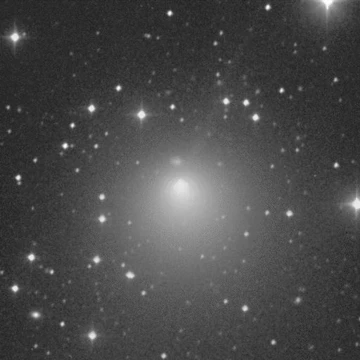
169P/NEAT
Parent body of the alpha Capricornids meteor shower.

169P/NEAT is a periodic comet about 5 kilometers across that circles the Sun once every 4.2 years. It is the source of the alpha Capricornids meteor shower, which peaks in late July and could become a major event around the 2200s. The comet may be linked to another object, P/2003 T12 (SOHO).
In mid-September 2026, 169P/NEAT shone at roughly magnitude 11. On 2 August 2026, it passed within 1 degree of the Hercules cluster M13. Its closest approach to Earth occurred on 11 August 2026, at 0.167 AU (about 25 million kilometers). At its next perihelion on 21 September 2026, the comet will have a solar elongation of 34 degrees and a magnitude near 11.
The comet is about 5.0 kilometers wide, rotates once every 8.4 hours, and shows low activity. It may have originated in the main asteroid belt.
Its last perihelion was on 9 July 2022. On 13 July 2022, it passed 0.1395 AU (20.87 million km) from Venus. On 11 August 2026, it passed 0.1672 AU (25.01 million km) from Earth, with its next perihelion on 21 September 2026. The orbits of 169P and P/2003 T12 (SOHO) are similarly stable, both avoiding close encounters with Jupiter. They likely split from a common parent body a little over 2,000 years ago. An earlier fragmentation event around 4,500 to 5,000 years ago may have created the alpha Capricornids meteors, whose total mass is comparable to that of the surviving comet.
Quick Facts
- Discoverer
- NEAT
- Discovery Date
- 15 March 2002
- Designations
- P/2002 EX · 12
- Orbit Ref
- jpldata · MPC
- Epoch
- 21 November 2025 (JD 2461000.5)
- Observation Arc
- 36.15 years
- Earliest Precovery Date
- 7 March 1989
- Obs
- 1,374
- Perihelion
- 0.604 AU
- Aphelion
- 4.603 AU
- Semimajor
- 2.604 AU
- Eccentricity
- 0.76796
Facts from the source article.
Lore & Background
169P/NEAT is a low-activity comet roughly 5.0 km in diameter with a rotation period lasting about 8.4 hours. It could have originated from the main asteroid belt. The comet has a similar stable orbit with the smaller body P/2003 T12 (SOHO), both avoiding close encounters with Jupiter. It is possible that both comets fragmented from a parent body a bit over 2,000 years ago. A further fragmentation event about 4,500 to 5,000 years ago could have produced the meteors of the alpha Capricornids meteor shower. The total estimated mass of the meteors is similar to that of the surviving comet.
Reader's Guide
169P/NEAT is significant as the identified parent body of the alpha Capricornids meteor shower, which occurs in late July and may become a major shower around the 23rd century. Its stable orbit and possible fragmentation history, including a potential split from a common parent with P/2003 T12 (SOHO) about 2,000 years ago and an earlier fragmentation 4,500 to 5,000 years ago, provide insight into the evolution of meteor streams. The comet's low activity and possible origin in the main asteroid belt add to its interest. In 2026, it passed less than 1 degree from the Hercules cluster (M13) on 2 August, made its closest approach to Earth on 11 August at 0.167 AU, and reached perihelion on 21 September at magnitude 11. Its legacy lies in linking a known comet to a meteor shower and suggesting a multi-stage fragmentation history.
Did You Know?
- 169P/NEAT is the parent body of the alpha Capricornids meteor shower.
- It may be related to comet P/2003 T12 (SOHO), possibly fragmenting from a common parent about 2,000 years ago.
More in Periodic Comets, Part 2 1-24
Spotted an error? Know more?
Reader corrections go straight into our review queue. Suggest an edit · How this site is sourced